7 Best Exercises for Bad Knees to Support Fat Loss
Trying to get more active when your knees hurt can feel frustrating.
You may want to burn calories, improve your fitness, and lose body fat, but many popular workouts seem to involve exactly what your knees dislike: jumping, running, deep squats, lunges, and other high-impact movements.
The good news is that bad knees do not automatically mean no exercise.
In many cases, the better approach is to choose activities that place less impact on the knees while still helping you move your body, strengthen your muscles, and improve cardiovascular fitness.
You don’t need to punish your joints to get a worthwhile workout.
Here are some of the best low-impact exercises for bad knees to consider, along with practical ways to make them more comfortable.
Can You Exercise and Lose Body Fat With Bad Knees?
Yes. Knee problems may change how you exercise, but they don’t necessarily prevent you from becoming more active.
Fat loss ultimately depends on your overall energy balance over time. Exercise can support that process by increasing activity, helping maintain muscle, improving fitness, and making an active lifestyle easier to maintain.
The key is finding exercises you can perform consistently without repeatedly aggravating your knees.
Depending on the cause of your knee pain, that might include:
- Walking on comfortable, level surfaces
- Swimming or water exercise
- Stationary cycling
- Upper-body strength training
- Carefully selected resistance exercises
- Core exercises that don’t place unnecessary pressure on the knees
You don’t have to do all of them. Start with the movements that feel best for your body.
1. Start With a Gentle Warm-Up
When your knees are already stiff or uncomfortable, jumping straight into a workout probably isn’t the best idea.
Spend about 5 to 10 minutes gradually warming up first.
A gentle warm-up increases blood flow and prepares your muscles and joints for the activity ahead.
Depending on what feels comfortable, you could try an easy walk, slow stationary cycling, gentle marching, or mobility exercises recommended by your doctor or physical therapist.
The goal isn’t to make yourself tired.
You simply want to get your body moving before increasing the intensity.
If walking hurts, don’t force yourself through it just because it is considered a warm-up. Choose another comfortable movement instead.
2. Try Swimming for a Joint-Friendly Cardio Workout
Swimming can be an excellent option when traditional cardio bothers your knees.
Water supports much of your body weight, which reduces the impact associated with activities such as running and jumping. At the same time, moving through water provides resistance that challenges your muscles.
Depending on your swimming ability and knee comfort, you might try:
- Easy swimming laps
- Water walking
- Gentle aqua aerobics
- Deep-water exercise
- Treading water
This makes the pool especially useful when you want cardiovascular exercise without repeatedly pounding your knees against the ground.
Start slowly and gradually increase the amount of time you spend exercising.
One important point: swimming isn’t automatically pain-free for every knee condition. Certain kicking motions or strokes may irritate some knees. If a particular movement hurts, switch to something more comfortable rather than trying to push through the pain.
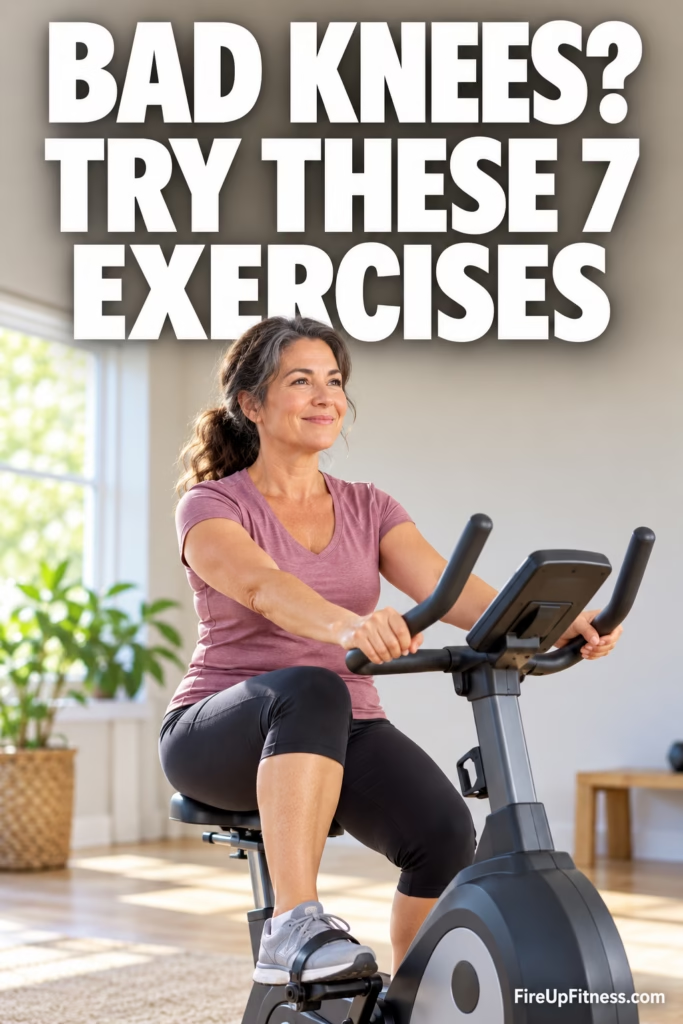
3. Use a Stationary Bike or Cycle on Flat Ground
Cycling is another popular low-impact cardio exercise for people with knee problems.
Unlike running, your feet remain supported by the pedals rather than repeatedly striking the ground.
Cycling also works several important lower-body muscles, including the quadriceps, hamstrings, calves, and glutes.
A stationary bike may be particularly useful because you can control the resistance, pace, and workout duration without worrying about hills or uneven terrain.
Start with relatively light resistance and a comfortable pace.
Your bike setup matters too.
A seat that is positioned incorrectly can make cycling uncomfortable. Your knee should generally retain a slight bend when the pedal reaches the bottom of the rotation rather than being extremely bent or completely locked out.
If you’re cycling outdoors, relatively flat routes may be easier to manage than steep hills, which require considerably more force through the pedals.
4. Don’t Forget Strength Training
When people think about exercising for fat loss, cardio often gets all the attention.
Strength training deserves a place in the conversation too.
Resistance exercise helps build or maintain muscle and can improve overall physical function. More importantly for someone dealing with knee discomfort, strength training doesn’t have to mean doing heavy squats and lunges.
You can build a substantial workout around your upper body and core.
For example, depending on your fitness level and available equipment, you might perform:
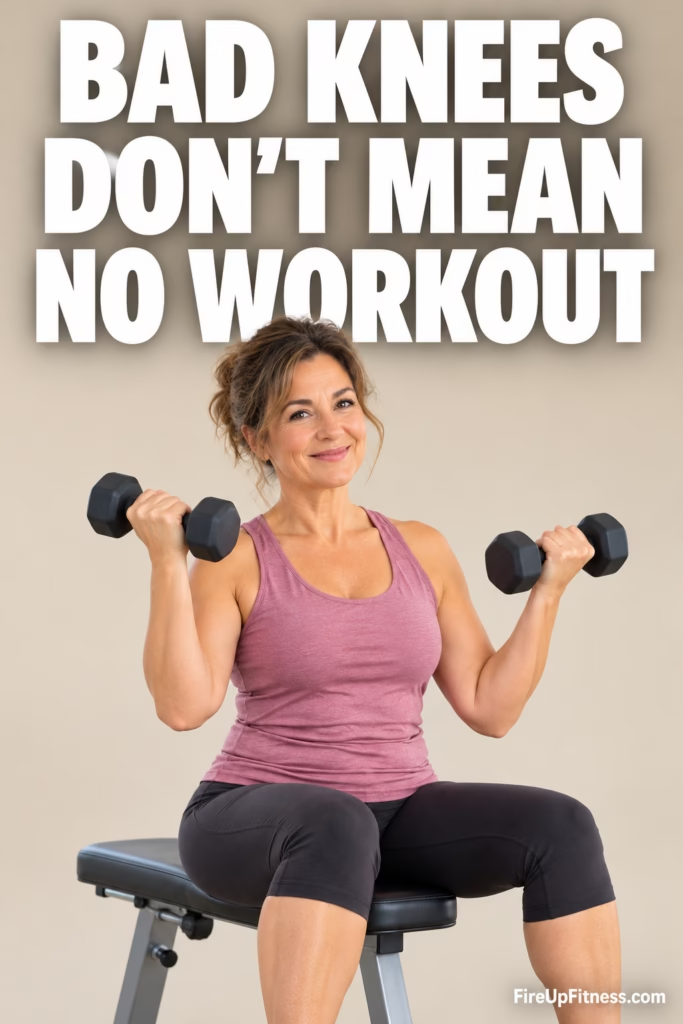
- Seated dumbbell shoulder presses
- Chest presses
- Biceps curls
- Triceps exercises
- Seated rows
- Lat pulldowns
- Suitable core exercises
Seated exercises can be particularly helpful when standing with weights feels uncomfortable.
Lower-body strengthening may also be useful for many knee conditions because stronger muscles around the hips and knees can support movement. However, the appropriate exercises depend heavily on why your knee hurts.
Instead of assuming that every squat, leg press, or knee exercise is bad, ask a physical therapist or qualified healthcare professional which movements and ranges of motion are appropriate for your particular condition.
5. Consider Water Walking
You don’t necessarily need to know how to swim to exercise in a pool.
Water walking can provide a surprisingly effective low-impact workout.
Walk through waist- or chest-deep water at a comfortable pace while naturally moving your arms. The water creates resistance, so even relatively simple movements can require more effort than they would on land.
As your fitness improves, you can gradually increase your pace or workout duration if your knees remain comfortable.
For someone who finds regular walking painful, exercising in water may provide another way to stay active without the same level of impact.
6. Try Short, Comfortable Walks
Walking is simple, accessible, and easy to underestimate.
You don’t need to start with a 60-minute walk or chase an arbitrary daily step goal.
When walking is comfortable for your knees, begin with something manageable—perhaps 5 or 10 minutes on a flat surface.
As your body adapts, you can slowly add time.
For example, several short walks throughout the day may feel much easier than one long walk.
Comfortable, supportive footwear can also make a difference.
Most importantly, pay attention to how your knees respond during the activity and afterward. Increasing your activity gradually is usually much more sustainable than suddenly doubling your walking distance.
7. Focus on Consistency, Not Punishing Workouts
This may be the most important part of the entire plan.
You don’t need the hardest workout to make progress.
You need an activity routine that you can realistically repeat.
Twenty minutes of comfortable movement performed consistently can be far more useful than an exhausting workout that leaves your knees irritated and makes you afraid to exercise again.
Start where you are.
Maybe that’s 10 minutes on a stationary bike.
Maybe it’s 15 minutes in the pool.
Maybe it’s an upper-body strength workout followed by a short walk.
As your fitness improves, you can gradually increase the duration, frequency, or resistance.
Progress doesn’t have to hurt to count.
Exercises to Be Careful With When Your Knees Hurt
Having knee pain doesn’t mean that every lower-body exercise is automatically off-limits. The right movements depend on the cause and severity of your symptoms.
However, you may need to be cautious with exercises involving substantial impact, twisting, heavy resistance, or ranges of motion that trigger your symptoms.
That can include running, repeated jumping, deep squats, heavy lunges, or high-impact workout classes for some people.
Use pain as useful information rather than something you must defeat.
If an exercise repeatedly makes your knee hurt, stop and find out why rather than continuing simply because the workout says you should.
A Simple Way to Start
You don’t have to completely change your lifestyle this week.
Choose one activity that feels comfortable and build from there.
You could swim twice a week, ride a stationary bike for 15 minutes, perform an upper-body strength routine, or take several short walks throughout your day.
Once that becomes easier, add a little more.
This slower approach may not look dramatic, but it is often much easier to maintain—and consistency is what ultimately matters.
Don’t Let Bad Knees Convince You That Exercise Isn’t for You
Knee discomfort can certainly make fitness more complicated, but it doesn’t have to end your efforts to become stronger, fitter, or lose body fat.
Instead of focusing on all the exercises you can’t comfortably perform, build your routine around the ones you can.
Swimming, water walking, cycling, appropriate strength training, and comfortable walking can all provide ways to keep moving without relying on high-impact workouts.
And remember: knee pain can have many causes, from temporary irritation to arthritis or an injury. New, severe, persistent, or worsening knee pain—particularly pain accompanied by significant swelling, instability, locking, or difficulty bearing weight—deserves medical evaluation.
When necessary, a doctor or physical therapist can help you determine which exercises are appropriate for your specific knee problem.
Your workout doesn’t have to look like anyone else’s.
It simply needs to help you keep moving safely and consistently.