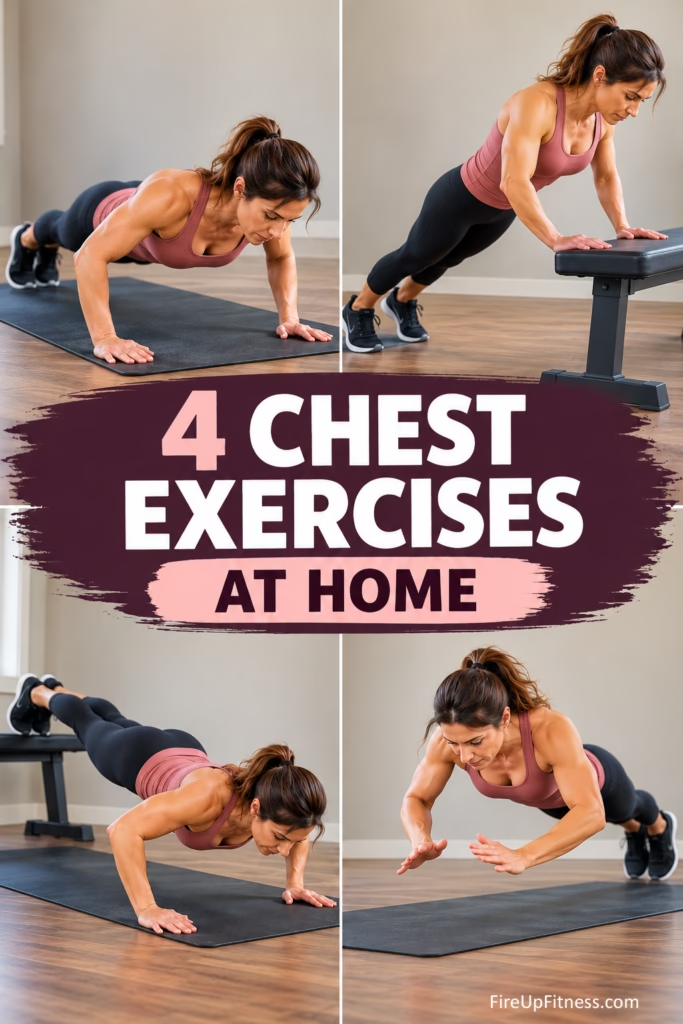
4 Chest Exercises at Home Without Equipment
Building a stronger upper body doesn’t always require dumbbells, gym machines, or expensive workout equipment. Some of the most effective chest exercises at home use nothing more than your body weight and a little space to move.
Your chest muscles play an important role in everyday activities, from pushing a shopping cart to lifting and moving household items. Strengthening these muscles can also improve upper body stability, support better posture, and make daily movements feel easier.
The good news? You can build chest strength without stepping into a gym.
This simple at-home chest workout includes four push-up variations that target your chest, shoulders, triceps, and core. Whether you’re beginning your fitness journey or looking for new ways to challenge your upper body, these exercises offer options for different strength levels.
Why Chest Exercises Are Important for Women
Chest workouts aren’t just for bodybuilders or people trying to build large muscles. Women can benefit from strengthening their chest muscles as part of a balanced fitness routine.
Your chest contains two main muscles: the pectoralis major and pectoralis minor. These muscles help move and stabilize your arms and shoulders during pushing and reaching movements.
Regular chest training can help you:
- Build upper body strength: Make everyday pushing and lifting tasks easier.
- Improve muscular endurance: Help your arms, chest, and shoulders handle repeated movements.
- Support better posture: Strengthen muscles that contribute to upper body stability when combined with back exercises.
- Improve core stability: Push-up variations engage your abdominal muscles to keep your body aligned.
- Build confidence: Develop strength through simple movements you can practice at home.
You don’t need to train your chest every day. Adding these exercises to your upper body workout two or three times per week can help you gradually build strength.
4 Best Chest Exercises at Home Without Equipment
These four exercises use different push-up positions to challenge your chest muscles. Start with the easiest variation and progress as your strength improves.
1. Basic Push-Ups
Basic push-ups are one of the most effective bodyweight exercises for strengthening your chest, shoulders, and triceps.
They also engage your core, making them a useful addition to a full body workout at home.
How to do basic push-ups:
- Begin in a high plank position with your hands slightly wider than shoulder-width apart.
- Extend your legs behind you, keeping your feet comfortably spaced.
- Engage your abdominal muscles and maintain a straight line from your head to your heels.
- Slowly bend your elbows and lower your chest toward the floor.
- Keep your elbows angled slightly backward rather than flaring them straight out.
- Push through your palms to return to the starting position.
Repetitions: 8–12 reps, or as many as you can perform with good form.
Beginner modification: Perform push-ups with your knees resting on the floor. Keep your hips aligned with your shoulders rather than bending at the waist.
Helpful tip: Focus on controlled movement instead of rushing through repetitions. Quality matters more than quantity.
2. Incline Push-Ups
Incline push-ups are an excellent starting point for beginners who find regular floor push-ups challenging.
By placing your hands on an elevated surface, you reduce the amount of body weight your arms and chest need to support.
How to do incline push-ups:
- Stand facing a sturdy countertop, exercise bench, or another stable elevated surface.
- Place your palms on the surface slightly wider than shoulder-width apart.
- Walk your feet backward until your body forms a straight diagonal line.
- Tighten your core and keep your shoulders away from your ears.
- Bend your elbows slowly, bringing your chest toward the elevated surface.
- Press through your hands to return to the starting position.
Repetitions: 10–15 reps.
Beginner modification: Use a wall or higher countertop to make the exercise easier.
Helpful tip: As your upper body becomes stronger, gradually use a lower surface to increase the challenge.
Incline push-ups are particularly useful for women beginning a no-equipment chest workout because they allow you to practice proper push-up technique before progressing to floor exercises.
3. Elevated Push-Ups (Decline Push-Ups)
Ready for something more challenging? Elevated push-ups, also known as decline push-ups, increase the difficulty by raising your feet above the floor.
This variation places greater emphasis on the upper portion of your chest and the front of your shoulders.
How to do elevated push-ups:
- Position a sturdy, non-slip exercise bench or low platform behind you.
- Place your hands on the floor slightly wider than shoulder-width apart.
- Carefully position your feet on the elevated surface.
- Keep your body straight from your shoulders to your heels.
- Slowly bend your elbows and lower your chest toward the floor.
- Push through your palms to return to the starting position.
Repetitions: 6–10 reps.
Easier modification: Keep your feet on the floor and perform regular push-ups until you develop enough strength for this variation.
Helpful tip: Start with a low platform. Raising your feet too high can shift more work toward your shoulders and make the exercise harder to control.
4. Gorilla Push-Ups
Gorilla push-ups are an advanced push-up variation that adds an explosive movement to traditional push-ups.
This exercise challenges your chest, shoulders, triceps, and upper body power. It requires more strength and coordination than the previous exercises.
How to do gorilla push-ups:
- Begin in a regular high plank position.
- Keep your core engaged and your body aligned.
- Lower your chest toward the floor by bending your elbows.
- Push upward explosively so your hands briefly leave the floor.
- Advanced exercisers may add a quick clap before landing.
- Land softly with slightly bent elbows and prepare for the next repetition.
Repetitions: 3–6 controlled reps.
Easier modification: Perform regular push-ups with a slightly faster upward movement while keeping both hands on the floor.
Helpful tip: Only attempt explosive push-ups once you can comfortably complete multiple sets of regular push-ups with proper form. Skip this variation if you experience wrist or shoulder discomfort.
Simple At-Home Chest Workout Routine
You can turn these four exercises into a short upper body strength session. Choose the variations that match your current fitness level.
| Exercise | Repetitions |
|---|---|
| Incline push-ups | 10–15 |
| Basic push-ups | 8–12 |
| Elevated push-ups | 6–10 |
| Gorilla push-ups | 3–6 |
Workout plan:
- Beginners: Complete 1–2 sets using incline or knee push-ups.
- Intermediate: Complete 2–3 sets using incline, basic, and elevated push-ups.
- Advanced: Complete 2–3 sets, adding gorilla push-ups if comfortable.
- Rest for 45–90 seconds between sets, or longer when needed.
You don’t need to complete every variation during each session. Select two or three exercises that allow you to maintain proper form.
Aim to practice your chest workout two or three times weekly, allowing at least one recovery day between challenging sessions.
Tips for Getting Better Results From Chest Workouts
Building strength takes consistency, patience, and proper technique.
Start with manageable repetitions and gradually increase them as your muscles become stronger. Keep your core engaged during push-ups and avoid letting your hips sag toward the floor.
Remember to breathe naturally. Inhale while lowering your body and exhale as you push upward.
For balanced upper body development, combine chest exercises with back, shoulder, and arm strengthening movements. This helps support overall strength and shoulder function.
Most importantly, listen to your body. Muscle fatigue is normal during challenging exercises, but sharp pain is a reason to stop.
Final Thoughts
You don’t need a gym membership or a collection of weights to build a stronger chest. These four chest exercises at home offer a practical way to improve upper body strength using your own body weight.
Begin with incline push-ups, gradually progress to traditional push-ups, and try more challenging variations as your strength develops.
Even a short workout can make a difference when practiced consistently.