Daily Yoga Routine: 4 Easy Poses for Core Strength
A daily yoga routine doesn’t have to be long or complicated to make a difference. Sometimes, just 10 minutes of gentle movement can help you feel stronger, improve your balance, and bring more flexibility into your day.
Whether you’re new to yoga or looking for a simple way to stay active at home, these four yoga-inspired exercises are a great place to start.
This routine combines seated core movements, standing balance exercises, and gentle strength-building poses to engage your abdominal muscles, improve stability, and support better posture.
Some of these movements may remind you of a Pilates workout because they focus on controlled movement, breathing, and core engagement.
The best part? You don’t need fancy equipment, a gym membership, or much space. Just grab a yoga mat and give yourself a few minutes to move.
Why Add a Daily Yoga Routine to Your Healthy Lifestyle?
Building a healthy lifestyle isn’t always about doing intense workouts. Small, consistent habits can make a meaningful difference in how your body feels and moves.
Practicing yoga at home can offer several benefits:
- Stronger core muscles: Many yoga poses engage your abdominal muscles and help support your lower back.
- Better balance: Standing poses challenge your stability and coordination.
- Improved flexibility: Gentle stretching helps maintain comfortable movement through your hips, legs, and spine.
- Better posture: Strengthening your core and supporting muscles can make it easier to maintain an upright position.
- Less everyday tension: Slow breathing and mindful movement can encourage relaxation.
- More consistency: A short routine is often easier to maintain than a complicated exercise plan.
Although yoga cannot specifically target lower abdominal fat, certain poses can strengthen the muscles around your midsection. That’s why this routine can complement a lower belly workout or beginner Pilates workout.
4 Easy Yoga Exercises to Try at Home
These four movements combine balance, flexibility, and gentle core strengthening. Move slowly, pay attention to your breathing, and choose the modifications that feel comfortable for your body.
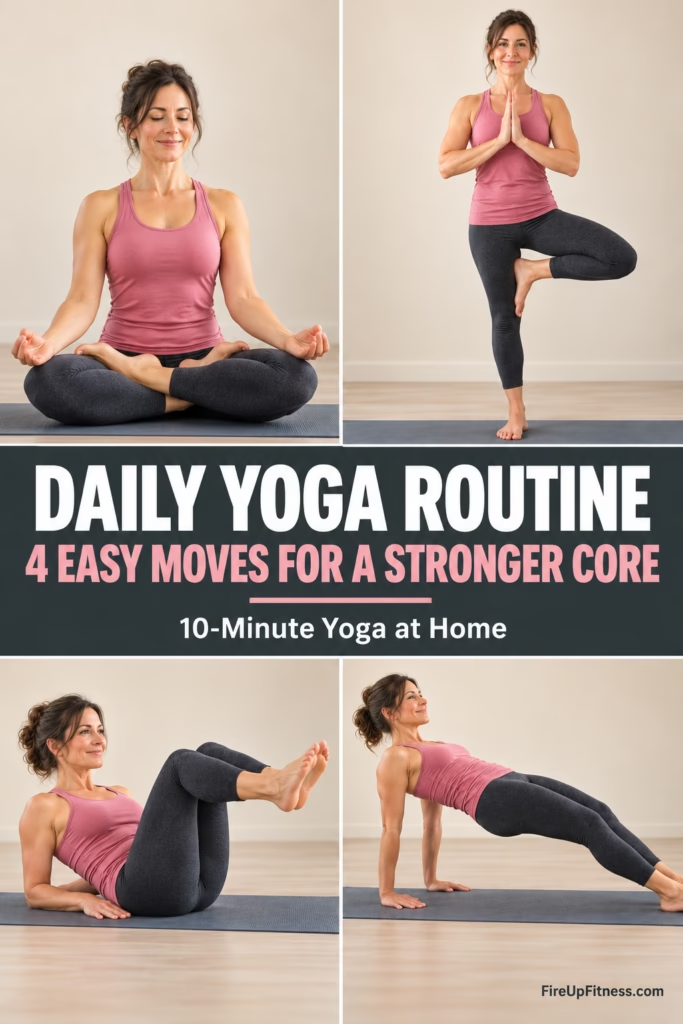
1. Lotus Pose – Improve Posture
Lotus Pose, also known as Padmasana, is a traditional seated yoga posture that encourages relaxation, upright posture, and mindful breathing. It’s a wonderful addition to a daily yoga routine, especially when you want to begin your practice with a few moments of calm.
Unlike more active core exercises, Lotus Pose focuses on maintaining a stable seated position while gently engaging your postural muscles.
How to do it:
- Sit on your yoga mat with your legs extended in front of you.
- Bend your right knee and gently place your right foot on top of your left thigh, with the sole facing upward.
- Bend your left knee and carefully place your left foot on top of your right thigh.
- Keep your spine tall, shoulders relaxed, and chest comfortably open.
- Rest your hands on your knees with your palms facing upward or downward.
- Breathe slowly and naturally while maintaining a comfortable upright position.
Duration: Hold for 20–30 seconds initially, gradually increasing to 1–2 minutes as comfortable.
Beginner modification: Try Easy Pose (Sukhasana), sitting cross-legged with both feet resting beneath the opposite knees. This is a more accessible option for beginners.
Why it helps: Lotus Pose encourages upright posture, body awareness, and mindful breathing. It can also help you develop the hip mobility needed for comfortable seated yoga practice.
Important: Full Lotus requires considerable hip mobility. Never force your feet onto your thighs or push through knee discomfort.
2. Tree Pose – Improve Balance and Stability
Tree Pose, also known as Vrksasana, is a classic standing yoga posture that strengthens your balance while encouraging better body awareness.
It may look simple, but maintaining the position requires your core, hips, and supporting leg to work together.
How to do it:
- Stand tall with your feet hip-width apart and your shoulders relaxed.
- Shift your body weight onto your left foot.
- Slowly lift your right foot and place it against your left ankle, calf, or inner thigh. Avoid placing it directly against your knee.
- Bring your palms together in front of your chest.
- Look straight ahead and focus on a stationary point.
- Gently engage your abdominal muscles while breathing naturally.
- Hold the position, then switch legs.
Duration: Hold for 20–30 seconds on each side. Repeat twice.
Beginner modification: Keep your toes resting on the floor like a kickstand, or lightly hold a wall or sturdy chair.
Why it helps: Tree Pose improves single-leg balance, strengthens stabilizing muscles, and encourages an upright posture.
3. U-Boat Pose – Strengthen Your Abdominal Muscles
U-Boat is a modified Boat Pose exercise that focuses on controlled abdominal engagement.
This movement is particularly useful for anyone interested in easy yoga for beginners or looking for gentle core exercises to complement a Pilates workout.
How to do it:
- Sit on your mat with your knees bent and feet flat on the floor.
- Lean backward slightly and rest your forearms on the mat for support.
- Keep your chest lifted and your neck relaxed.
- Tighten your abdominal muscles gently without holding your breath.
- Lift your feet off the floor, bringing your knees toward your chest.
- Maintain approximately a 90-degree bend in your knees.
- Hold for a few seconds, then slowly lower your feet.
Repetitions: Complete 8–10 repetitions, holding each lift for 3–5 seconds.
Beginner modification: Lift one foot at a time while keeping the other foot on the floor.
Why it helps: U-Boat challenges the hip flexors and abdominal muscles, including the muscles that help stabilize your pelvis.
Keep your lower back comfortable and avoid forcing your legs higher than you can control.
4. Reverse Plank Hover – Strengthen Your Core and Upper Body
Reverse Plank Hover is a yoga-inspired strength exercise that engages your abdominal muscles, glutes, shoulders, and arms.
It’s an excellent finishing movement for this short daily yoga routine because it challenges several muscle groups at once.
How to do it:
- Sit on the floor with your legs extended in front of you.
- Place your hands slightly behind your hips with your fingers pointing forward or outward, whichever feels comfortable for your wrists.
- Bend your knees slightly and place your heels firmly on the floor.
- Press through your hands and heels to lift your hips.
- Gently tighten your core and squeeze your glutes.
- Keep your chest open and your neck in a comfortable position.
- Hold briefly, then lower your hips slowly to the mat.
Repetitions: Perform 6–10 controlled lifts, holding each for 3–5 seconds.
Beginner modification: Bend your knees more deeply and keep your feet flat on the floor to perform a reverse tabletop lift.
Why it helps: This movement strengthens your posterior chain, shoulders, and core while encouraging controlled hip extension.
Avoid this exercise if it aggravates wrist or shoulder discomfort.
Your 10-Minute Daily Yoga Routine
You can turn these four exercises into a simple home workout without needing to memorize a complicated sequence.
| Exercise | Duration or repetitions |
|---|---|
| Lotus Pose | 30-60 seconds |
| Tree Pose | 30 seconds per side |
| U-Boat Pose | 8–10 repetitions |
| Reverse Plank Hover | 6–10 repetitions |
| Rest between exercises | 15–20 seconds |
Complete two rounds at a comfortable pace, allowing approximately 10 minutes for the full routine.
Beginners can start with one round and gradually increase as their balance and strength improve.
How to Make Yoga at Home a Daily Habit
Starting a daily yoga routine is one thing. Making it part of your lifestyle is where the long-term benefits begin.
You don’t have to practice for an hour or master advanced poses. A few thoughtful changes can help you stay consistent.
Choose a time that works for you. Morning yoga can help you ease into the day, while an evening routine may help you unwind after a busy schedule.
Keep your yoga mat somewhere visible. A simple reminder can make it easier to begin, even on days when motivation is low.
Focus on movement quality rather than speed. Yoga isn’t a race. Slow, controlled movements help you pay attention to your posture and breathing.
Combine yoga with other gentle exercises. Walking, resistance training, and a beginner Pilates workout can complement your yoga practice and support overall fitness.
Allow time for recovery. Gentle yoga may be comfortable daily, but more challenging strength-focused poses can require rest, especially when your muscles feel sore.
Can a Daily Yoga Routine Help Strengthen Your Lower Abs?
Yes. Yoga poses that involve balancing, lifting your legs, or supporting your body can engage your abdominal muscles, including the deeper muscles responsible for stability.
Movements such as U-Boat and Rock ‘n’ Roll Lotus challenge abdominal control, while Tree Pose and Reverse Plank Hover strengthen supporting muscles.
However, no single exercise can selectively reduce fat from one area of your body. The value of this routine comes from improving strength, stability, posture, and movement confidence.
For a well-rounded approach, combine yoga with regular walking, appropriate resistance exercises, and other activities you enjoy.
Daily Yoga Routine vs. Pilates Workout: What’s the Difference?
Yoga and Pilates share several benefits, particularly when it comes to core strength, balance, and controlled movement.
Yoga often emphasizes breathing, flexibility, balance, and holding postures. Pilates typically places greater emphasis on controlled repetitions, alignment, and muscular endurance.
Both can be beginner-friendly and practiced at home with minimal equipment.
This four-exercise routine includes elements of both approaches, making it a practical choice for anyone who enjoys gentle, core-focused movement.
Final Thoughts
A daily yoga routine doesn’t need to be perfect to be worthwhile.
These four simple exercises give you an opportunity to strengthen your core, improve your balance, and move more mindfully without leaving home.
Start with the beginner modifications, practice at your own pace, and gradually build confidence as the movements become more familiar.
Even 10 minutes of intentional movement can be a positive step toward a stronger, more active, and healthier lifestyle.
Save this routine for your next at-home yoga session and return to it whenever you need a simple way to move.