5 Easy Office Exercises to Boost Energy and Mobility
Sitting at a desk for hours can leave your body feeling stiff, your shoulders tense, and your energy running low. By mid-afternoon, even simple tasks can feel exhausting. But sometimes, all your body needs is a little movement to feel refreshed again.
The good news? You don’t need a gym, expensive equipment, or a full workout session to make a difference.
These 5 easy office exercises can help improve circulation, strengthen your muscles, release tension, and give you a refreshing break from your daily routine.
Whether you work from home or spend most of your day in an office, these simple movements can fit into your schedule.
Why Office Exercises Are Worth Trying
Spending long hours sitting can contribute to muscle stiffness, poor posture, and general fatigue. Taking short movement breaks throughout the day can help your body feel more comfortable.
A few minutes of movement may help you:
- Improve circulation after prolonged sitting.
- Release tension in your shoulders, hips, and back.
- Strengthen muscles that support everyday movement.
- Improve posture and body awareness.
- Refresh your mind and support concentration.
- Break up long periods of inactivity.
You don’t have to do all five exercises at once. Even choosing two or three during a short work break can be a helpful start.
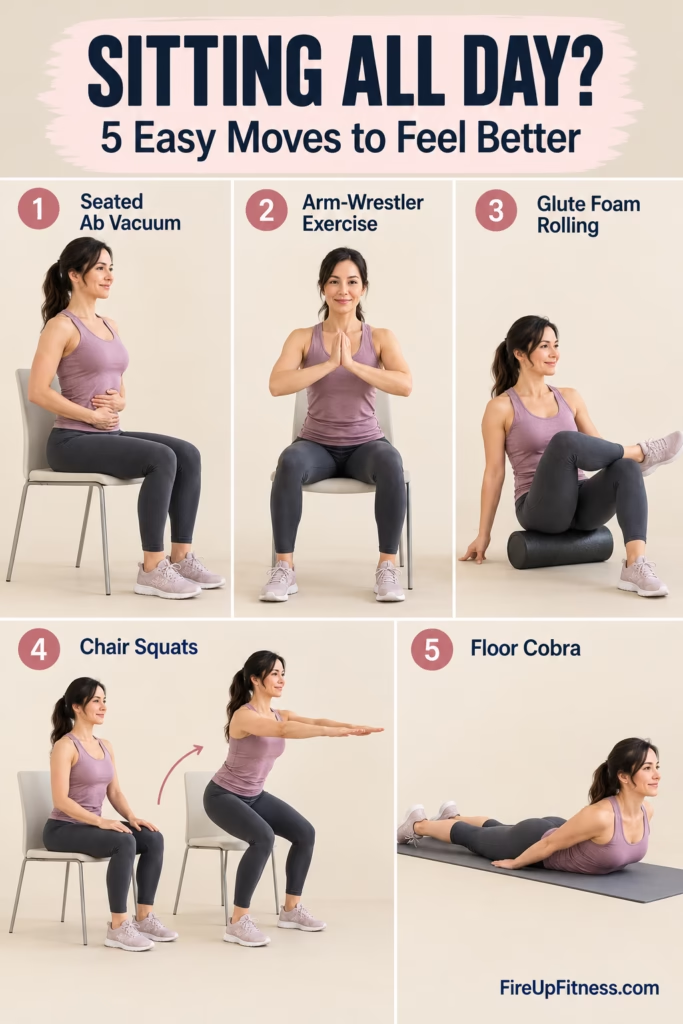
1. Seated Ab Vacuum for Core Strength
The seated ab vacuum is a gentle core exercise that focuses on engaging your deep abdominal muscles, particularly the transverse abdominis.
These muscles help support your spine and maintain stability while sitting, standing, and moving.
How to do it:
- Sit upright in a sturdy chair with both feet flat on the floor.
- Relax your shoulders and keep your spine comfortably straight.
- Take a slow breath in through your nose.
- Exhale gently while drawing your lower abdominal muscles inward.
- Hold the gentle contraction for 3–5 seconds without holding your breath.
- Relax your muscles and return to normal breathing.
Repeat: 5–8 times.
Beginner tip: Avoid pulling your stomach inward forcefully. Focus on gentle muscle engagement and steady breathing.
This is one of the easiest desk exercises to practice when you want to work on core awareness without leaving your chair.
2. Arm-Wrestler Exercise for Stronger Arms
Want to activate your arm muscles without picking up dumbbells?
The arm-wrestler exercise uses isometric contractions, meaning your muscles work against resistance without creating much movement.
It’s a convenient way to engage your biceps, triceps, and upper-body muscles during a short office break.
How to do it:
- Sit tall with your shoulders relaxed.
- Bring your hands together in front of your chest.
- Position one palm facing upward and the other facing downward.
- Press your hands against each other, creating moderate resistance.
- Hold the pressure for 10–15 seconds while breathing normally.
- Reverse your hand positions and repeat.
Repeat: 2–3 rounds on each side.
Beginner tip: Start with light pressure and gradually increase the effort. Keep your wrists comfortable and avoid tensing your neck.
This simple upper-body exercise can help wake up your muscles after long periods of typing or working at a computer.
3. Glute Foam Rolling to Release Hip Tension
Sitting for extended periods can leave your hips and glutes feeling tight and uncomfortable.
A little foam rolling may provide temporary relief from muscle tightness and help you feel more comfortable when you return to your desk.
You’ll need a foam roller and a small amount of floor space for this movement.
How to do it:
- Place a foam roller on the floor and sit on top of it.
- Position your hands behind you for balance.
- Cross your right ankle over your left knee, keeping the position comfortable.
- Shift your body slightly toward your right glute.
- Slowly roll forward and backward over a small area.
- Continue for 20–30 seconds, then switch sides.
Repeat: 1–2 rounds per side.
Beginner tip: Keep both feet on the floor instead of crossing your legs if you need more stability. Use gentle pressure and avoid rolling directly over painful areas.
Foam rolling is optional, but it can be a useful addition to your office stretching routine.
4. Chair Squats to Strengthen Your Legs
One of the simplest ways to break up a long sitting session is to stand up and sit back down a few times.
This movement, often called a chair squat, engages your thighs, glutes, and core while practicing a movement you use every day.
How to do it:
- Sit near the front of a sturdy, nonrolling chair.
- Place your feet hip-width apart and flat on the floor.
- Keep your chest lifted and gently engage your core.
- Lean forward slightly from your hips.
- Push through your feet to stand up.
- Slowly lower yourself back into the chair with control.
Repeat: 10–12 times.
Beginner tip: Use the chair’s armrests for support if needed. As your strength and balance improve, try standing without using your hands.
Chair squats are especially useful for anyone looking to maintain lower-body strength and mobility while working at a desk.
5. Floor Cobra to Improve Upper-Back Strength
After hours of looking at a computer screen, your shoulders may begin to round forward and your upper back can feel tired.
The floor cobra helps activate the muscles around your shoulder blades and upper back, supporting better posture and spinal control.
Unlike the other seated exercises, this movement requires a comfortable floor space or exercise mat.
How to do it:
- Lie face down on a mat with your legs extended.
- Rest your arms beside your body, palms facing downward.
- Keep your neck neutral and look toward the floor.
- Gently draw your shoulder blades together and downward.
- Lift your chest slightly off the floor using your upper-back muscles.
- Hold for 2 seconds, then slowly lower yourself.
Repeat: 8–10 times.
Beginner tip: Keep the lift small and avoid arching your lower back excessively. Stop if you experience discomfort.
Office-friendly alternative: Try standing shoulder-blade squeezes. Stand tall, gently bring your shoulder blades together, hold for 3 seconds, and release.
Try This Quick 5-Minute Office Workout
Short on time? Use this simple routine during your next work break.
| Exercise | Duration |
|---|---|
| Seated Ab Vacuum | 45 seconds |
| Arm-Wrestler Exercise | 45 seconds |
| Chair Squats | 1 minute |
| Standing Shoulder-Blade Squeezes | 45 seconds |
| Marching in Place | 1 minute |
| Gentle Breathing | 45 seconds |
This quick office workout requires no special equipment and can be adjusted to your comfort level.
Save the foam rolling and floor cobra exercises for a longer break or when you’re working from home.
How Often Should You Do Office Exercises?
Consistency matters more than intensity when it comes to staying active during a busy workday.
Try taking a short movement break every 30–60 minutes, especially when you’ve been sitting continuously.
You might stand while taking a phone call, walk around your workspace, stretch your shoulders, or complete a few chair squats.
These small movement breaks can help reduce stiffness and make your workday feel more comfortable.
Final Thoughts
You don’t need an hour-long workout to give your body some attention during a busy day.
These 5 easy office exercises offer simple ways to activate your muscles, support better posture, and refresh your energy without disrupting your schedule.
Start with the movements that feel comfortable, build a routine you can maintain, and remember that a little movement throughout the day is better than staying seated for hours without a break.