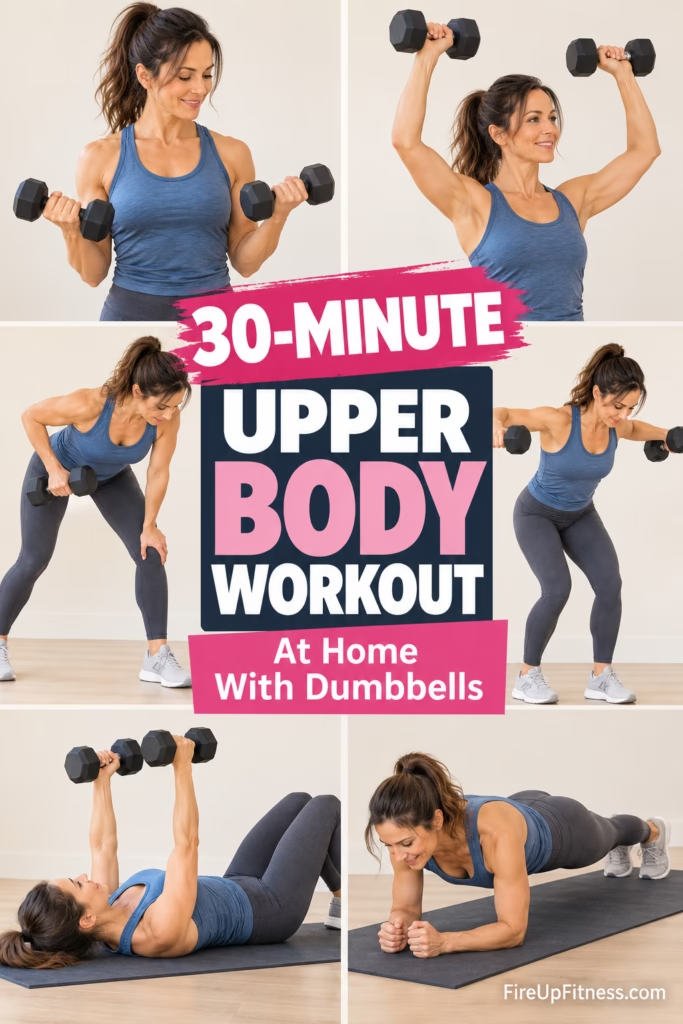
30-Minute Upper Body Workout at Home With Dumbbells
Want stronger arms, better posture, and an upper body that feels more capable during everyday activities? You don’t need a complicated gym routine to get started. A pair of dumbbells, a little floor space, and 30 minutes can give your arms, shoulders, chest, back, and core a satisfying workout.
This 30-minute upper body workout at home combines traditional strength exercises with creative movements that challenge your balance, coordination, and stability.
And here’s something you’ll appreciate: you won’t spend the entire workout getting up and down from the floor. Most of the routine happens standing, making it easy to settle into a rhythm before moving onto your mat for the final exercises.
Whether you’re returning to exercise after a break, building strength after 40, or simply looking for a fresh dumbbell routine, this workout offers plenty of ways to adjust the intensity.
Why Try This 30-Minute Upper Body Workout?
Upper body strength is about much more than having toned arms.
Think about how often you use your shoulders, back, and arms throughout the day. Carrying groceries, lifting laundry baskets, reaching overhead, gardening, and even maintaining good posture all depend on these muscles working together.
When you regularly challenge your upper body with resistance exercises, you give those muscles a reason to become stronger.
Here are a few reasons this workout deserves a place in your weekly routine.
1. It works multiple upper body muscles. Rather than focusing on one area, you’ll train your biceps, triceps, shoulders, chest, and back.
2. It includes core strengthening. Several exercises challenge your abdominal muscles to stabilize your body while your arms move.
3. It supports functional strength. The combination movements encourage your muscles to work together, similar to how they do during everyday activities.
4. It’s convenient for home workouts. You only need dumbbells and an exercise mat. No large machines or complicated equipment.
5. It’s easy to modify. You can use lighter dumbbells, skip the balance challenges, or perform certain movements without weights.
For women over 40, regular strength training can be especially valuable for maintaining muscle strength, supporting bone health, and making daily movement feel easier.
What You’ll Need for This Upper Body Dumbbell Workout
You don’t need much equipment to make this workout effective.
- Dumbbells: The original routine demonstrates two 10-pound dumbbells, but choose a weight that matches your strength and experience.
- Exercise mat: Helpful for push-ups, kneeling movements, chest exercises, and core work.
- Water: Keep some nearby for short breaks.
- Comfortable clothing: Wear something that allows your shoulders and arms to move freely.
Beginners may prefer starting with 2–5-pound dumbbells for shoulder exercises. You can use heavier weights for movements such as rows if you can maintain good form.
The right weight should make the final repetitions feel challenging without forcing you to swing, shrug, or rush.
How the 30-Minute Workout Works
The routine uses a simple interval format:
45 seconds of exercise followed by 15 seconds of rest.
During each 45-second interval, move at a controlled pace. The goal isn’t to complete as many repetitions as possible. It’s to keep your muscles working while maintaining proper technique.
The workout begins with a standing warm-up, moves through upper body dumbbell exercises, and finishes with floor-based strength and core movements.
Because the original routine contains several combination exercises, you’ll be working more than one muscle group during some intervals.
You can follow the complete sequence as demonstrated or select fewer movements for a shorter beginner workout.
Start With a Gentle Upper Body Warm-Up
Before picking up your dumbbells, spend a few minutes preparing your shoulders, arms, back, and core.
A warm-up helps you gradually increase your movement and practice the positions you’ll use during the workout.
1. Alternating Knee Scoops
Stand tall with your arms extended to the sides.
Lift one knee while bringing your arms forward in a gentle scooping motion. Return to standing and repeat with the opposite knee.
Keep the movement comfortable and controlled.
This is a simple way to begin moving your arms, hips, and core together.
2. Alternating Arm Circles
Extend both arms forward with your palms facing down.
Circle one arm backward and around, bringing it forward again. Repeat with the opposite arm.
Move slowly and explore a comfortable range of motion.
You should feel your shoulders gradually loosening up.
3. Hip Hinge With Elbow Row
Stand with your feet hip-width apart and soften your knees.
Hinge forward at your hips while keeping your back neutral. Reach your arms forward, then return upright and draw your elbows backward as though performing a row.
Squeeze your shoulder blades gently together.
This prepares your upper back and shoulders for the dumbbell exercises ahead.
4. Standing Side Crunches
Reach your right arm overhead.
Bring your right elbow toward your right knee as you lift the knee and bend slightly to the side.
Return to standing and repeat.
Switch to your left side.
This movement wakes up your obliques, the muscles along the sides of your abdomen.
Finish the warm-up with gentle wrist movements and a short march in place.
Now you’re ready to grab your dumbbells.
Part 1: Standing Upper Body Workout With Dumbbells
This is the longest portion of the workout. You’ll move through exercises for your biceps, shoulders, back, and triceps, with a few balance and core challenges along the way.
1. Rotating Bicep Curls
Let’s begin with a familiar movement that strengthens the front of your arms.
Stand with your feet hip-width apart, holding a dumbbell in each hand. Keep your arms beside your body with your palms facing inward.
As you bend your elbows and lift the weights, gradually rotate your palms to face upward.
Pause briefly at the top, then lower the dumbbells with control, rotating your palms inward again.
Form tip: Keep your elbows close to your sides and avoid swinging your upper body.
This simple variation challenges your biceps while adding a natural forearm rotation.
2. Bicep Rotation With Knee Lift
Ready to make those arms work a little harder?
Hold both dumbbells with your elbows bent and palms facing inward.
Rotate your forearms outward, return them inward, and then extend your arms as you lift one knee.
Lower the knee and repeat, alternating legs.
The combination challenges your biceps while asking your core to help maintain balance.
Beginner option: Keep both feet planted and concentrate on the arm movements until you feel comfortable adding the knee lift.
3. Upright Row and Lateral Raise
Your shoulders take center stage with this combination.
Stand tall with a dumbbell in each hand.
Pull the weights upward in a controlled upright row, keeping them close to your body and your elbows at a comfortable height.
Lower the dumbbells.
Next, raise your arms out to the sides, stopping at or below shoulder height.
Lower slowly and repeat the sequence.
Keep your shoulders relaxed rather than lifting them toward your ears.
Beginner option: Use lighter dumbbells or perform only the lateral raise. Skip the upright row if it causes shoulder discomfort.
4. Rotating Shoulder Press
Overhead pressing helps build strength for everyday movements such as placing items on a high shelf.
Hold the dumbbells near shoulder height with your palms facing inward.
As you press upward, rotate your palms to face forward.
Lower the weights slowly while rotating your palms inward again.
Exhale as you press and inhale as you lower.
Keep your ribs stacked over your pelvis rather than arching your lower back.
Beginner option: Press one arm at a time or use a neutral grip without rotating your wrists.
5. Front Reach With Side Chop
This exercise brings your shoulders and core together.
Hold one dumbbell securely with both hands.
Extend it forward at a comfortable height, then guide it diagonally toward one side of your body.
Return to the center and repeat toward the opposite side.
Allow a small, controlled rotation through your upper body while keeping your hips stable.
Avoid swinging the dumbbell or forcing a deep twist.
You should feel your shoulders working as your abdominal muscles help control the movement.
6. Dumbbell Front Hold With Rotation
Sometimes the simplest-looking exercises are surprisingly challenging.
Hold one dumbbell securely with both hands and extend it forward at a comfortable height.
Maintain that position while making small, controlled rotations from side to side.
Keep your elbows slightly bent and shoulders relaxed.
Because your arms stay lifted, your shoulder muscles work continuously.
Beginner option: Hold the dumbbell closer to your chest or shorten the interval.
7. Single-Arm Row and Reverse Fly — Right Side
Now it’s time to give your upper back some attention.
Hold one dumbbell in your right hand.
Step your right foot slightly backward and hinge forward at the hips. Rest your left hand on your left thigh for support.
Pull the dumbbell toward your right hip, keeping your elbow close to your body.
Lower the weight.
Next, raise your right arm outward in a reverse-fly motion with a slight bend in the elbow.
Lower and repeat the combination.
Keep your back neutral and avoid twisting your torso.
Form tip: The reverse fly usually requires a lighter weight than the row.
8. Single-Arm Row and Reverse Fly — Left Side
Switch the dumbbell to your left hand and step your left foot slightly backward.
Repeat the same row and reverse-fly combination.
Focus on squeezing your shoulder blade gently toward your spine during the row.
Avoid using momentum to lift the weight.
Training both sides separately can help you notice differences in strength and control.
9. Standing Dumbbell Side Bends
Hold a dumbbell in each hand and stand with your feet hip-width apart.
Slowly bend toward your right side, allowing the right dumbbell to move down beside your thigh.
Return upright using your side abdominal muscles.
Repeat toward the left.
The original routine adds a small elbow lift as you alternate sides.
Keep the movement controlled and avoid leaning forward or backward.
Beginner option: Perform the exercise without weights.
10. Overhead Triceps Extension With Shoulder Press
This combination targets the back of your arms while adding shoulder work.
Hold the dumbbells overhead with your palms facing inward.
Bend your elbows to lower the weights behind your head within a comfortable range.
Extend your elbows to raise the weights again.
Then lower the dumbbells to shoulder level and perform an overhead press.
Repeat the sequence slowly.
Keep your abdomen engaged and avoid arching your lower back.
Beginner option: Use one dumbbell held securely with both hands, or separate the two exercises.
11. Triceps Kickbacks With Optional Toe Tap
Stand with your feet hip-width apart and a dumbbell in each hand.
Hinge forward slightly, keeping your back neutral.
Pull your elbows close to your ribs and bend them to approximately 90 degrees.
Straighten your elbows to extend the dumbbells backward.
Pause briefly, then bend your elbows again.
For an added coordination challenge, alternate tapping one foot backward as you extend your arms.
Form tip: Your upper arms should remain relatively still. Most of the movement comes from your elbows.
12. Zottman Curls
This bicep exercise adds a forearm-strengthening challenge.
Start with a dumbbell in each hand, palms facing forward.
Curl the weights toward your shoulders.
At the top, rotate your palms to face downward.
Slowly lower the dumbbells, then rotate your palms forward again before the next repetition.
Move deliberately, especially during the lowering phase.
Avoid bending your wrists excessively.
13. Alternating Hammer Curls
Hold your dumbbells beside your body with your palms facing inward.
Curl the right dumbbell toward your shoulder while keeping your palm facing inward.
Lower it and repeat with your left arm.
Continue alternating sides.
Keep your elbows close to your ribs and your posture tall.
Hammer curls strengthen the elbow flexors, including the brachialis and brachioradialis muscles.
14. Underhand Row With Bicep Curl
This combination trains your back and biceps together.
Hold both dumbbells with your palms facing forward.
Hinge at your hips with a neutral back and slightly bent knees.
Pull your elbows backward to perform an underhand row.
Lower the dumbbells.
Return to standing, then perform a bicep curl.
Lower the weights and repeat.
Beginner option: Separate the row and curl into individual exercises until you feel confident maintaining your posture.
15. Front Raise With an Arc
Stand tall with a dumbbell in each hand.
Begin with your arms by your sides.
Lift the weights forward in a smooth arc until they reach approximately shoulder height, rotating your palms gently toward the floor as you raise them.
Lower the weights slowly.
Avoid swinging or leaning backward to lift the dumbbells.
Because this exercise focuses heavily on the shoulders, a lighter weight is often enough.
16. Single-Arm Overhead Press With Opposite Knee Lift — Right Side
Hold one dumbbell in your right hand at shoulder height.
Press it overhead while standing tall.
As you lower the weight, lift your left knee toward your right elbow.
Return your foot to the floor and repeat.
This movement combines shoulder strength with balance and core control.
Beginner option: Keep both feet on the ground and perform a regular single-arm shoulder press.
17. Single-Arm Overhead Press With Opposite Knee Lift — Left Side
Switch the dumbbell to your left hand.
Press overhead, then bring your right knee toward your left elbow as you lower the weight.
Keep your movements slow and deliberate.
You may notice one side feels more coordinated than the other. That’s completely normal.
The important thing is to maintain control rather than rush through the interval.
Part 2: Floor-Based Upper Body Exercises
After completing the standing exercises, move onto your mat.
These movements continue challenging your arms, chest, and shoulders while adding different positions and muscle demands.
18. Narrow Push-Ups
Place your hands on the floor approximately shoulder-width apart.
Extend your legs behind you to form a plank position, or keep your knees on the mat.
Bend your elbows close to your sides and lower your chest toward the floor.
Push through your palms to return upward.
The original routine includes a gentle backward movement of the hips between repetitions.
Beginner option: Perform the push-ups on your knees or with your hands against a sturdy elevated surface.
Keep your body aligned and only lower as far as you can comfortably control.
19. Kneeling Triceps Kickback With Rotation — Right Side
Start on your hands and knees.
Hold one dumbbell in your right hand while supporting yourself with your left hand.
Draw your right elbow close to your side.
Straighten your elbow backward, rotating your palm upward near the end of the movement.
Pause briefly before bending your elbow again.
You can keep both knees down or extend your left leg behind you for an additional stability challenge.
Maintain a neutral spine throughout.
20. Kneeling Triceps Kickback With Rotation — Left Side
Switch the dumbbell to your left hand.
Repeat the same kickback movement, keeping your elbow lifted and close to your body.
Rotate your palm gently upward as you straighten your arm.
If you’re using the extended-leg variation, stretch your right leg behind you.
Keep your hips level and your core engaged.
21. Kneeling Overhead Triceps Extensions
Sit back comfortably on your heels or choose a tall kneeling position.
Hold one dumbbell securely with both hands, or use two light dumbbells if you can control them safely.
Raise the weight overhead.
Bend your elbows to lower it behind your head.
Straighten your arms to lift the weight again.
Keep your elbows pointing generally forward and avoid flaring them excessively.
Beginner option: Sit on a sturdy chair if kneeling feels uncomfortable.
22. Kneeling Forward Press With Twist
Begin in a tall kneeling position with one dumbbell held close to your chest.
Lean backward slightly while maintaining a straight line from your head through your knees.
Press the dumbbell forward, then gently rotate your upper body to one side.
Return to the center and alternate directions.
Keep your hips stable and your abdominal muscles engaged.
The farther you lean backward, the more challenging the movement becomes.
Beginner option: Stay upright and perform a small forward press without the twist.
23. Dumbbell Chest Fly With Optional Knee Lift
Lie on your back with your knees bent and feet flat on the floor.
Hold a dumbbell in each hand above your chest, palms facing inward.
Keep a slight bend in your elbows.
Slowly open your arms out to the sides until your upper arms approach the floor or reach a comfortable depth.
Bring the dumbbells back together above your chest.
For an additional core challenge, alternate lifting one knee as your arms come together.
Form tip: Avoid lowering your elbows too far below your torso. A controlled range protects your shoulders.
24. Narrow Chest Press With Core Extension
Remain lying on your back.
Hold your dumbbells above your chest with your palms facing inward.
Lower your elbows close to your sides, then press the weights upward.
For the combination variation, bring your knees toward your chest as you lower the weights.
As you press upward, extend your legs outward or return your feet toward the floor.
Keep your lower back in a comfortable, stable position.
Beginner option: Keep both feet planted and focus entirely on the chest press.
Part 3: Finish With a Core Strengthening Challenge
Your dumbbells are finished for the day, but your workout isn’t quite over.
The final exercises focus on your abdominal muscles and core stability.
These movements also provide a satisfying finish after all that upper body work.
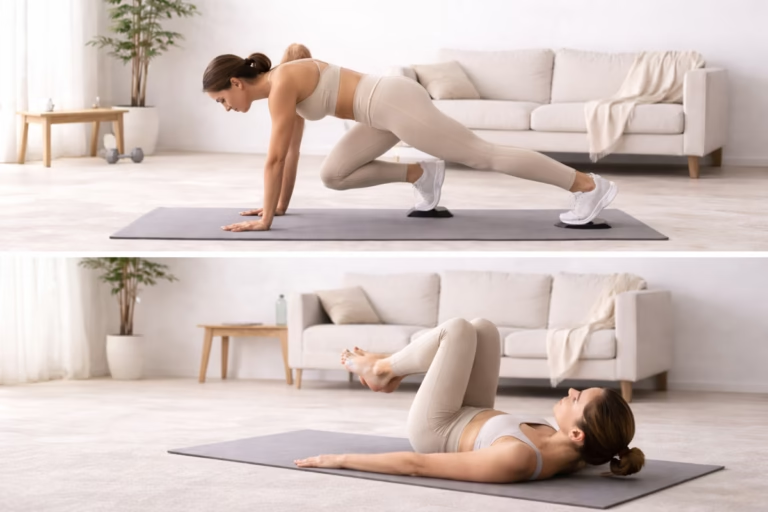
25. Eagle-Leg Crunch With Twist — Right Side
Lie on your back with your knees bent.
Cross your right thigh over your left, using a comfortable leg position.
Place your hands lightly behind your head.
Lift your shoulders slightly off the floor for a controlled crunch.
Lower, then lift again while rotating gently toward the right.
Continue alternating a center crunch with a right-side twist.
Avoid pulling on your neck.
Beginner option: Keep your feet uncrossed and perform small, traditional crunches.
26. Eagle-Leg Crunch With Twist — Left Side
Switch the leg crossing so your left thigh is over your right.
Repeat the crunch sequence, alternating a center lift with a gentle twist toward the left.
Exhale as you lift your shoulders.
Keep your elbows wide and your neck relaxed.
You don’t need to lift very high to engage your abdominal muscles.
27. Seated Lean-Back With Alternating Leg Lift
Sit on your mat with your legs extended comfortably in front of you.
Lean backward slightly while keeping your chest lifted and spine neutral.
Raise one leg as you bring your arms downward in a controlled chopping motion.
Lower the leg and repeat on the opposite side.
The farther you lean backward, the more challenging it becomes for your core.
Beginner option: Bend your knees, keep your heels on the floor between lifts, or place your hands beside your hips for support.
28. Forearm Plank With Forward and Backward Rock
This is your final exercise.
Place your forearms on the mat with your elbows beneath your shoulders.
Extend your legs behind you, forming a straight line from your head to your heels.
Engage your abdomen and glutes.
Slowly shift your body forward, then backward, using your toes to control the movement.
Keep the motion small and avoid allowing your lower back to sag.
Beginner option: Lower your knees to the mat and hold a stationary forearm plank.
Take steady breaths throughout the interval.
And that’s it. You’ve completed the strength portion of your upper body workout!
Cool Down With Gentle Upper Body Stretches
After challenging your muscles, give yourself a few minutes to slow down.
You don’t need an elaborate stretching routine. A handful of comfortable movements can help you transition out of your workout.
Child’s Pose
Kneel on your mat and gently sit your hips backward toward your heels.
Extend your arms forward and lower your chest toward the floor.
Rest your forehead comfortably and breathe slowly.
Seated Side Stretch
Sit comfortably with your back tall.
Reach your right arm overhead and lean gently toward the left.
Return to the center and repeat on the opposite side.
Cross-Body Shoulder Stretch
Extend your right arm across your chest.
Use your left hand to support the upper arm and draw it gently toward your body.
Hold for 15–30 seconds, then switch sides.
Overhead Triceps Stretch
Raise your right arm overhead and bend your elbow so your hand moves toward your upper back.
Use your opposite hand to guide the elbow gently backward.
Repeat on the other side.
Finish with two slow, deep breaths, reaching your arms upward as you inhale and lowering them as you exhale.
Here is the follow along video for this 30 min Upper Body Workout.
How to Make This Upper Body Workout Beginner-Friendly
A 30-minute workout with multiple dumbbell combinations can feel challenging, especially when you’re just starting strength training.
The good news is that you don’t have to complete every movement at full intensity to benefit.
Here are a few ways to make the routine work for you.
Start with lighter weights. Shoulder raises and triceps extensions often feel harder than bicep curls or rows. Using different dumbbell weights for different exercises is perfectly fine.
Shorten the intervals. Instead of 45 seconds of exercise, begin with 30 seconds of movement and 30 seconds of rest.
Skip the balance challenges. Knee lifts and toe taps add variety, but the basic strength movements are still effective without them.
Take longer breaks. Give yourself additional recovery time when your muscles feel tired or your breathing becomes difficult to control.
Split the workout into two sessions. Complete the standing exercises one day and the floor-based exercises another day.
Most importantly, remember that good technique matters more than lifting heavy weights.
Stop or modify any movement that causes sharp pain, dizziness, or joint discomfort.
How Often Should You Do an Upper Body Workout?
For many adults, training the major muscle groups at least twice per week is a useful goal.
However, that doesn’t mean repeating this entire 30-minute upper body routine every day.
Your muscles need time to recover between challenging strength sessions.
A simple weekly schedule could look like this:
| Day | Workout |
|---|---|
| Monday | Upper body dumbbell workout |
| Tuesday | Walking or gentle mobility |
| Wednesday | Lower body strength workout |
| Thursday | Rest or gentle yoga |
| Friday | Upper body dumbbell workout |
| Saturday | Walking or full-body mobility |
| Sunday | Rest and recovery |
You can adjust this schedule based on your energy, experience, and other activities.
For beginners, even one complete upper body session per week can be a useful starting point while gradually building toward a more consistent routine.
Tips for Getting More From Your Dumbbell Workouts
It’s easy to think that a successful workout must leave you completely exhausted.
But strength training isn’t about pushing yourself to the limit every time.
Small improvements in technique, control, and consistency matter.
Focus on Slow, Controlled Movements
Avoid rushing through repetitions simply to complete more during each interval.
Slower, controlled lifting helps you pay attention to the muscles you’re training.
Keep Your Core Engaged
During standing exercises, gently brace your abdomen as though preparing for someone to press against your stomach.
This helps stabilize your torso and reduces unnecessary swinging.
Remember to breathe rather than holding your breath.
Give Your Shoulders Some Attention
The shoulders are involved in many of these movements, so avoid forcing your arms higher than your comfortable range.
Choose lighter weights when necessary and keep your shoulders relaxed.
Increase the Challenge Gradually
Once a movement begins to feel easier, you might increase the dumbbell weight slightly, improve your range of motion, or complete more controlled repetitions.
You don’t need to change everything at once.
Celebrate Strength Beyond the Workout
Notice the small changes in everyday life.
Maybe carrying groceries feels easier. Perhaps your posture improves, or lifting something overhead feels more comfortable.
These improvements are meaningful signs that your efforts are paying off.
Frequently Asked Questions
Can beginners do this 30-minute upper body workout?
Yes, but beginners may want to shorten the routine and use lighter dumbbells. Start with basic movements such as bicep curls, rows, shoulder presses, and chest presses before trying more complicated combinations.
Is a 30-minute dumbbell workout enough?
A focused 30-minute workout can be an effective strength-training session. Your results depend on exercise selection, resistance, consistency, recovery, and how the routine fits into your overall activity.
What dumbbell weight should women start with?
There isn’t one ideal dumbbell weight for everyone. Some beginners may find 2–5-pound weights suitable for shoulder movements, while others can comfortably lift more. Choose weights that allow controlled repetitions with good form.
Can I do this workout without dumbbells?
You can practice many movements without weights, especially when learning the technique. However, resistance is important for building strength over time. Light resistance bands may work for some exercises, although the setup and movement may differ.
Does this workout help improve posture?
Strengthening the upper back, shoulders, and core can support better posture and muscular endurance. Exercises such as rows and reverse flies are especially useful for training muscles involved in shoulder-blade control. Posture also depends on mobility, daily habits, and individual factors.
Should I do upper body exercises every day?
Challenging the same muscles with resistance training every day generally isn’t necessary. Allow recovery between demanding sessions, especially when you’re starting out.
Final Thoughts: Stronger Arms Start With Consistency
Building upper body strength doesn’t have to involve complicated equipment, long gym sessions, or an intimidating workout plan.
Sometimes, all you need is a pair of dumbbells, a little determination, and 30 minutes set aside for yourself.
This upper body workout brings together arm exercises, shoulder strengthening, back movements, chest exercises, and core challenges in one convenient home routine.
Some movements will feel easier than others. You might breeze through the bicep curls but need to pause during the shoulder raises or push-ups.
That’s part of the process.
Start where you are, adjust the exercises to suit your body, and focus on becoming a little stronger over time.
Save this 30-minute upper body workout for your next at-home strength session, and come back to it whenever you want to give your arms, shoulders, back, and core some extra attention.
Consistency, not perfection, is what makes a routine worth keeping.