5 Effective Exercises for Strength and Stamina
A good workout doesn’t need to be complicated. Sometimes, a few well-chosen exercises are enough to challenge your muscles, increase your heart rate, and leave you feeling stronger and more energized.
The key is finding movements that work different muscle groups while improving your overall fitness. Combining strength training, cardio, and core exercises can help you build endurance, improve coordination, and make everyday activities feel easier.
These five exercises bring together some of the most effective movements for a well-rounded workout. From goblet squats to jump rope and short cardio intervals, each one offers a different way to challenge your body.
You can practice them individually or combine them into a full-body workout at home.
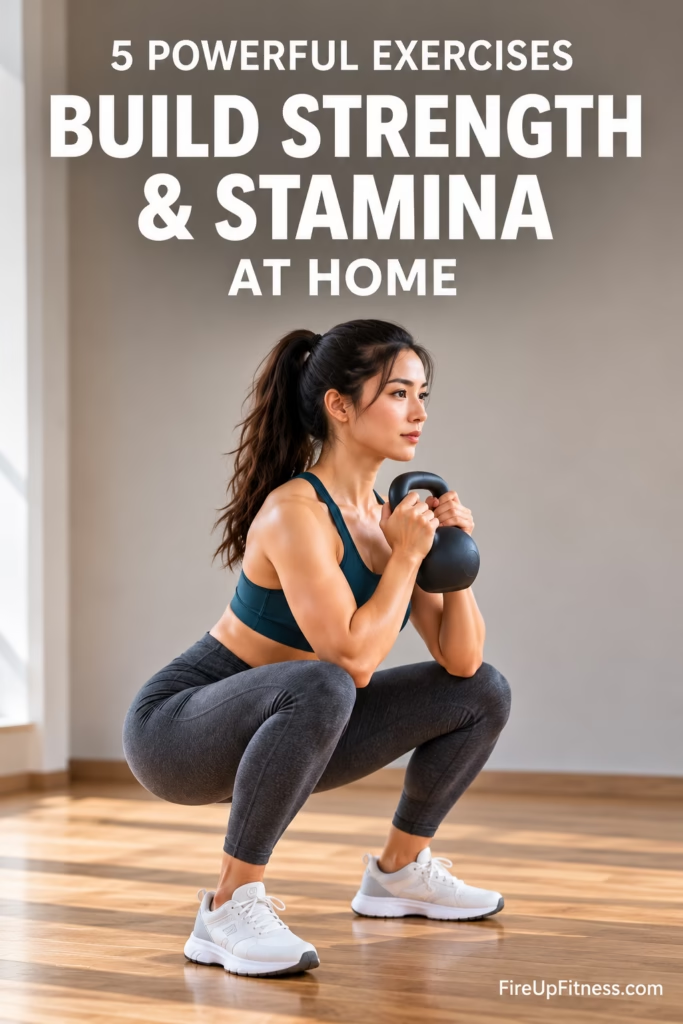
1. Goblet Squats for Lower Body Strength
Goblet squats are an excellent strength-training exercise for your legs, glutes, and core. Unlike traditional barbell squats, this variation uses a single dumbbell or kettlebell held close to your chest.
Holding the weight in front of your body can help you maintain an upright torso while encouraging controlled movement.
How to do goblet squats
- Stand with your feet slightly wider than hip-width apart.
- Hold a dumbbell or kettlebell close to your chest with both hands.
- Keep your chest lifted and your abdominal muscles engaged.
- Bend your knees and push your hips back to lower into a squat.
- Lower as far as you comfortably can while keeping your heels grounded.
- Push through your feet to return to standing.
Recommended routine: Perform 3 sets of 10–12 repetitions, resting for 45–60 seconds between sets.
Why goblet squats are worth trying
Goblet squats strengthen your quadriceps, hamstrings, and glutes while challenging your core stability. They also help develop the lower-body strength needed for everyday movements such as climbing stairs, lifting objects, and getting up from a chair.
Beginner tip: Start with bodyweight squats before introducing a dumbbell. Focus on maintaining good form rather than lifting heavier weights.
2. Jump Rope for Cardio and Coordination
Jump rope is a simple but surprisingly challenging cardio exercise. It requires minimal equipment, takes up little space, and can quickly raise your heart rate.
Beyond cardiovascular fitness, skipping rope challenges your coordination, rhythm, and lower-leg endurance.
How to jump rope correctly
- Stand tall with your feet close together and your knees slightly bent.
- Hold the rope handles at your sides with your elbows near your body.
- Rotate the rope primarily using your wrists.
- Jump just high enough for the rope to pass underneath your feet.
- Land softly on the balls of your feet, allowing your heels to lower naturally.
Try this 5-minute jump rope workout
- 30 seconds of comfortable skipping
- 30 seconds of rest or marching in place
- Repeat for 5 rounds.
Once you become comfortable with the movement, experiment with alternating-foot jumps or slightly faster intervals.
Why jump rope works
Jumping rope helps improve cardiovascular endurance, agility, balance, and timing. It also engages your calves, shoulders, and core.
Beginner tip: You don’t need to use a rope immediately. Practice small, controlled jumps or alternate your feet while mimicking the rope movement. Anyone with joint discomfort can choose low-impact marching instead.
3. Quick Cardio Booster for Better Endurance
Short cardio intervals are a practical way to challenge your heart and lungs without spending a long time exercising.
Interval training alternates periods of higher effort with easier recovery movements. This approach allows you to adjust the intensity based on your current fitness level.
You can use jogging, brisk walking, running, or incline walking to create an effective cardio routine.
Try this 16-minute cardio interval workout
| Exercise | Duration |
|---|---|
| Brisk walk or comfortable jog | 1 minute |
| Easy walk | 1 minute |
| Faster walk or run on a gentle incline | 1 minute |
| Easy walk | 1 minute |
Repeat the four-minute circuit four times.
Begin with a three- to five-minute warm-up and finish with a comfortable cooldown.
Benefits of cardio intervals
Interval workouts can improve aerobic fitness, exercise tolerance, and cardiovascular endurance. They also provide variety, which can make regular workouts more interesting.
The faster intervals should feel challenging but manageable. You don’t need to sprint at maximum speed to benefit.
Beginner tip: Start with two rounds and use brisk walking instead of running. Increase your pace or number of rounds as your endurance improves.
4. 10-Minute Core Workout for Strength and Stability
A strong core supports much more than your abdominal muscles. It helps stabilize your spine, maintain good posture, and improve balance during everyday movements.
This short core routine combines static holds with controlled movements to challenge different areas of your midsection.
The core workout circuit
1. Plank hold — 30 seconds
Place your forearms on the floor with your elbows beneath your shoulders. Extend your legs behind you and keep your body in a straight line. Engage your abdominal muscles without letting your lower back sag.
2. Pilates roll-ups — 8–10 repetitions
Lie on your back with your legs extended. Reach your arms overhead, then slowly lift your head, shoulders, and torso as you roll toward a seated position. Reverse the movement with control. Bend your knees or perform a partial curl-up if needed.
3. Cross-body mountain climbers — 20 total repetitions
Start in a high plank position. Bring one knee toward the opposite elbow, return to plank, and alternate sides. Keep your hips steady and avoid rushing.
4. Bicycle crunches — 20 total repetitions
Lie on your back with your hands lightly supporting your head. Lift your shoulders and bring one knee toward the opposite elbow while extending the other leg. Alternate sides slowly without pulling on your neck.
Complete two rounds, resting for 30–45 seconds between exercises as needed. With controlled repetitions, the routine takes approximately 10 minutes.
What makes this core routine effective?
These movements challenge your abdominal muscles in different ways. Planks build stability, roll-ups emphasize controlled spinal movement, and cross-body exercises engage the obliques.
Rather than focusing on speed, concentrate on steady breathing and maintaining proper alignment.
Beginner tip: Keep your knees on the floor during planks, substitute dead bugs for mountain climbers, and replace full roll-ups with partial abdominal curls.
5. Blast-Off Push-Ups for Upper Body and Core Strength
Blast-off push-ups combine a traditional push-up with a backward hip movement, creating a dynamic exercise that challenges several muscle groups.
This movement engages your chest, shoulders, triceps, core, and legs while encouraging coordination between your upper and lower body.
It’s best suited to people who can already perform controlled push-ups.
How to do blast-off push-ups
- Begin in a high plank position with your hands slightly wider than shoulder-width apart.
- Bend your knees and push your hips backward toward your heels while keeping your hands planted.
- Shift your body forward into a strong plank position.
- Bend your elbows to lower your chest toward the floor.
- Push back up, then move your hips backward again.
- Repeat with smooth, controlled movements.
Try this short strength interval
- 20 seconds of blast-off push-ups
- 10 seconds of rest
- 20 seconds of bodyweight squats
- 10 seconds of rest
Repeat for four rounds, taking additional recovery time whenever needed.
This combination challenges your upper and lower body while adding a cardiovascular element to your strength workout.
Beginner tip: Practice regular incline push-ups against a sturdy bench or countertop before progressing to blast-off push-ups. Avoid forcing the movement if you experience wrist, shoulder, or lower-back discomfort.
How to Combine These Exercises Into a Full-Body Workout
You don’t have to complete every routine at its full suggested duration. A shorter combination can be an effective way to train several muscle groups in one session.
Here’s an example of a balanced home workout:
| Exercise | Suggested amount |
|---|---|
| Warm-up | 5 minutes |
| Goblet squats | 2 sets of 10 |
| Jump rope | 3 minutes of intervals |
| Cardio booster | 8 minutes |
| Core circuit | 1 round |
| Blast-off push-ups | 2 sets of 5–8 |
| Cooldown stretches | 3–5 minutes |
Allow yourself additional rest between exercises, especially when transitioning from cardio to strength training.
For general fitness, try this workout two or three times per week on nonconsecutive days, adjusting the duration and intensity to your experience.
Simple Tips to Get More From Your Workout
A successful exercise routine isn’t necessarily the hardest one. It’s the one you can perform safely and consistently.
- Prioritize good technique. Controlled repetitions help you train the intended muscles without relying on momentum.
- Increase difficulty gradually. Add repetitions, resistance, or workout time as your strength and stamina improve.
- Balance movement with recovery. Muscles need time to recover after challenging workouts.
- Choose exercises that suit your body. Low-impact alternatives can be just as valuable for building a sustainable fitness routine.
- Track your progress. Notice improvements in strength, balance, endurance, and how comfortable you feel during exercise.
Final Thoughts
Building a stronger, more capable body doesn’t require complicated equipment or exhausting workout sessions.
Goblet squats develop lower-body strength, jump rope challenges coordination, cardio intervals improve endurance, and core exercises support stability. Blast-off push-ups bring several of these elements together in one dynamic movement.
You don’t need to master all five exercises immediately. Start with the movements that match your current ability, practice them consistently, and progress at a comfortable pace.
The goal isn’t to finish every workout exhausted. It’s to finish knowing you’ve done something positive for your strength, energy, and long-term health.