15 Minute Thigh Workout at Home for Stronger, Toned Legs
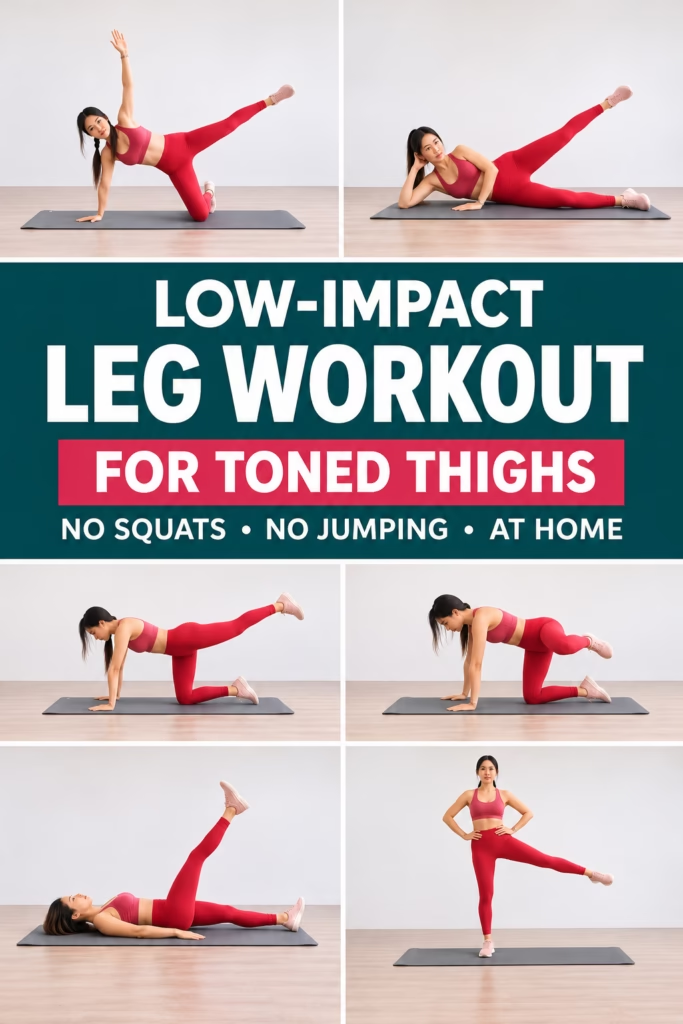
Want to strengthen your thighs without doing endless squats, jumping exercises, or intense cardio? This thigh workout at home offers a low-impact way to work your inner thighs, outer thighs, hamstrings, and glutes using nothing more than an exercise mat.
Some days, you want a leg workout that challenges your muscles without leaving you completely exhausted. That’s where this routine comes in.
With 28 exercises combining floor movements, controlled leg lifts, and standing exercises, this workout helps you build lower-body strength, improve muscular endurance, and develop better balance.
The best part? No squats, no jumping, and no weights required.
Whether you’re looking for an inner thigh workout, a simple leg toning routine, or a low-impact workout for your lower body, these exercises can fit into your fitness schedule.
Why Try This Thigh Workout at Home?
Your thighs contain several important muscle groups that support walking, climbing stairs, balancing, and everyday movement.
This routine works multiple areas of your lower body:
- Inner thighs (adductors): Help bring your legs toward the center of your body and stabilize your hips.
- Outer thighs and hip muscles: Support sideways movement and pelvic stability.
- Hamstrings: Located at the back of your thighs, these muscles help bend your knees and extend your hips.
- Quadriceps: Located at the front of your thighs, they help straighten your knees.
- Glutes: Support hip movement, posture, and lower-body strength.
Unlike workouts built around heavy resistance or explosive movements, this routine uses controlled, repetitive exercises to challenge your muscles.
It is also a practical option for people who prefer mat-based exercises over traditional leg workouts.
Can Thigh Exercises Make Your Legs Slimmer?
Thigh exercises can strengthen and develop the muscles in your legs, improving their firmness and muscular definition over time.
However, exercise cannot selectively remove fat from your inner or outer thighs. Changes in body fat depend on factors such as overall activity, nutrition, genetics, and individual physiology.
This workout is best viewed as a way to build stronger thighs, improve endurance, and support overall fitness rather than a guaranteed method for changing thigh size.
How to Follow This 28-Exercise Thigh Workout
This workout uses short intervals with minimal rest, keeping your muscles engaged throughout the routine.
| Workout details | Plan |
|---|---|
| Total exercises | 28 |
| Work interval | 30 seconds |
| Rest between exercises | 5–10 seconds |
| Equipment | Exercise mat |
| Difficulty | Beginner-friendly, with modifications |
| Workout style | Low-impact, bodyweight |
| Main focus | Inner thighs, outer thighs, hamstrings, glutes |
The working intervals add up to 14 minutes. Including transitions and breaks, allow approximately 16–19 minutes, plus a short warm-up and cooldown.
Before starting, spend three to five minutes warming up with gentle marching, hip circles, and easy leg swings.
You can follow the video below to complete the exercises in the correct order and maintain a steady pace.
Watch the Full Thigh Workout Video
Part 1: Side-Lying Thigh Exercises
The first section focuses on your inner thighs, outer thighs, and hip muscles.
These movements are performed close to the floor, making them suitable for a low-impact leg workout.
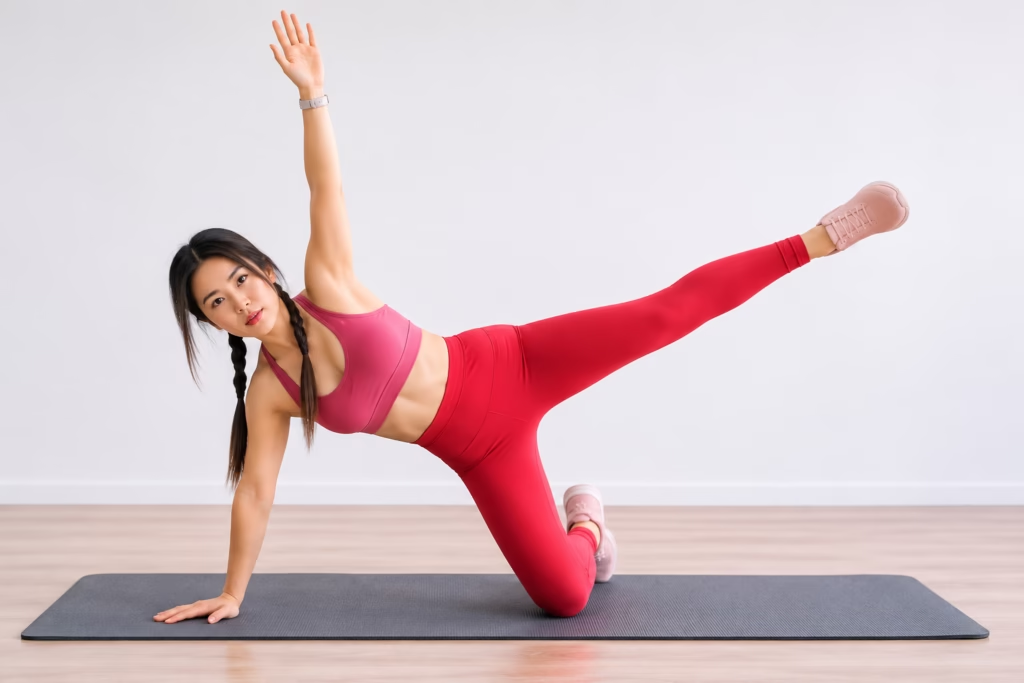
1. Modified Side Plank With Leg Raise
Begin in a modified side plank with one knee resting on the mat and your supporting hand or forearm on the floor.
Extend your top leg and slowly lift it sideways before lowering it with control.
Keep your hips stable and engage your abdominal muscles to avoid rocking backward.
This movement challenges your outer hips, glutes, and core while the supporting leg helps maintain stability.
2. Side-Lying Leg Lifts
Lie on your side with your legs extended. Support your head with your lower arm or prop yourself on your forearm.
Lift your top leg toward the ceiling, pause briefly, and lower it without letting it drop.
Keep your toes pointing forward rather than rotating your hips upward.
Tip: Small, controlled lifts can be more effective than swinging your leg as high as possible.
3. Side-Lying Leg Circles
Remain on your side and raise your top leg slightly above the floor.
Draw small circles in the air while keeping your upper body relaxed.
Avoid making the circles so large that your pelvis starts moving.
This exercise challenges the muscles surrounding your hips and encourages better leg control.
4. Forward Leg Press and Lift
Keep your top leg raised with your foot flexed.
Move the leg forward in a controlled motion, then add a small upward lift before returning toward the starting position.
Maintain a steady torso and avoid arching your lower back.
The combination of forward movement and lifting engages several hip muscles.
5. Knee Touch Extensions
Bend your top knee toward the mat, then extend your leg upward and slightly backward.
Focus on squeezing your glutes as you straighten your leg.
Move slowly enough to maintain control through the entire exercise.
6. Mountain-Shaped Leg Raises
Extend your top leg forward and lightly touch the floor with your toes.
Lift your leg in a smooth arc, moving it upward and backward as though drawing an upside-down U in the air.
Return along the same path.
This movement combines hip flexion, abduction, and extension, helping challenge different muscles around your thighs and hips.
7. Triangle Leg Raises
Position yourself on your side as demonstrated in the video, holding your upper ankle or thigh for support.
Lift your lower leg upward using your inner thigh muscles.
Keep your torso steady rather than pulling your leg upward with momentum.
Beginner modification: Bend your knees slightly or hold your thigh instead of your ankle if flexibility is limited.
Repeat on the Opposite Side
Exercises 8–14 repeat the same seven movements on the other side.
Complete each exercise for 30 seconds, paying attention to your form and maintaining a comfortable range of motion.
Training both sides helps develop balanced strength and coordination.
Part 2: All-Fours Exercises for Thighs and Glutes
The next section moves into a hands-and-knees position.
These exercises strengthen the muscles surrounding your hips and target the outer and back portions of your thighs.
15–16. All-Fours Side Leg Raises
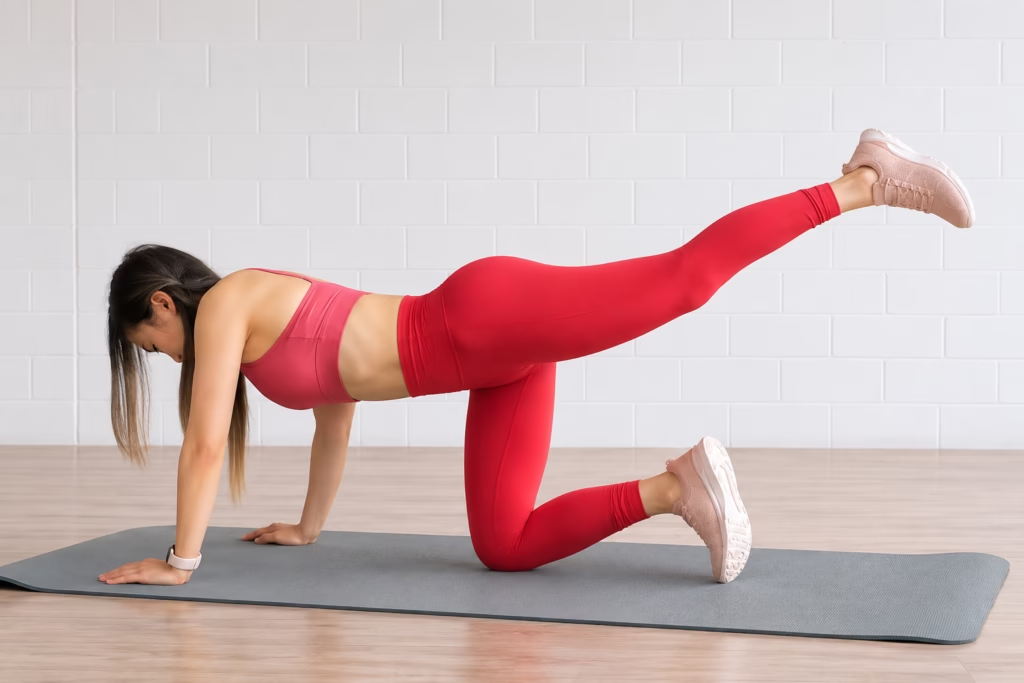
Begin on your hands and knees, with your wrists beneath your shoulders and knees beneath your hips.
Keeping one knee bent, lift your leg outward to the side.
Lower it slowly without shifting your weight excessively.
Complete 30 seconds on one leg, then switch.
This movement emphasizes your gluteus medius and other hip muscles that help stabilize your pelvis.
17–18. Rainbow Leg Raises
Stay on all fours and extend one leg outward.
Move your leg through a gentle rainbow-shaped arc, tapping the floor lightly at each end.
Keep your abdominal muscles engaged to prevent excessive lower-back movement.
Perform the exercise on both sides.
Rainbow leg raises challenge the glutes and hip muscles while encouraging coordination and controlled movement.
19–20. Fire Hydrants
Start with your knees bent at approximately 90 degrees.
Lift one knee out to the side without twisting your hips, then return it to the mat.
Keep your shoulders level and avoid leaning too far into your supporting arm.
Repeat on the opposite leg.
Fire hydrants are particularly useful for strengthening the outer hip muscles, which play an important role in balance and lower-body stability.
Part 3: Floor Leg Circles
21–22. Lying Leg Circles
Lie comfortably on your back and extend one leg upward.
Draw controlled circles with your raised leg, changing direction halfway through the interval.
Keep your pelvis stable and your lower back in a comfortable position.
Switch legs after 30 seconds.
These circles challenge your hip flexors, thigh muscles, and core stabilizers.
Beginner modification: Bend your supporting knee and keep its foot flat on the floor. Make smaller circles if your lower back starts to arch.
Part 4: Standing Thigh Exercises
The final section adds standing movements to improve balance, coordination, and muscular endurance.
These exercises can also help you become more comfortable controlling your legs during everyday activities.
23. Alternating Heel Raises
Stand with your feet comfortably apart and soften your knees.
Lower your body slightly, then alternate lifting your left and right heels.
Keep your movements smooth and your posture upright.
This exercise works your calves and challenges lower-body stability.
24–25. Standing Knee Openers
Place your hands on your hips and stand tall.
Lift one knee, rotate it outward, and return it toward the starting position.
Keep your supporting leg slightly bent and avoid leaning sideways.
Complete 30 seconds on each leg.
This movement develops hip mobility and challenges your core as you balance.
26–27. Standing Leg Sweeps
Stand upright with your hands on your hips or hold a sturdy chair for support.
Sweep one leg across the front of your body, then move it outward in a controlled motion.
Avoid swinging forcefully or twisting your torso.
Repeat on the opposite leg.
Standing leg sweeps engage your inner and outer thigh muscles while helping improve coordination.
28. Lunge Taps
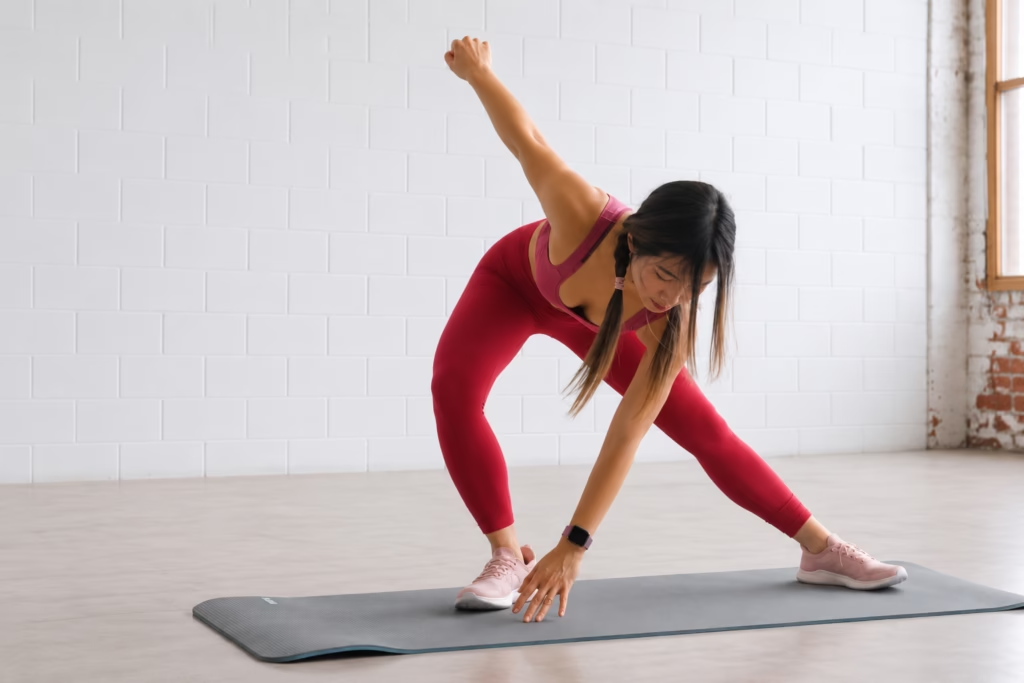
Finish the workout with gentle lunge taps.
Step one foot backward into a shallow lunge position, lightly tap the floor, and return to standing.
Alternate legs while keeping your chest lifted.
Use a smaller range of motion if you have limited mobility or find deeper lunges uncomfortable.
Although this workout avoids traditional squats and jumping, this final movement adds a little extra lower-body challenge.
Tips to Get More From Your Thigh Workout
Small adjustments can make a noticeable difference in how comfortably and effectively you perform these exercises.
Focus on Muscle Control
Rather than rushing through repetitions, concentrate on lifting and lowering your legs with intention.
Controlled movement helps you maintain proper alignment and reduces the temptation to rely on momentum.
Keep Your Core Engaged
Many thigh exercises also challenge your abdominal muscles.
Gently brace your core to support your spine, particularly during side planks, leg circles, and standing balance movements.
Use a Comfortable Range of Motion
You don’t need to lift your leg extremely high to make an exercise worthwhile.
A smaller movement performed with good technique is often preferable to a larger movement that causes discomfort or poor alignment.
Rest When Needed
The video includes only short breaks, but you can pause longer between exercises.
Beginners may find it helpful to complete fewer movements initially and gradually build up to the full routine.
Stay Consistent
Building strength takes time. Focus on completing your workouts regularly, improving your technique, and noticing how your movements become easier.
You don’t need to push through pain to make progress.
How Often Should You Do This Thigh Workout?
You can include this routine in your weekly fitness schedule two or three times, depending on your experience, recovery, and other activities.
Here is a simple example:
| Day | Activity |
|---|---|
| Monday | Full thigh workout |
| Tuesday | Walking or gentle stretching |
| Wednesday | Upper-body and core workout |
| Thursday | Full thigh workout |
| Friday | Light walking or mobility exercises |
| Saturday | Optional full-body workout |
| Sunday | Rest or gentle stretching |
Allow your muscles enough time to recover, especially when you are beginning a new exercise program.
The original video is part of a four-episode program spread over 25 days. You can follow that schedule if you have access to the complete series, or use this individual workout as part of your regular fitness routine.
Frequently Asked Questions
Can I Do This Thigh Workout Without Equipment?
Yes. All 28 exercises use your body weight. A mat provides cushioning for floor exercises, while a sturdy chair or wall can offer extra support during standing movements.
Is This Thigh Workout Suitable for Beginners?
Many movements are beginner-friendly because they do not involve jumping or heavy weights. However, the short rest periods and repeated leg raises can still be challenging.
Take additional breaks and modify the exercises as needed.
Will This Workout Make My Thighs Bulky?
This bodyweight routine primarily challenges muscular endurance and control. Significant muscle growth generally requires progressively increasing resistance, adequate nutrition, and consistent training over time.
Individual results vary.
Can I Reduce Inner Thigh Fat With These Exercises?
Inner thigh exercises strengthen the muscles in that area, but they cannot specifically target fat loss. Overall body composition changes are influenced by several factors, including genetics, nutrition, and activity levels.
Can I Do This Workout Every Day?
You may be able to perform some gentle movements daily, but completing the full routine every day is not necessary. Two or three sessions per week can provide a useful starting point, with recovery time between challenging sessions.
Final Thoughts: Stronger Thighs Start With Consistent Movement
A good leg workout doesn’t have to involve heavy dumbbells, deep squats, or high-impact exercises.
This 28-exercise thigh workout combines side-lying leg lifts, hip-strengthening movements, floor exercises, and standing balance work to challenge your lower body from different angles.
The goal isn’t to achieve a particular thigh measurement. It’s to develop strength, move with greater control, and feel more confident in what your legs can do.
Roll out your mat, follow along with the video, and work at a pace that feels right for you.
Which part of your legs would you like to strengthen most—your inner thighs, outer thighs, or the back of your thighs?