
What Happens to Your Body When You Start Running Regularly
Running doesn’t automatically flatten your stomach. It doesn’t mean you should run seven days a week. And running farther isn’t always the fastest way to become fitter.
So instead of another list telling you that running is “good for your heart,” let’s look at something more useful:
What actually happens to your body when you start running regularly—and how can you get the benefits without turning running into another exhausting fitness project?
The First Thing Running Changes Isn’t Your Body
For many beginners, the biggest obstacle to running isn’t physical fitness.
It’s the belief that running is something other people do.
Runners are fast.
Runners have expensive watches.
Runners wake up at 5 a.m.
Runners somehow enjoy hills.
Meanwhile, you’re wondering whether jogging to the end of the street counts.
It does.
The moment you stop defining running by speed, distance, or appearance, it becomes much more accessible.
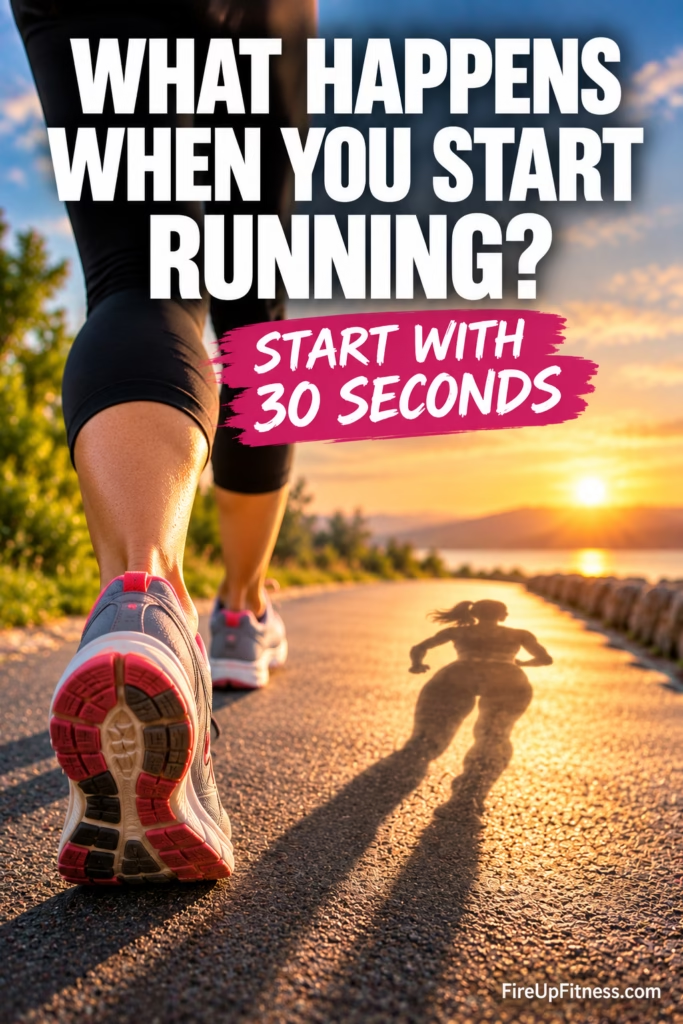
Running can mean jogging for 30 seconds and walking for two minutes.
It can mean a slow mile.
It can mean running three times a week and walking on the other days.
Your first goal isn’t to become fast.
It’s to make running feel normal enough that you want to do it again.
Your First Few Runs May Feel Surprisingly Hard
Let’s not romanticize the beginning.
Running can feel awful when you haven’t done it in a while.
Your breathing becomes heavy.
Your calves tighten.
Your heart pounds.
Two minutes somehow feels like twelve.
And your brain immediately asks:
“How do people actually enjoy this?”
There’s a reason.
Running asks several systems in your body to work harder at the same time. Your heart has to deliver more blood to working muscles. Your breathing increases to meet the greater demand for oxygen. Your legs repeatedly absorb and produce force.
Your body simply isn’t accustomed to the workload yet.
This is also why your first runs shouldn’t be a test of how much discomfort you can tolerate.
They should be an introduction.
After a Few Weeks, Something Starts to Feel Different
This is where running becomes rewarding.
The exact timeline varies from person to person, but consistent aerobic exercise encourages your body to adapt to the work you’re asking it to perform.
The run that once felt impossible may start feeling manageable.
Perhaps you used to need a walking break after one minute. Now you can comfortably jog for three.
Maybe you always stopped at the same hill. One morning, you realize you’ve reached the top without stopping.
Those changes can seem small, but they’re evidence of improving fitness.
Your cardiovascular system becomes better conditioned for exercise, your muscles become accustomed to repeated movement, and your confidence begins catching up with your physical ability.
This is one reason progress shouldn’t always be measured by a bathroom scale.
Sometimes the most meaningful result is realizing:
“That used to be hard for me.”
Your Heart Gets Better at Handling Exercise
Running is cardiovascular exercise, which means it challenges your heart, lungs, blood vessels, and muscles to work together.
During a run, your muscles need more oxygen. Your heart rate rises and your breathing becomes faster to help meet that demand.
Repeated aerobic training can improve cardiorespiratory fitness over time.
And you may notice those improvements outside your workouts.
Stairs feel easier.
You recover faster after walking uphill.
A long day on your feet doesn’t leave you quite as exhausted.
You can keep up with your kids or grandchildren more comfortably.
Those everyday improvements may matter far more than running a faster mile.
Your Breathing Stops Feeling Like the Enemy
Beginners often assume they have “bad lungs” because they become breathless quickly.
Frequently, the problem is simpler:
They’re running too fast.
Try this the next time you run.
Slow down until the pace feels almost embarrassingly easy.
Then slow down a little more.
During an easy run, you should generally be able to say a short sentence rather than gasping out individual words.
If you can’t, walk.
Once your breathing settles, start jogging again.
There’s nothing wrong with this.
Run-walk training isn’t a lesser version of running. It’s one of the smartest ways to build endurance without making every workout miserable.
Your Legs Are Learning Too
Your cardiovascular system isn’t the only thing adapting.
Every step requires coordinated work from your glutes, quadriceps, hamstrings, calves, hips, ankles, and core.
Running repeatedly exposes those tissues to load.
That’s one reason increasing your mileage too quickly can cause problems even when you feel cardiovascularly capable of doing more.
Your lungs might be saying:
“We can keep going!”
while your calves and tendons are saying:
“Could we discuss this first?”
Give your body time.
Fitness isn’t only about how much work you can tolerate today. It’s also about how well you can recover and do it again later.
The Scale May Not Do What You Expect
This is where many people become frustrated.
They start running because they want to lose body fat.
They run several times a week.
They sweat.
Their fitness improves.
Then they step on the scale expecting a dramatic change.
Nothing.
Does that mean running isn’t working?
Not necessarily.
Running burns energy, but fat loss depends on your overall energy balance over time. Exercise is only one part of that equation.
Appetite can change when activity increases. Food choices matter. Sleep matters. Your overall daily movement matters.
And body weight naturally fluctuates.
That’s why judging a running routine solely by the number on the scale can make you overlook everything else you’re gaining.
Ask yourself:
Can I run farther?
Do I recover faster?
Do my legs feel stronger?
Am I moving more during the rest of the day?
Do I have more energy?
Does my usual route feel easier?
Those are results too.
What About Belly Fat?
Running cannot choose where your body loses fat.
Unfortunately, neither can crunches, planks, waist trainers, or any magical “belly fat” exercise.
Where your body stores and loses fat is influenced partly by factors outside your control.
Running can contribute to the overall energy expenditure that supports fat loss, but it cannot specifically command your body to remove fat from your stomach, hips, thighs, or arms.
That doesn’t make running ineffective.
It simply means the goal should be bigger than trying to shrink one body part.
Combine running or walking with sensible nutrition, resistance training, sufficient sleep, and consistent everyday activity.
That combination gives you a much more complete fitness strategy.
Running Can Change Your Relationship With Stress
Some benefits of running are difficult to photograph.
You leave home carrying an entire day in your head.
Work.
Bills.
Appointments.
Family responsibilities.
The conversation you keep replaying.
Twenty minutes later, the problems haven’t disappeared—but somehow they don’t feel quite as loud.
Exercise can affect brain processes and chemicals involved in mood and stress. But running also provides something increasingly rare:
uninterrupted time.
No emails.
No dishes.
No scrolling.
No one asking you for anything.
Just movement.
For some people, that’s where the famous “runner’s high” appears.
For others, there’s no dramatic rush of happiness at all.
They simply return home feeling a little calmer.
That’s valuable too.
Running Can Become Moving Meditation
You don’t need to sit perfectly still to experience a meditative moment.
Running has its own rhythm.
Step.
Step.
Breathe.
Step.
Step.
Breathe.
Your surroundings slowly pass by while your body repeats the same basic movement.
Some days you’ll think through problems.
Other days you’ll notice the wind, trees, sunlight, traffic, birds, or the sound of your feet touching the ground.
And some days you’ll think about absolutely nothing important.
That’s part of the appeal.
Try doing one easy run without constantly checking your pace.
Don’t worry about calories.
Don’t try to break a record.
Simply move.
You may discover that the mental space is one of your favorite benefits.
Then Something Unexpected Happens: You Start Trusting Your Body
This may be one of the most overlooked benefits of becoming fitter.
At first, every difficult sensation can feel like a warning.
Heavy breathing feels alarming.
Tired legs feel like failure.
A hill feels like proof that you’re “not fit.”
But gradually, you learn your body.
You discover the difference between challenging effort and going too hard.
You know when you can keep going.
You know when you should walk.
You learn when your body needs recovery.
And you begin collecting little pieces of evidence:
I ran five minutes without stopping.
I finished the hill.
I went out even though I didn’t feel motivated.
I can do more than I could last month.
Fitness can build confidence in a very practical way.
Not because exercise changes how you look, but because it repeatedly shows you what your body can do.
But Running Has a Weak Spot
Running is excellent cardiovascular exercise.
It is not a complete fitness program.
This distinction becomes particularly important as we get older.
Running doesn’t provide the same muscle-building stimulus as progressive resistance training.
That’s why a routine built entirely around cardio can be improved by adding strength work.
You don’t need complicated gym sessions.
Two strength workouts each week can include exercises such as:
- Squats
- Step-ups
- Glute bridges
- Lunges or supported split squats
- Calf raises
- Rows
- Wall or incline push-ups
- Bird dogs or dead bugs
Think of strength training and running as partners rather than competitors.
Running develops cardiovascular fitness and endurance.
Strength training helps maintain and build muscle and prepares your body to handle everyday physical demands.
Walking and mobility work can fill in the spaces between them.
Should You Run Every Day?
For most recreational runners—especially beginners—there’s no need.
This is where enthusiasm sometimes works against us.
You finish your first few runs feeling motivated and decide:
“I’m doing this every day now.”
Monday goes well.
Tuesday is harder.
By Thursday, your legs are sore.
By Sunday, you don’t want to see your running shoes.
Instead of trying to build a seven-day streak, build a routine you can still imagine following three months from now.
For a beginner, that could mean three running days per week.
For example:
Monday: Run-walk workout
Tuesday: Strength training or walking
Wednesday: Recovery
Thursday: Run-walk workout
Friday: Strength training
Saturday: Easy run or run-walk
Sunday: Rest or gentle walking
That’s still an active week.
Rest doesn’t cancel your progress.
It helps you prepare for your next workout.
The 20-Minute Running Experiment
Here’s a different approach for beginners.
Don’t promise yourself that you’re becoming a runner.
Don’t buy a bunch of equipment.
Don’t commit to running five miles.
Try this simple experiment three times a week for the next few weeks.
Minutes 0–5: Walk
Start comfortably and gradually increase your pace.
Let your body warm up.
Minutes 5–15: Alternate Running and Walking
Jog easily for:
30–60 seconds
Then walk for:
60–90 seconds
Repeat.
The running portions should feel controlled, not like sprints.
Minutes 15–20: Walk
Slow down gradually and allow your breathing to settle.
Done.
It may seem almost too easy.
That’s intentional.
You want to finish thinking:
“I could have done a little more.”
That feeling makes it much easier to come back.
Try the “One More Minute” Rule
Fitness plans often encourage dramatic progress.
Try something quieter.
When your current running interval begins feeling comfortable, add one minute.
Running three minutes comfortably?
Try four.
Comfortable running for ten?
Try eleven.
You don’t need to improve every workout.
You don’t even need to improve every week.
Tiny increases accumulate.
The goal is not to discover how quickly you can exhaust yourself.
It’s to discover how much your body can gradually learn to do.
Running After 40: Stop Training Like You’re 20
This is especially important for women beginning or returning to running in midlife.
Your goal doesn’t need to be proving that you can train the way you did decades ago.
Make recovery part of your program.
Prioritize strength training.
Don’t be embarrassed about walking intervals.
Increase running volume gradually.
Pay attention to persistent aches instead of automatically pushing through them.
And don’t underestimate walking.
A brisk walking day between running sessions can keep you moving while reducing impact and giving your body additional recovery time.
The goal isn’t to win against your younger self.
The goal is to build a body that continues carrying you confidently through the decades ahead.
Don’t Chase Calories—Collect Evidence
Fitness trackers make it easy to reduce a workout to numbers.
317 calories.
2.6 miles.
12:04 pace.
4,821 steps.
Numbers can be useful, but they can also distract you from progress happening right in front of you.
Instead, collect evidence.
Week 1: I ran for one minute.
Week 3: I ran for three.
Week 6: I completed my usual route without needing the extra walking break.
Week 10: The hill I hated doesn’t bother me anymore.
That’s your body adapting.
Those small victories are often much more motivating than staring at a calorie estimate.
The Best Running Routine Is Surprisingly Unexciting
It isn’t an extreme 30-day challenge.
It isn’t running until your legs shake.
It isn’t waking up every morning determined to burn as many calories as possible.
A sustainable routine might look almost boring:
Run a few times each week.
Walk often.
Lift weights twice a week.
Eat reasonably well.
Sleep.
Recover.
Repeat.
And that is precisely why it works.
You don’t need heroic workouts.
You need ordinary workouts repeated long enough to matter.
When Running Isn’t the Right Choice
Running is optional.
That’s worth saying clearly.
Some people love it.
Some tolerate it.
Some genuinely hate it.
And people dealing with certain injuries, medical concerns, or significant pain may need a different form of exercise or professional guidance before starting.
You can improve your fitness without becoming a runner.
Brisk walking, cycling, swimming, strength training, hiking, dancing, and other activities can all have a place in a healthy lifestyle.
Running isn’t superior because it’s harder.
It’s useful because it’s accessible, scalable, and surprisingly powerful when you enjoy it enough to keep doing it.
So, What Really Happens When You Start Running?
At first, you’ll probably notice the struggle.
Your breathing.
Your legs.
The distance.
The temptation to stop.
Keep going consistently—not excessively—and eventually you start noticing something else.
The same body that once struggled through 30 seconds can run several minutes.
The route doesn’t seem as long.
The hill doesn’t look as intimidating.
Your breathing settles faster.
Your legs feel more capable.
And somewhere along the way, running stops feeling like something you’re trying to force yourself to do.
It simply becomes something you do.
That’s the part of running that doesn’t fit neatly into a calorie calculator.
You aren’t only training your heart and legs.
You’re accumulating proof that your body can adapt.
So forget about becoming “a runner” for now.
Put on your shoes.
Walk for five minutes.
Jog for 30 seconds.
Walk again.
Then do it again another day.
Don’t chase the runner you think you should become. Give your body enough time to show you the runner it can become.