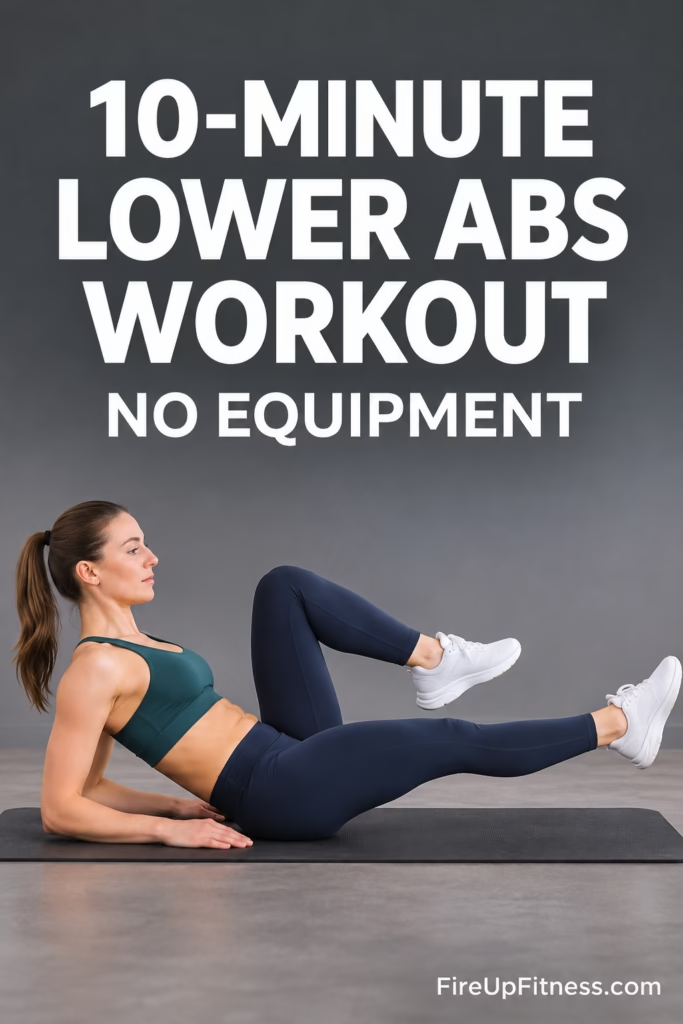
10-Minute Lower Abs Workout at Home (No Equipment Needed)
Building a stronger core doesn’t have to mean spending hours doing crunches. Sometimes, all you need is 10 minutes, a comfortable exercise mat, and a few controlled movements that challenge your abdominal muscles.
This 10-minute lower abs workout focuses on strengthening your deep core muscles, improving stability, and developing better control over your movements. The routine combines beginner-friendly floor exercises, reverse crunches, plank variations, and a short abdominal finisher.
The best part? You don’t need weights, machines, or a gym membership. This abs workout routine can be done at home with minimal space.
Whether you’re working on core strength or looking for a quick addition to your fitness routine, these exercises offer a practical way to challenge your abs without complicated equipment.
Why Focus on Your Lower Abs?
Your abdominal muscles work together to support your spine, stabilize your pelvis, and help you move efficiently throughout the day.
Although you can’t completely isolate your lower abdominal muscles, certain movements emphasize the lower portion of the rectus abdominis while also engaging the deeper core muscles.
A consistent lower abdomen workout can help you:
- Build abdominal strength and endurance.
- Improve pelvic control and core stability.
- Support better posture during everyday activities.
- Develop greater control during other workouts.
- Strengthen the muscles involved in maintaining balance and stability.
The secret isn’t how many repetitions you complete. It’s how well you control each movement.
10-Minute Lower Abs Workout: What You’ll Need
This ab and core workout is designed to be simple enough to follow at home while still offering a challenge.
| Workout details | |
|---|---|
| Duration | 10 minutes |
| Equipment | Exercise mat |
| Fitness level | Beginner to intermediate |
| Focus | Lower abdominal emphasis and core stability |
| Workout style | Floor exercises and planks |
| Rest | Short breaks, approximately 15 seconds where indicated |
Most exercises are performed lying on your back, with two plank variations added toward the end.
Follow the video for the exact exercise timing and transitions.
Follow Along With the 10-Minute Lower Abs Workout Video
This follow-along workout from MadFit guides you through each movement, with demonstrations and modifications to help you maintain proper form.
Keep your mat in a position where you can comfortably see the screen. Move at your own pace, take additional breaks when needed, and focus on controlled breathing throughout the routine.
10-Minute Lower Abs Workout Routine: Step by Step
1. Heel Walkouts
CORE ACTIVATION AND WARM-UP
Start your lower ab exercises with a gentle movement that helps you practice engaging your abdominal muscles.
How to do it:
- Lie on your back with your knees bent and feet flat on the mat.
- Gently engage your core and keep your pelvis steady.
- Slowly walk your heels away from your body.
- Stop before your lower back begins to arch excessively.
- Walk your feet back toward your hips.
Exhale as you move your feet away, then inhale as you return.
Form tip: Keep your ribs relaxed and avoid letting your lower back lift as your legs extend. Only move as far as you can comfortably maintain control.
2. Dead Bugs
Dead bugs are an excellent addition to an abs workout for beginners because they train coordination and core stability without requiring fast movements.
How to do it:
- Lie on your back and lift your knees into a tabletop position.
- Extend both arms toward the ceiling.
- Slowly extend your right arm and left leg away from your body.
- Return to the starting position.
- Repeat with your left arm and right leg.
Keep your abdominal muscles engaged and avoid arching your back as your limbs extend.
Form tip: Move slowly and exhale during each extension. Shorten your range of motion whenever maintaining a steady pelvis becomes difficult.
3. Same-Side Dead Bugs With Resistance
This variation increases the challenge by adding gentle resistance between your hand and knee.
How to do it:
- Begin on your back with your knees in tabletop position.
- Press your left hand gently against your left knee.
- Extend your right arm and right leg away from your body.
- Bring them back to the starting position.
- Switch sides and repeat.
The pressure between your hand and knee encourages your core to remain engaged while the opposite side moves.
Form tip: Keep the resistance steady without holding your breath or tensing your neck.
4. Single-Leg Heel Taps
Heel taps are simple but effective movements for developing lower abdominal control.
How to do it:
- Lie on your back with both knees bent at approximately 90 degrees.
- Keep your legs in tabletop position.
- Slowly lower one heel toward the mat.
- Lightly tap the floor and return to tabletop.
- Alternate legs while keeping your pelvis steady.
To make this exercise harder, straighten the moving leg and hover your heel slightly above the floor.
Beginner modification: Keep your knees bent and use a smaller range of motion.
5. Double-Leg Heel Taps
This movement builds on the previous exercise by lowering both legs together.
How to do it:
- Begin with both legs in tabletop position.
- Engage your abdominal muscles.
- Slowly lower both heels toward the floor.
- Stop before your lower back begins to arch.
- Bring your knees back to tabletop.
Form tip: Keep your movements controlled rather than relying on momentum. Return to alternating heel taps if lowering both legs feels too challenging.
Take the short rest shown in the video before continuing.
6. Reverse Crunches
Reverse crunches are one of the most useful movements in this lower abs workout because they involve curling the pelvis toward the rib cage.
How to do it:
- Lie on your back with your knees bent.
- Lift your feet off the floor.
- Gently curl your pelvis upward, bringing your knees slightly toward your chest.
- Lift your hips only a small distance from the mat.
- Slowly lower your pelvis with control.
Avoid swinging your legs or using momentum to lift your hips.
Form tip: Think about curling your tailbone off the floor rather than throwing your knees toward your face. A small, controlled movement is enough.
7. Elbow-Supported Single-Leg Extensions
This variation changes your upper-body position and challenges your abdominal muscles from a slightly different angle.
How to do it:
- Sit back on your mat and support your upper body on your forearms.
- Lift your chest and maintain a comfortable, steady spine.
- Bring both knees into tabletop position.
- Extend one leg away from your body.
- Return to tabletop and alternate sides.
Keep your torso as still as possible while your legs move.
Beginner modification: Instead of straightening your leg, keep the knee bent and gently tap your heel on the floor.
8. Elbow-Supported Double-Leg Lowers
Now increase the challenge by moving both legs together.
How to do it:
- Remain supported on your forearms.
- Bring both knees toward your chest into tabletop position.
- Slowly lower both legs toward the floor.
- Keep your chest lifted without collapsing into your shoulders.
- Return your legs to the starting position.
Form tip: Only lower your legs as far as you can without straining your lower back. Bent-knee heel taps are a good alternative.
9. High Plank Knee Drives
This exercise adds a plank position to your abs workout routine, engaging your abdominal muscles, shoulders, and other stabilizing muscles.
How to do it:
- Begin in a high plank with your hands beneath your shoulders.
- Extend your legs behind you.
- Keep your body in a straight line from your head to your heels.
- Slowly bring one knee toward your chest.
- Return to plank and repeat on the opposite side.
Avoid lifting your hips excessively or rounding your back to pull your knee forward.
Form tip: Move slowly and keep your shoulders stable. You can perform the movement with your hands elevated on a sturdy bench to reduce the difficulty.
10. High Plank Opposite Toe Reaches
This movement combines core stability with a controlled hip lift.
How to do it:
- Start in a high plank.
- Lift your hips as you reach one hand toward the opposite foot.
- Touch your foot or reach as close as comfortably possible.
- Return to a straight high plank.
- Alternate sides.
Keep your movements deliberate and return to a stable plank between repetitions.
Form tip: Bend your knees slightly if needed. Prioritize balance and control over touching your toes.
Final 90-Second Lower Abs Finisher
The workout ends with three 30-second intervals designed to challenge your abdominal endurance.
Caucasian fit woman doing flutter kicks exercise isolated on white
30 seconds: Flutter kicks or scissors
Lie on your back and alternate small, controlled leg movements. Keep your legs higher if lowering them causes your back to arch.
30 seconds: Elbow-supported rainbow leg lowers
Support yourself on your forearms, bring your knees into tabletop, and move your feet in a controlled arc toward alternating sides of the mat.
30 seconds: Flutter kicks
Return to your back for the final interval. Breathe steadily, keep your core engaged, and shorten the movement as needed.
This finisher is meant to challenge your muscles, not force you to push through discomfort. Take a break whenever your form starts to deteriorate.
How to Make This Lower Abs Workout Beginner-Friendly
You don’t need to complete every exercise at its most difficult level to make progress.
For a more manageable low abs workout, try these adjustments:
- Keep your knees bent during leg-lowering exercises.
- Reduce your range of motion when your lower back begins to arch.
- Rest longer than 15 seconds when necessary.
- Perform plank exercises with your hands elevated.
- Slow down rather than rushing through repetitions.
Some abdominal fatigue is expected, but sharp pain or persistent lower-back discomfort is a reason to stop and modify the exercise.
How Often Should You Do This Abs Workout?
This 10-minute routine can fit into a balanced weekly abs workout plan alongside walking, strength training, Pilates, or other activities you enjoy.
For beginners, start with two sessions per week on nonconsecutive days. As your endurance improves, you may gradually increase to three sessions, allowing enough recovery between challenging core workouts.
A simple schedule might look like this:
| Day | Activity |
|---|---|
| Monday | 10-minute lower abs workout |
| Tuesday | Walking or gentle mobility |
| Wednesday | Full-body strength training |
| Thursday | 10-minute lower abs workout |
| Friday | Walking or Pilates |
| Saturday | Full-body workout or active recovery |
| Sunday | Rest or gentle stretching |
Remember that your abdominal muscles also work during squats, lunges, carries, and many everyday movements. You don’t need to train them intensely every day.
Tips for Getting More From Your Lower Ab Exercises
Small changes in technique can make a noticeable difference in how your core muscles work.
Focus on breathing. Exhale during the challenging portion of each exercise. Avoid holding your breath, especially during leg extensions and reverse crunches.
Maintain a comfortable spine position. During exercises on your back, gently control your pelvis and ribs. During planks, maintain a neutral spine rather than allowing your hips to sag.
Choose control over speed. Slower repetitions can help you recognize when you’re using momentum instead of your abdominal muscles.
Progress gradually. Begin with bent-knee variations, then extend your legs farther as you develop strength and stability.
Stay consistent. A manageable routine performed regularly is more useful than an overly difficult workout you struggle to repeat.
Frequently Asked Questions
Does a lower abs workout help flatten your stomach?
Lower abdominal exercises strengthen your core, but they don’t specifically burn fat from your lower stomach. Changes in body composition depend on several factors, including overall physical activity, nutrition, genetics, and lifestyle.
Can beginners do this 10-minute abs workout?
Yes. Many exercises include easier variations, such as single-leg heel taps and bent-knee extensions. Beginners can take additional breaks and gradually build toward the full routine.
Do I need equipment for this lower abdomen workout?
No. A comfortable exercise mat is the only recommended item. The entire workout uses bodyweight movements.
Is 10 minutes enough for an effective ab workout?
Ten minutes can provide a useful core-strengthening session when the exercises are challenging enough for your current fitness level and performed with proper technique. Progress comes from consistency and gradually increasing the challenge.
Why do I feel some lower ab exercises in my hip flexors?
Your hip flexors help lift and stabilize your legs, so they naturally participate in movements such as flutter kicks and leg lowers. To shift more emphasis toward abdominal control, bend your knees, reduce the range of motion, and keep your pelvis steady.
Final Thoughts
A stronger core develops through consistent practice, controlled movement, and gradual progress.
This 10-minute lower abs workout at home offers a convenient way to strengthen your abdominal muscles without equipment or a complicated exercise plan. From gentle heel walkouts and dead bugs to reverse crunches and plank variations, each movement challenges your core in a different way.
Follow along with the video, use the modifications that suit your fitness level, and focus on making each repetition count.
You don’t need a longer workout to get started. Just a few focused minutes and a routine you can return to regularly.