Standing Core Workout With Dumbbells at Home
Want to strengthen your core without getting down on a yoga mat? This standing core workout with dumbbells combines controlled movements, balance exercises, and light arm training to challenge your abdominal muscles while keeping you on your feet.
You don’t need complicated equipment or a large workout space. Just a pair of dumbbells, comfortable shoes, and enough room to move.
Unlike traditional floor-based ab exercises, standing core workouts encourage your abdominal muscles to work alongside your hips, back, and shoulders. Every controlled knee lift, twist, and overhead movement challenges your ability to stay balanced and maintain good posture.
This routine follows a simple superset format, pairing two exercises together before moving on to the next combination. You’ll work through overhead marches, dumbbell halos, figure eights, standing knee drives, and wood chops.
The result is a practical standing abs and arms workout you can complete at home.
Why Try a Standing Core Workout With Dumbbells?
Your core does much more than help you perform crunches. It supports your spine, stabilizes your body, and helps you maintain control during everyday activities.
Adding dumbbells to standing exercises creates an additional challenge because your abdominal muscles must help stabilize your body as you move the weight.
Here are some reasons to include this workout in your routine.
- Build core strength: Controlled movements engage your abdominal muscles, including the deeper muscles responsible for stability.
- Improve balance: Single-leg movements challenge coordination and body control.
- Strengthen your arms and shoulders: Holding and moving dumbbells adds upper-body work.
- Support better posture: Maintaining proper alignment encourages awareness of your spine, ribs, and pelvis.
- Exercise without floor movements: All exercises are performed standing, making this a convenient alternative to traditional mat workouts.
The goal isn’t to move quickly or lift the heaviest weights. It’s to maintain control throughout each repetition.
What You’ll Need for This Standing Dumbbell Workout
Before starting, gather the following:
- One or two dumbbells appropriate for your strength level
- Comfortable workout clothing
- Supportive shoes
- A small, clear workout area
- Water for breaks
The instructor uses two 10-pound dumbbells, but that doesn’t mean you need to use the same weight.
Beginners may prefer 2–5-pound dumbbells, depending on their strength and comfort. Some movements can also be performed without weights while learning the technique.
Workout structure: The routine uses four supersets. Each superset contains two exercises, and each exercise is repeated for a second round before moving on.
The final wood chop exercises use 40-second intervals with a 15-second rest between rounds. For the earlier exercises, follow the timing in the accompanying video.
1. Standing Dumbbell March With Overhead Reach
The first exercise combines a controlled standing march with an overhead dumbbell movement.
This movement challenges your core stability while engaging your shoulders and helping you practice coordination.
How to do it
- Stand tall with your feet approximately hip-width apart.
- Hold one dumbbell securely with both hands above your head.
- Engage your abdominal muscles and keep your spine neutral.
- Slowly lift one knee upward and slightly forward.
- Lower the dumbbell toward your raised knee without rounding your back.
- Exhale as your knee and dumbbell move toward each other.
- Return to the starting position and alternate legs.
Keep your movements slow and controlled. Rather than curling your upper body toward your knee, focus on lifting your knee while maintaining an upright posture.
Form tip: Avoid arching your lower back when raising the dumbbell overhead. Reduce the weight or range of motion if you feel shoulder discomfort.
2. Dumbbell Halo for Core Stability
The dumbbell halo may look like an upper-body exercise, but your core works to keep your torso stable as the weight travels around your head.
It also challenges shoulder mobility and control.
How to do it
- Stand with your feet firmly planted and knees slightly bent.
- Hold one dumbbell securely in front of your chest.
- Engage your core and align your ribs over your hips.
- Slowly circle the dumbbell around your head.
- Keep your torso steady rather than leaning or arching your back.
- Complete the movement in the opposite direction.
Move only through a comfortable shoulder range.
Form tip: Imagine keeping your hips and rib cage stacked throughout the exercise. Your arms move around your head while your core helps prevent unnecessary movement through your torso.
Repeat exercises 1 and 2 to complete the first superset.
3. Overhead Dumbbell March
This standing core exercise increases the stability challenge by holding weights overhead while marching.
It engages your shoulders and requires your abdominal muscles to help keep your body upright.
How to do it
- Hold one dumbbell in each hand.
- Raise both arms overhead while keeping your ribs aligned over your pelvis.
- Stand tall with your abdominal muscles engaged.
- Lift your right knee forward without leaning sideways.
- Lower your foot slowly.
- Repeat with your left knee.
- Continue alternating at a controlled pace.
Keep your upper body as steady as possible.
The goal is to lift your knee without turning the movement into a side step or rocking your torso from one side to the other.
Beginner modification: Hold one lighter dumbbell securely with both hands, or perform the march without weights.
4. Standing Dumbbell Figure Eights
Standing dumbbell figure eights introduce a rotational movement that challenges your obliques and core coordination.
The obliques are muscles along the sides of your abdomen that assist with rotation and stability.
How to do it
- Stand with your feet slightly wider than hip-width apart.
- Hold one dumbbell securely with both hands.
- Keep a soft bend in your knees.
- Lower the dumbbell toward one side of your hip.
- Sweep the weight through a controlled figure-eight pattern.
- Gently rotate through your torso while keeping your hips mostly facing forward.
- Return through the center and repeat toward the opposite side.
Keep the movement comfortable and avoid forcing a deep twist through your lower back.
Form tip: Think about moving the weight with control rather than swinging it. A smaller range of motion can make it easier to maintain proper alignment.
Repeat exercises 3 and 4 to complete the second superset.
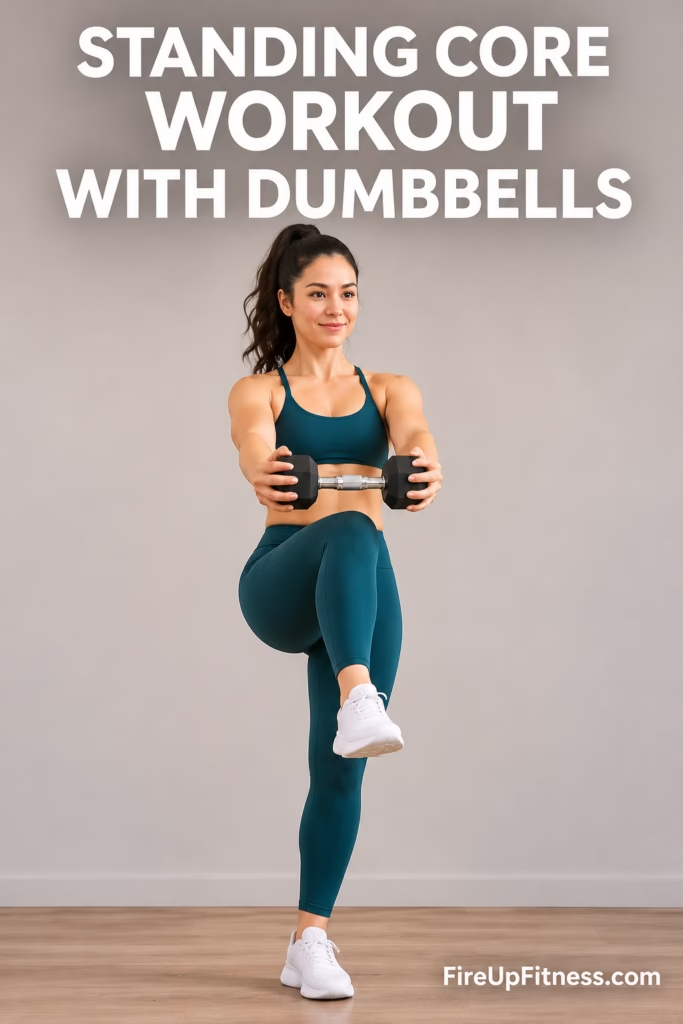
5. Single-Arm Dumbbell Knee Drive With Leg Extension
This exercise combines balance, coordination, and abdominal engagement.
Moving one leg backward and then forward challenges your ability to stabilize your body while controlling the dumbbell.
How to do it
- Stand with your right foot firmly planted.
- Hold one dumbbell in your right hand, with your arm raised overhead.
- Extend your left leg slightly behind you without arching your back.
- Bring your left knee forward and upward.
- Lower your right elbow toward the raised knee with a gentle torso rotation.
- Extend your arm upward again.
- Lower your leg and repeat.
Complete the movement on one side before switching to the other.
Keep the backward leg extension small. You don’t need to lift your leg high to challenge your balance.
Form tip: Focus on your standing leg and abdominal muscles to help maintain stability. Use a wall or sturdy chair for balance support when practicing without a dumbbell.
6. Opposite-Side Dumbbell Knee Drive
Now repeat the same movement on the other side.
This helps train both sides of your body while challenging coordination.
How to do it
- Plant your left foot firmly on the floor.
- Hold the dumbbell in your left hand and raise your arm overhead.
- Extend your right leg slightly behind you.
- Bring your right knee forward.
- Lower your left elbow toward the knee with a controlled twist.
- Return your arm overhead and lower your leg.
- Repeat while maintaining your balance.
Avoid rushing between the leg extension and knee drive.
Move slowly enough to feel your core working to keep you steady.
Repeat exercises 5 and 6 for a second round to complete the third superset.
7. Standing Dumbbell Wood Chops
The final superset features standing dumbbell wood chops.
This exercise combines diagonal arm movement with controlled torso rotation to challenge your obliques, abdominal muscles, and shoulders.
How to do it
- Stand with your feet slightly wider than hip-width apart.
- Hold one dumbbell securely with both hands.
- Shift your weight toward one leg and lower the dumbbell toward that side.
- Move the weight diagonally upward across your body.
- Allow a comfortable amount of rotation through your torso and hips.
- Slowly lower the dumbbell along the same diagonal path.
- Continue for 40 seconds before switching sides.
The lowering phase matters just as much as the lifting phase.
Rather than letting the dumbbell fall back down, use your muscles to control its movement.
Final superset timing
- Wood chops, first side: 40 seconds
- Wood chops, opposite side: 40 seconds
- Rest: 15 seconds
- Repeat both sides for one more round, starting with the side you just finished
Beginner modification: Perform the diagonal movement without a dumbbell. Focus on maintaining balance and controlling your torso throughout the exercise.
Follow Along With the Standing Core Workout Video
Ready to put these exercises together?
Follow the complete standing core workout in the video below. The instructor demonstrates each movement, explains proper alignment, and guides you through the supersets.
Following the video can help you maintain a steady pace while learning the transitions between exercises.
Remember that you can pause whenever necessary, use lighter weights, or perform the movements without dumbbells.
Tips to Get More From Your Standing Abs Workout
A few adjustments can make your standing core routine more comfortable and effective.
Keep your ribs aligned over your hips
When holding weights overhead, it’s easy to arch your lower back. Keep your rib cage stacked over your pelvis to help maintain a stable position.
Exhale during challenging movements
Breathe out as you lift your knee or move through the demanding part of an exercise. Avoid holding your breath unnecessarily.
Choose control over speed
Slower movements give you more time to maintain balance, coordinate your muscles, and notice changes in your posture.
Start with manageable weights
Heavier dumbbells aren’t automatically better for core training. Choose a weight that allows you to complete the movements without excessive leaning, swinging, or shoulder discomfort.
Give yourself enough recovery time
Standing core exercises can also fatigue your shoulders and legs. Allow time for recovery, especially when combining this routine with other strength workouts.
Stop or modify any movement that causes sharp pain, dizziness, or joint discomfort.
How Often Should You Do a Standing Core Workout?
You can include this standing dumbbell workout in your weekly fitness routine approximately two or three times, depending on your experience, recovery, and other activities.
Beginners may start with two sessions per week on nonconsecutive days.
As the movements become more comfortable, you can gradually increase the number of repetitions, improve your control, or use slightly heavier dumbbells when appropriate.
You can also combine standing core training with walking, lower-body strength exercises, and mobility work for a balanced fitness routine.
Frequently Asked Questions
Can standing core workouts strengthen your abs?
Yes. Standing exercises can strengthen your abdominal muscles when they provide enough resistance and require controlled stabilization. Dumbbell marches, knee drives, and wood chops challenge your core in different ways.
Are standing ab workouts good for beginners?
Many standing core exercises can be adapted for beginners. Starting without weights, reducing the range of motion, and using balance support can make the movements more manageable.
Can I do this workout without dumbbells?
Yes. You can practice the same movement patterns without weights, particularly when learning balance and coordination. Dumbbells provide additional resistance as your strength improves.
Does a standing core workout also strengthen your arms?
Yes. Overhead holds, halos, and wood chops engage the shoulders and arms. However, a complete upper-body strength routine should also include exercises that train additional muscle groups.
Do standing ab workouts help with belly fat?
Standing core exercises can strengthen your abdominal muscles, but they cannot selectively remove fat from one area. Overall fitness and body composition depend on several factors, including physical activity, nutrition, sleep, and individual physiology.
Final Thoughts
A stronger core isn’t built through endless crunches alone. It’s developed through consistent movement, good technique, and exercises that challenge your body to stay stable.
This standing core workout with dumbbells brings together abdominal strength, balance, and upper-body control in one convenient routine.
Start with a weight that feels manageable, follow the video at your own pace, and focus on how well you move rather than how many repetitions you complete.
Sometimes the most effective workout is the one that fits naturally into your day and keeps you coming back.
What’s your favorite way to train your core: standing exercises or traditional mat workouts?