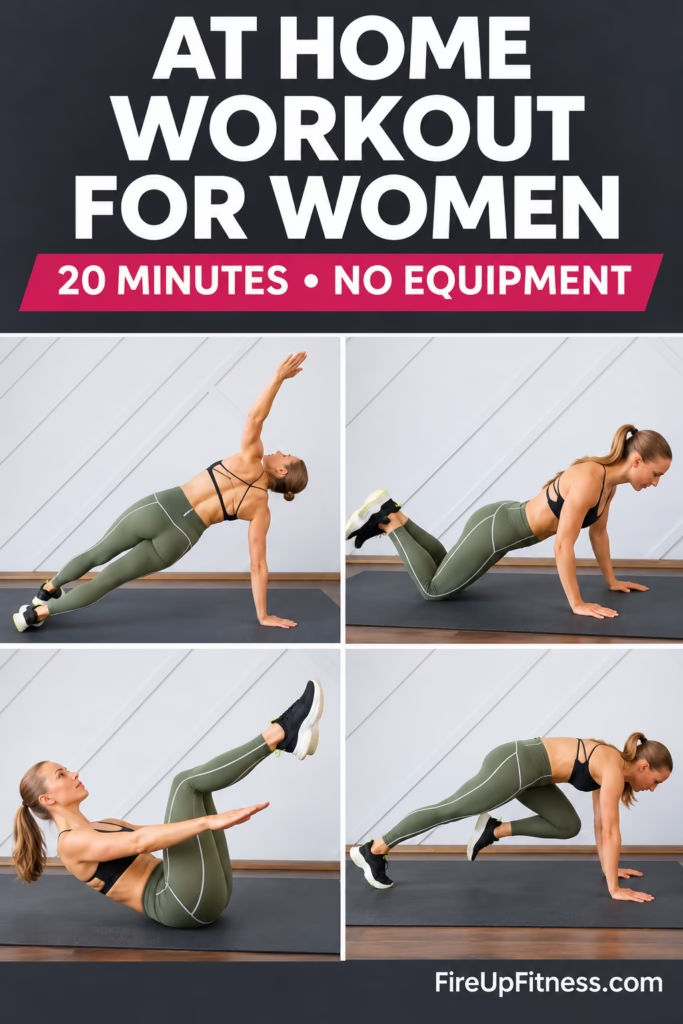
20-Minute Full Body Workout at Home – No Jumping
You don’t need a gym membership, heavy dumbbells, or an hour of free time to get a good workout. Sometimes, 20 minutes, a little floor space, and your own body weight are all you need to challenge your muscles and feel stronger.
This 20-minute full body workout at home is designed to work your legs, glutes, arms, shoulders, and core without jumping or using weights. It’s a practical option for apartment living, busy mornings, or those days when getting to the gym simply isn’t happening.
The routine combines squats, lunges, glute bridges, push-ups, and core exercises into a continuous workout. You’ll also practice balance, coordination, and controlled movement, which are important parts of everyday fitness.
One of the best things about this workout is that you don’t have to be an experienced exerciser to get started. Several movements can be adjusted to suit your strength and comfort level.
Grab your mat, clear a little space, and get ready for 20 minutes of purposeful movement.
Why This 20-Minute Full Body Workout Is Worth Trying

A full body workout doesn’t have to include dozens of exercises to be effective. What matters is choosing movements that challenge different muscle groups and performing them with good technique.
This routine brings together some of the best body weight exercises for developing strength, muscular endurance, and stability.
Here’s what makes it a useful addition to your home exercise routines:
- No jumping: The low-impact movements are suitable for many apartment and small-space workouts.
- No weights required: Your body provides the resistance, so there’s no need to purchase equipment.
- Full-body training: You’ll work your lower body, upper body, and abdominal muscles in one session.
- Balance and coordination: Single-leg exercises challenge your ability to stay stable while moving.
- Adjustable difficulty: You can shorten the intervals or modify individual exercises as needed.
- Time-efficient: The 20-minute format makes it easier to fit strength training into a busy schedule.
Unlike a workout that focuses entirely on one muscle group, this routine moves between different areas of the body. That variety helps make the session challenging without requiring complicated equipment or excessive space.
What to Know Before Starting
This is a follow-along bodyweight workout that uses supersets. A superset simply means performing two different exercises in sequence before repeating them or moving to another pair.
The workout includes five sections, each with two exercises.
Workout details
- Duration: 20 minutes
- Equipment: Exercise mat or comfortable floor surface
- Work interval: 45 seconds
- Rest interval: 15 seconds
- Total exercises: 10
- Structure: Five exercise pairs, with four intervals per pair
- Fitness level: Beginner-friendly with modifications, while still challenging for intermediate exercisers
- Main focus: Full-body strength, muscular endurance, balance, and core stability
The original workout video does not include a warm-up or cool-down. Before pressing play, spend three to five minutes doing gentle marching, arm circles, hip movements, and easy squats.
You can also finish with a few stretching exercises for flexibility to help your body transition from exercise to rest.
The warm-up and cool-down are additional to the 20-minute session.
20-Minute Full Body Workout at Home: 10 Effective Exercises
The exercises below follow the same sequence as the accompanying video, making it easy to read the instructions first and then follow along with the instructor.
Each movement is performed for 45 seconds, followed by 15 seconds of rest.
1. Narrow Squat to Regular Squat
Targets: Quadriceps, glutes, and inner thighs
Start by working your lower body with a squat variation that alternates between narrow and wider foot positions.
How to do it:
- Stand with your feet close together and your arms comfortably in front of you.
- Bend your knees and lower into a narrow squat.
- Push through your feet to stand.
- Step your feet apart into a regular squat stance.
- Lower into another squat, keeping your chest lifted.
- Stand and bring your feet together to repeat.
Make it effective: Keep your feet grounded and your knees aligned with your toes. Avoid pushing your hips excessively forward when standing up. Instead, finish the movement by straightening your legs and engaging your glutes.
You don’t have to squat extremely low. A comfortable depth with proper control is more useful than forcing a deeper position.
2. Plank Walkout With Knee Drives
Targets: Core, shoulders, arms, and hip flexors
This movement takes you from standing into a high plank, adding alternating knee drives to challenge your abdominal stability.
How to do it:
- Stand at the end of your exercise mat.
- Hinge forward, bending your knees as needed to reach the floor.
- Walk your hands forward until your body forms a high plank.
- Bring your right knee toward your chest and return it.
- Repeat with your left knee.
- Walk your hands back toward your feet and carefully stand up.
Make it effective: Keep your hips relatively level during the knee drives. Think about tightening your abdominal muscles rather than allowing your lower back to sag.
For an easier variation, perform the walkout without the knee drives or place your hands on a sturdy elevated surface.
Repeat exercises 1 and 2 once more before moving on.
Strengthen Your Legs and Glutes With Single-Leg Exercises
The next two movements shift the focus toward balance and lower-body strength.
Working one leg at a time can help you notice differences in coordination and strength between sides. These exercises also challenge your core as it works to keep your body stable.
3. Reverse Lunge With Knee Drive
Targets: Glutes, quadriceps, hamstrings, and core
The reverse lunge strengthens your lower body, while the knee drive adds a balance challenge.
How to do it:
- Stand tall with your feet hip-width apart.
- Step your left leg backward into a reverse lunge, keeping your right foot planted.
- Lower until both knees are comfortably bent.
- Press through your right foot to stand.
- Bring your left knee forward and upward.
- Pause briefly before stepping back into the next lunge.
Make it effective: Focus on pressing through your supporting foot and engaging your glutes as you rise.
The instructor demonstrates a powerful knee drive, but beginners can move slowly. You can also hold a wall or sturdy chair for additional balance.
4. Single-Leg Romanian Deadlift
Targets: Hamstrings, glutes, and core stabilizers
The single-leg Romanian deadlift is a hip-hinge exercise that trains your posterior chain, particularly the muscles along the backs of your legs.
How to do it:
- Stand on your right leg with a slight bend in your knee.
- Keep your spine neutral and begin hinging forward from your hips.
- Extend your left leg behind you as your torso leans forward.
- Lower only as far as you can while maintaining control.
- Engage your right glute to return to standing.
Make it effective: Think about moving your hips backward rather than reaching your hands toward the floor.
You should feel the movement primarily through your supporting glute and hamstring.
Beginner option: Keep your back toes lightly on the floor for support. This allows you to practice the hip hinge without worrying as much about balance.
Complete the reverse lunge and single-leg deadlift with your right leg supporting, then repeat both exercises with your left leg supporting.
Build Stronger Glutes With Floor Exercises
After the standing exercises, you’ll move onto your mat for two glute-focused movements.
These exercises are especially useful for training hip extension, which plays an important role in activities such as walking, climbing stairs, and standing up from a seated position.
5. Glute Bridge With Pulse
Targets: Glutes, hamstrings, and core
This variation adds a small pulse at the top of a traditional glute bridge, increasing the time your glutes spend working.
How to do it:
- Lie on your back with your knees bent and feet flat on the mat.
- Keep your feet approximately hip-width apart.
- Gently tilt your pelvis backward and engage your abdominal muscles.
- Press through your heels to lift your hips.
- Lower your hips halfway.
- Lift again, squeezing your glutes at the top.
- Lower completely and repeat.
Make it effective: The goal isn’t to lift your hips as high as possible by arching your back. Instead, focus on using your glutes to raise your pelvis while maintaining control.
Move slowly enough to feel the muscles working throughout the exercise.
6. Reverse Bridge March
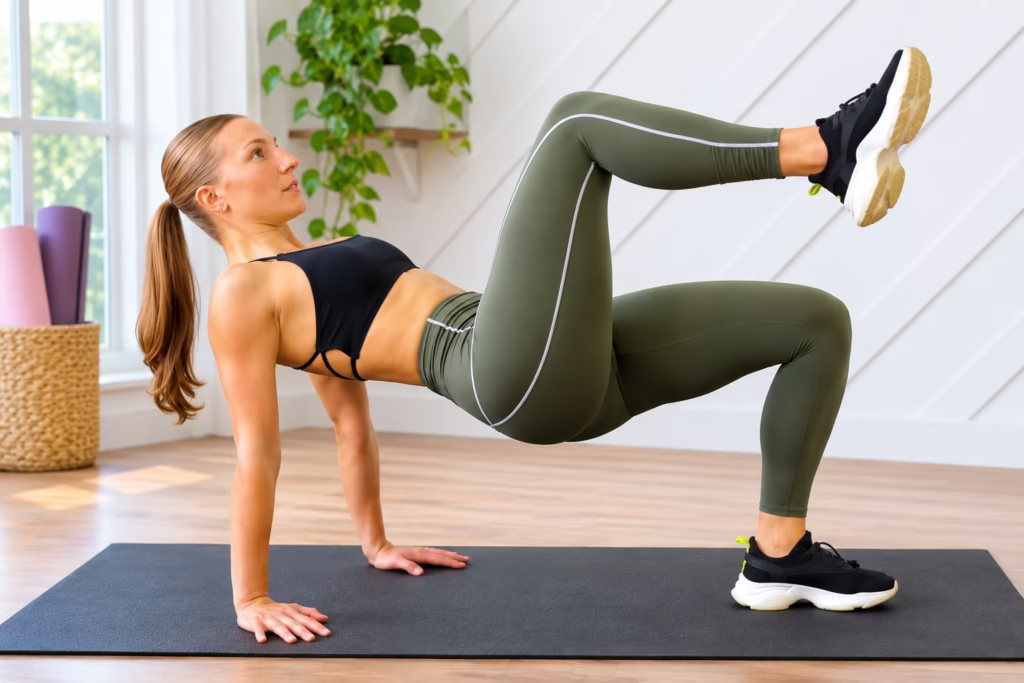
Targets: Glutes, hamstrings, shoulders, and core
This exercise builds on a reverse bridge by adding alternating knee lifts.
How to do it:
- Sit on your mat with your knees bent and feet flat.
- Place your hands behind you in a comfortable position.
- Press through your hands and feet to lift your hips.
- Keep your hips elevated while lifting your right knee.
- Lower your right foot and lift your left knee.
- Continue alternating without allowing your hips to drop excessively.
Make it effective: Take your time. The challenge comes from maintaining a stable bridge while shifting your weight.
Keep your shoulders supported and avoid forcing your wrists into an uncomfortable position.
For a simpler variation, hold the reverse bridge without marching or perform a regular glute bridge march on your back.
Repeat exercises 5 and 6 for a second round.
Upper-Body Workout Moves Without Weights
Now that your legs and glutes have done plenty of work, the routine shifts toward your chest, shoulders, arms, and core.
These exercises demonstrate why bodyweight training can be effective even without dumbbells.
7. Push-Ups
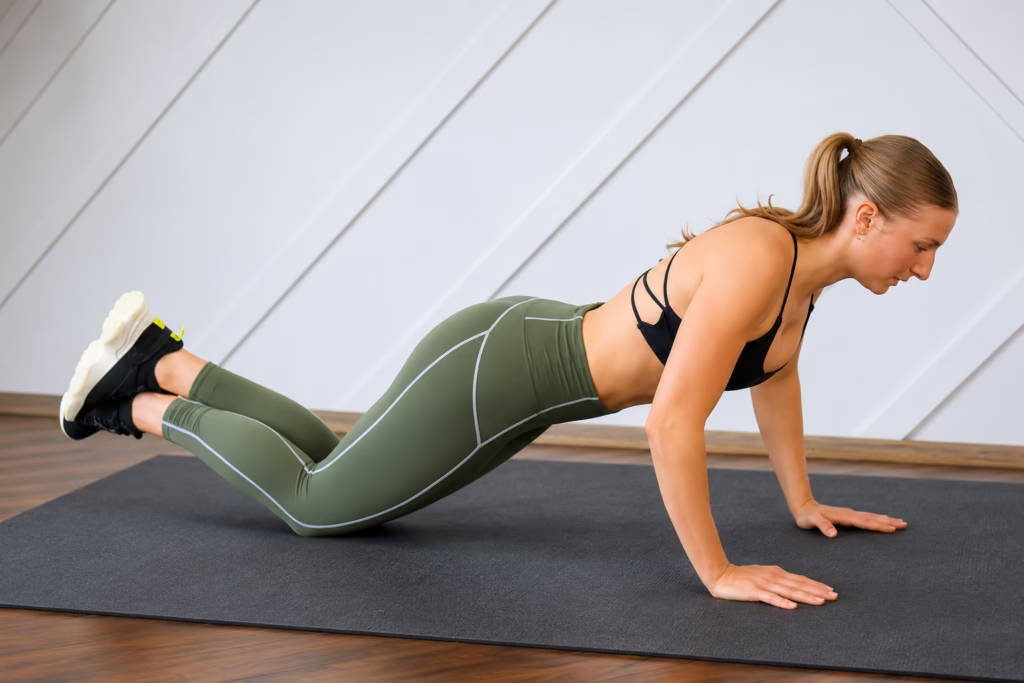
Targets: Chest, triceps, shoulders, and core
Push-ups are among the most useful bodyweight exercises for developing upper-body strength.
How to do it:
- Begin in a high plank with your hands slightly wider than shoulder-width apart.
- Keep your abdominal muscles engaged and your body aligned.
- Bend your elbows to lower your chest toward the mat.
- Keep your elbows angled backward rather than pointing directly outward.
- Press through your palms to return to the starting position.
Make it effective: Maintain a controlled pace and avoid letting your hips sag.
You can modify the exercise by lowering to the floor, briefly releasing your hands, and pressing back up. Knee push-ups or incline push-ups against a sturdy surface are also good options.
Quality matters more than the number of repetitions.
8. Plank Shoulder Taps With Side Plank Rotation
Targets: Core, shoulders, arms, and obliques
This movement combines shoulder taps with alternating side plank rotations to challenge your ability to stabilize your torso.
How to do it:
- Start in a high plank with your hands under your shoulders.
- Tap your left shoulder with your right hand.
- Return your right hand to the mat.
- Tap your right shoulder with your left hand.
- Rotate your torso to the right, opening into a side plank.
- Return to the high plank.
- Rotate to the left and continue the sequence.
Make it effective: Keep your hips as steady as possible during the shoulder taps.
Widening your feet can provide a more stable base. You can also practice shoulder taps separately before adding the rotations.
Repeat exercises 7 and 8 once more.
Finish With Two Core-Strengthening Exercises
The final section focuses on your abdominal muscles.
Both movements require your core to control your torso and pelvis, particularly as your legs move away from your body.
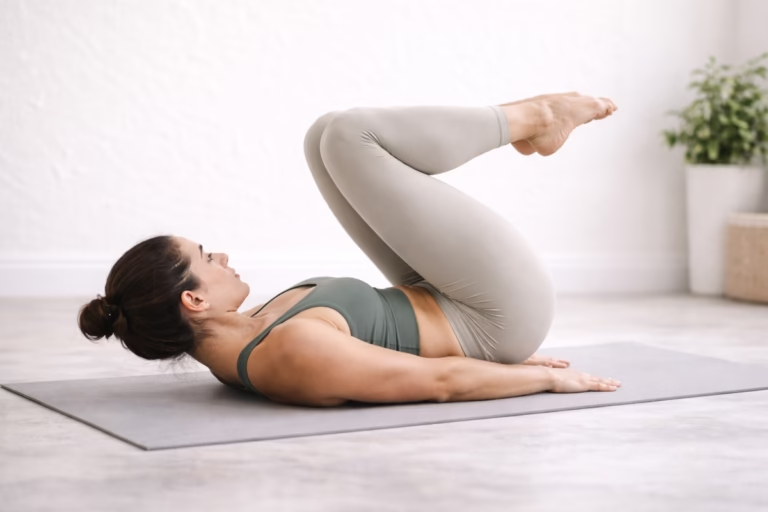
9. Tabletop Crunch With Under-Knee Tap
Targets: Rectus abdominis and core stabilizers
This crunch variation adds an arm reach beneath your knees while keeping your legs in a tabletop position.
How to do it:
- Lie on your back and lift your legs into tabletop, with your knees bent at approximately 90 degrees.
- Extend your arms toward the ceiling.
- Engage your abdominal muscles.
- Lift your shoulder blades slightly off the mat.
- Reach your hands underneath your knees.
- Lower with control and repeat.
Make it effective: Keep your neck relaxed and avoid pulling your chin toward your chest.
The movement should come from your abdominal muscles rather than momentum.
For a gentler version, keep your feet on the floor while performing a small crunch.
10. Tabletop Leg Extension With Open-Close
Targets: Abdominal muscles and hip flexors
The last exercise challenges your core to maintain pelvic stability while your legs extend, open, and close.
How to do it:
- Sit in a reclined position, supporting your upper body on your forearms.
- Lift your knees into a bent tabletop position.
- Keep your chest open and gently engage your abdominal muscles.
- Extend both legs forward.
- Open your legs slightly, then bring them together.
- Bend your knees and return to tabletop.
Make it effective: Avoid allowing your lower back to arch excessively as your legs extend.
For an easier variation, extend your legs higher rather than closer to the floor. You can also skip the open-close movement and perform simple knee extensions.
Repeat exercises 9 and 10 for your final round.
You’ve completed the full 20-minute workout.
Follow Along With the 20-Minute Full Body Workout Video
The accompanying video demonstrates all 10 exercises in the correct sequence, including the 45-second work intervals and 15-second recovery periods.
Following the instructor makes it easier to maintain the routine’s pace while concentrating on your movements.
The workout begins with standing lower-body exercises, progresses through glute and upper-body movements, and finishes with abdominal training.
Remember to warm up before starting and allow a few minutes for gentle stretching afterward.
Quick Reference: Your 20-Minute Workout Plan
| Exercise | Work | Rest |
|---|---|---|
| Narrow squat to regular squat | 45 sec | 15 sec |
| Plank walkout with knee drives | 45 sec | 15 sec |
| Repeat both exercises | 2 intervals | 15 sec after each |
| Reverse lunge with knee drive, right leg supporting | 45 sec | 15 sec |
| Single-leg Romanian deadlift, right leg supporting | 45 sec | 15 sec |
| Reverse lunge with knee drive, left leg supporting | 45 sec | 15 sec |
| Single-leg Romanian deadlift, left leg supporting | 45 sec | 15 sec |
| Glute bridge with pulse | 45 sec | 15 sec |
| Reverse bridge march | 45 sec | 15 sec |
| Repeat both exercises | 2 intervals | 15 sec after each |
| Push-ups | 45 sec | 15 sec |
| Plank shoulder taps with rotation | 45 sec | 15 sec |
| Repeat both exercises | 2 intervals | 15 sec after each |
| Tabletop crunch with under-knee tap | 45 sec | 15 sec |
| Tabletop leg extension with open-close | 45 sec | 15 sec |
| Repeat both exercises | 2 intervals | 15 sec after each |
The 20 exercise intervals, including their rest periods, total 20 minutes.
Make Your Workout More Effective With These Simple Tips
You don’t need to add more exercises to make this routine worthwhile. A few small adjustments can help you get more from the movements already included.
Focus on controlled repetitions
It’s tempting to move quickly when you’re working against a timer. However, rushing can make it harder to maintain proper alignment.
Use a pace that allows you to control both the lifting and lowering portions of each exercise.
Keep your core engaged
Your abdominal muscles play a role in almost every movement in this workout, not just the final two exercises.
During squats, lunges, planks, and bridges, maintain gentle abdominal tension while continuing to breathe naturally.
Choose the right modifications
An exercise should challenge your muscles without forcing you into an uncomfortable position.
Use supported single-leg movements, modified push-ups, or shorter plank intervals when needed.
As your strength improves, you can gradually work toward more demanding variations.
Pay attention to recovery
Muscle recovery is an important part of improving strength and endurance.
Avoid pushing the same muscles through challenging workouts every day, especially when you’re just starting.
Consistency over several weeks matters more than making one workout unnecessarily difficult.
Stretching Exercises for Flexibility After Your Workout
After completing the final core exercise, give your muscles a few minutes to relax.
Adding stretches for flexibility to your cool-down can help maintain comfortable joint movement and provide a gentle transition out of your workout.
Try these four stretches.
Standing Quadriceps Stretch
Stand tall and gently bring one heel toward your glutes while holding your ankle. Keep your knees close together and avoid arching your lower back.
Hold for 20–30 seconds per side.
Seated Hamstring Stretch
Sit on your mat with one leg extended. Bend your opposite knee and hinge forward from your hips until you feel a comfortable stretch along the back of your extended leg.
Hold for 20–30 seconds per side.
Child’s Pose
Kneel on your mat and gently lower your hips toward your heels. Reach your arms forward and allow your back to lengthen comfortably.
Hold for approximately 30 seconds while breathing slowly.
Standing Chest Stretch
Stand upright and gently draw your shoulders back. If comfortable, clasp your hands behind your body and lift them slightly without forcing the movement.
Hold for 20–30 seconds.
These simple stretches complement the strength-focused workout. For greater flexibility improvements, consider including dedicated mobility and stretching sessions throughout the week.
How to Fit This Workout Into Your Weekly Routine
One of the biggest advantages of at home workouts for women is the flexibility to exercise around your daily responsibilities.
You can complete this workout in the morning, during an afternoon break, or whenever you have enough energy and time to move comfortably.
For most beginners, two full-body strength sessions per week are a reasonable starting point.
Here’s an example of how to organize your week:
| Day | Activity |
|---|---|
| Monday | 20-minute full body workout |
| Tuesday | 20–30-minute walk |
| Wednesday | Gentle yoga or flexibility stretches |
| Thursday | 20-minute full body workout |
| Friday | Walking or light mobility |
| Saturday | Optional low-impact cardio |
| Sunday | Rest or easy movement |
You can gradually add another strength session as your fitness improves, provided you’re recovering well.
The goal is to create a routine you can maintain rather than trying to do everything at once.
Can a 20-Minute Bodyweight Workout Really Build Strength?
Yes. Bodyweight training can improve muscular strength and endurance, particularly for people who are new to resistance exercise.
Squats, lunges, push-ups, and glute bridges require your muscles to produce force against resistance. With consistent practice, your body can adapt to those demands.
The key is progressive overload, which means gradually increasing the challenge as your strength develops.
With home workouts, that might involve:
- Performing more controlled repetitions within the same interval.
- Using a greater comfortable range of motion.
- Choosing a more challenging exercise variation.
- Improving balance during single-leg movements.
- Slowing the lowering phase to increase muscular effort.
You don’t have to increase every element at once. Small improvements over time can make a meaningful difference.
As you become more advanced, some muscle groups may eventually benefit from added resistance.
Frequently Asked Questions
Is this workout suitable for beginners?
Yes, with modifications. Beginners can use shorter work intervals, supported lunges, incline push-ups, and simpler plank variations.
You can also begin with one round of each exercise pair and gradually build toward the complete workout.
Can I do this full body workout every day?
Because the routine challenges several major muscle groups, doing it at high intensity every day may not allow enough recovery.
Two or three sessions per week, separated by recovery time, is a more practical approach for many people.
On other days, consider walking, stretching, or gentle yoga.
Will this workout strengthen my abs?
Yes. Plank walkouts, shoulder taps, tabletop crunches, and leg extensions all challenge your abdominal muscles.
Your core also contributes to stability during squats, lunges, and single-leg deadlifts.
Is this a good workout for small spaces?
Yes. The exercises require only enough space for a mat and comfortable movement. There is no jumping, running, or need for large exercise equipment.
Do I need dumbbells for a full body workout?
No. Bodyweight exercises can provide an effective strength-training stimulus, particularly for beginners and intermediate exercisers.
Dumbbells can be useful later when you need additional resistance, but they’re not required to get started.
Is this workout better than walking?
Both activities offer benefits, but they serve somewhat different purposes.
Walking is a convenient form of aerobic activity, while this workout emphasizes muscular strength, endurance, and stability.
Including both in your weekly routine can support a more balanced approach to fitness.
How long will it take to notice improvements?
Some people notice better coordination and exercise confidence within a few sessions. Changes in muscular strength and endurance generally develop over several weeks of consistent training.
Progress varies depending on your starting fitness level, recovery, nutrition, and training frequency.
Final Thoughts: A Stronger Body Starts With Consistent Movement
Finding time for exercise isn’t always easy, but a workout doesn’t have to take over your schedule to be worthwhile.
This 20-minute full body workout at home brings together 10 effective bodyweight exercises that challenge your legs, glutes, arms, shoulders, and core without jumping or equipment.
It also gives you an opportunity to practice balance, strengthen important movement patterns, and build confidence with exercises you can repeat as you improve.
Some days you’ll complete every interval comfortably. Other days you may need shorter sets or easier variations. Both can be part of a consistent fitness routine.
Save this workout for the next time you want a simple, effective way to move your body at home. With regular practice, those 20-minute sessions can become a lasting part of your weekly routine.