6 Anti-Rotation Core Exercises for Women at Home
A strong core does more than help you perform crunches or hold a plank. It also keeps your body steady when you reach for something, carry groceries, walk on uneven ground, or lift an object with one hand.
Think about carrying a heavy shopping bag on one side. Your body naturally wants to lean toward the weight, but your core muscles work to keep you upright. That ability to resist unwanted movement is an important part of everyday strength.
This is where anti-rotation core exercises come in.
Unlike traditional ab workouts that involve twisting or bending your torso, anti-rotation exercises challenge your abdominal muscles to keep your spine and pelvis stable while your arms or legs move.
The best part? You can practice several of these movements at home without complicated equipment.
This six-exercise routine is designed to help women develop better core stability, improve balance, and strengthen the muscles that support everyday movement.
What Are Anti-Rotation Core Exercises?
Anti-rotation exercises train your core to resist twisting forces rather than actively rotating your torso.
For example, when you extend one arm during a bird dog, your body naturally wants to shift or rotate. Your abdominal muscles, obliques, and back stabilizers work together to keep your hips and shoulders level.
That resistance is what makes the exercise effective.
Anti-rotation training primarily challenges several muscle groups:
- Transverse abdominis: A deep abdominal muscle that helps stabilize your trunk.
- Internal and external obliques: Muscles along the sides of your abdomen that help control rotation.
- Rectus abdominis: The front abdominal muscles that contribute to trunk stability.
- Multifidus and other spinal stabilizers: Muscles that help control movement around your spine.
- Glutes: Muscles that support hip and pelvic stability.
These muscles work together during many everyday activities.
Anti-rotation training is especially useful because it teaches your body to maintain control when movement or resistance challenges your balance.
Benefits of Anti-Rotation Core Training
Adding anti-rotation movements to your regular core strengthening exercises can help develop several important physical abilities.
1. Better Core Stability
Anti-rotation exercises challenge your abdominal muscles to maintain a steady torso while your limbs move or an external force tries to rotate your body.
2. Improved Balance and Coordination
Many of these movements involve shifting your weight or moving one arm or leg at a time. This encourages your core and supporting muscles to work together.
3. Stronger Deep Core Muscles
Exercises such as the Pallof press and bird dog challenge the deeper abdominal muscles responsible for controlling trunk movement.
4. Better Control During Everyday Activities
Carrying bags, lifting objects, and reaching across your body all require some degree of trunk stability.
Practicing controlled resistance exercises can help strengthen the muscles involved in these activities.
5. A More Balanced Core Workout
Traditional abdominal exercises often emphasize bending the spine. Anti-rotation movements add a different challenge, making them a useful complement to planks, crunches, and other core exercises.
How to Do This Anti-Rotation Core Workout at Home
This routine includes six movements that focus on resisting unwanted twisting or leaning.
Workout details:
- Duration: Approximately 15 minutes
- Exercises: 6
- Work interval: 40 seconds
- Rest interval: 20 seconds
- Rounds: 2
- Equipment: Exercise mat, resistance band, and one light dumbbell or water bottle
- Fitness level: Beginner to intermediate
Rest for one minute between rounds. Allow a few extra minutes for warming up and changing positions.
Choose a resistance level that allows you to keep your torso steady. If your body twists or leans excessively, reduce the resistance or use an easier variation.
6 Anti-Rotation Core Exercises for Women
1. Pallof Press
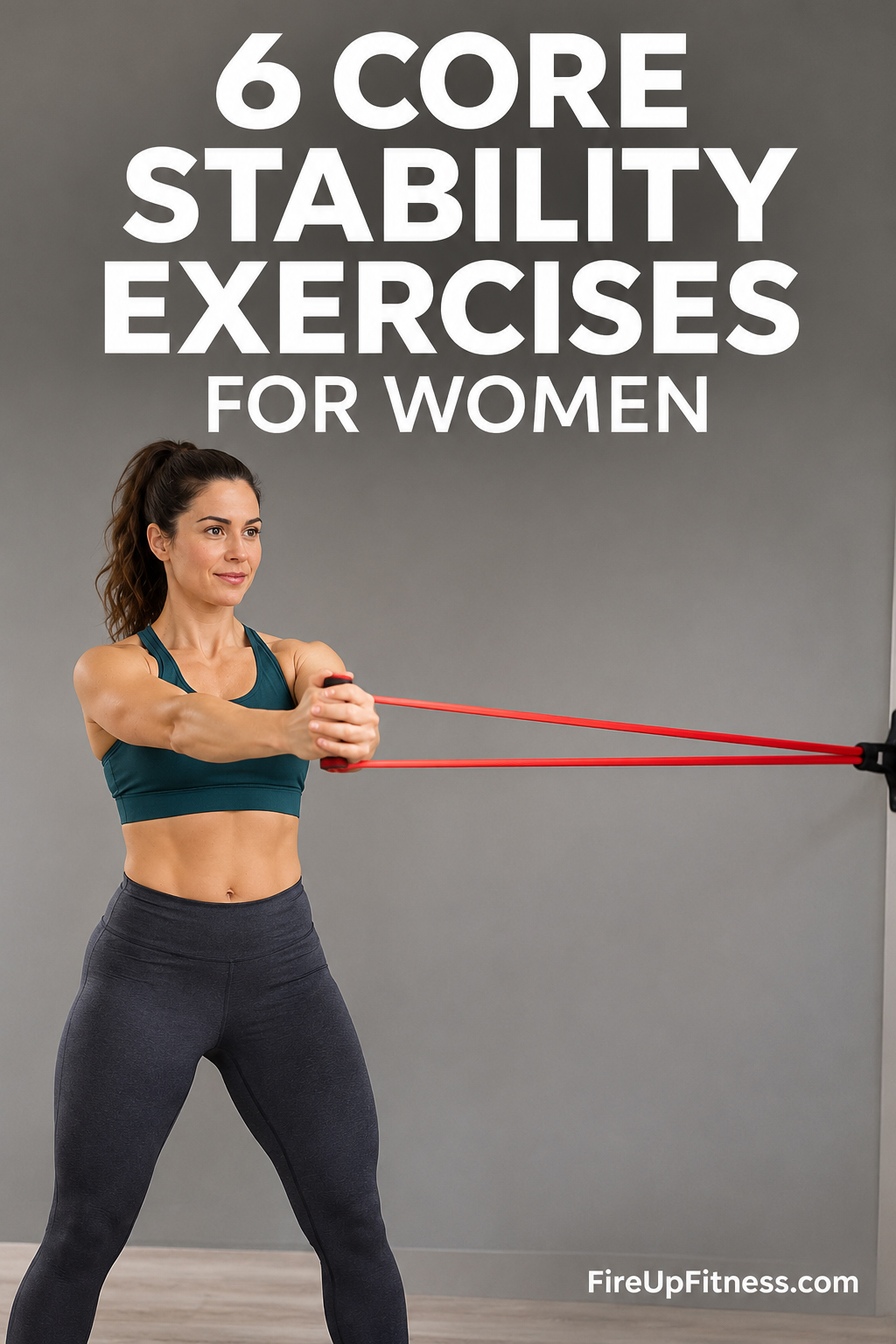
The Pallof press is one of the most recognizable anti-rotation exercises because it directly challenges your core to resist a sideways pulling force.
You will need a resistance band secured to a sturdy anchor at approximately chest height.
How to do it:
- Stand sideways to the band’s anchor point with your feet shoulder-width apart.
- Hold the band with both hands at the center of your chest.
- Step away from the anchor until you feel gentle tension.
- Tighten your abdominal muscles and keep your shoulders and hips facing forward.
- Slowly press your hands straight out in front of your chest.
- Pause briefly without allowing your torso to rotate toward the anchor.
- Bring your hands back to your chest.
Perform for 20 seconds, then turn around and repeat on the opposite side.
Beginner modification: Stand closer to the anchor to reduce the resistance.
Form tip: Keep your ribs positioned over your pelvis and avoid twisting your shoulders as you press.
2. Bird Dog with Pause
The bird dog is a useful bodyweight movement for developing core control.
Adding a short pause makes it more challenging because your abdominal muscles must maintain stability while your arm and leg remain extended.
How to do it:
- Begin on your hands and knees with your wrists beneath your shoulders.
- Position your knees directly below your hips.
- Gently engage your abdominal muscles.
- Extend your right arm forward and your left leg backward.
- Hold for three seconds while keeping your hips level.
- Return to the starting position.
- Repeat with your left arm and right leg.
Continue alternating for 40 seconds.
Beginner modification: Extend only one leg at a time while keeping both hands on the floor.
Form tip: Avoid lifting your leg higher than your hips. The goal is to maintain a steady torso rather than achieve maximum height.
3. Single-Arm Farmer Carry
A single-arm farmer carry, sometimes called a suitcase carry, challenges your core to resist leaning toward the side holding the weight.
This exercise is particularly relevant to everyday activities such as carrying groceries or a suitcase.
How to do it:
- Stand upright while holding one dumbbell or a filled water bottle in your right hand.
- Keep your shoulders level and your feet approximately hip-width apart.
- Gently tighten your abdominal muscles.
- Walk forward slowly while keeping your torso upright.
- Avoid leaning toward or away from the weight.
- After 20 seconds, switch the weight to your left hand.
Continue for another 20 seconds.
Beginner modification: Use a lighter weight or march slowly in place.
Form tip: Keep your shoulders relaxed and avoid shrugging the shoulder holding the weight.
4. High Plank Shoulder Taps
High plank shoulder taps challenge your core to resist rotation while you briefly support your upper body with one hand.
They also strengthen your shoulders and improve coordination.
How to do it:
- Begin in a high plank with your hands beneath your shoulders.
- Position your feet slightly wider than hip-width for stability.
- Engage your abdominal muscles and glutes.
- Slowly lift your right hand and tap your left shoulder.
- Return your hand to the floor.
- Repeat with your left hand, tapping your right shoulder.
- Continue alternating sides.
Perform for 40 seconds.
Beginner modification: Place your hands on a sturdy countertop or wall to reduce the difficulty.
Form tip: Keep your hips as level as possible. Avoid rocking from side to side each time you lift a hand.
5. Half-Kneeling Pallof Press Hold
The half-kneeling Pallof press changes your base of support, creating a different stability challenge.
This variation requires you to maintain an upright posture while resisting the sideways pull of a resistance band.
How to do it:
- Secure a resistance band to a sturdy anchor at approximately chest height for your kneeling position.
- Kneel sideways to the anchor with one knee on the mat and the opposite foot planted in front.
- Hold the band at the center of your chest.
- Gently tighten your abdominal muscles.
- Press your hands forward and hold for three to five seconds.
- Keep your shoulders and hips facing forward.
- Return your hands to your chest and repeat.
Work for 20 seconds on each side, repositioning your stance as needed.
Beginner modification: Reduce the band’s tension and shorten the hold.
Form tip: Avoid arching your lower back or leaning toward the band.
6. Dead Bug with Single-Arm Weight Hold
This dead bug variation adds an asymmetrical load to challenge your core stability.
Holding a light weight in one hand encourages your trunk muscles to resist shifting as your opposite leg moves.
How to do it:
- Lie on your back with your knees bent at 90 degrees above your hips.
- Hold a light dumbbell in your right hand, extending that arm toward the ceiling.
- Keep your left arm resting comfortably beside your body.
- Engage your abdominal muscles.
- Slowly lower your left heel toward the floor while keeping your torso steady.
- Return your leg to the starting position.
- Repeat the movement without allowing your pelvis to tilt or rotate.
Perform for 20 seconds, then switch the weight to your left hand and move your right leg.
Beginner modification: Perform the exercise without a weight.
Form tip: Keep the weight directly above your shoulder and use a range of motion that allows you to maintain control.
15-Minute Anti-Rotation Core Workout Plan
Follow the exercises in the order below. Complete two rounds, resting for one minute between rounds.
| Exercise | Duration |
|---|---|
| Pallof Press | 20 seconds per side |
| Bird Dog with Pause | 40 seconds |
| Single-Arm Farmer Carry | 20 seconds per side |
| High Plank Shoulder Taps | 40 seconds |
| Half-Kneeling Pallof Press Hold | 20 seconds per side |
| Dead Bug with Single-Arm Weight Hold | 20 seconds per side |
Rest for 20 seconds after each exercise.
The two rounds, including rest periods and transitions, take approximately 15 minutes.
How to Make Anti-Rotation Exercises More Effective
The goal of anti-rotation training isn’t to complete as many repetitions as possible. Instead, you want to develop better control over how your torso responds to movement and resistance.
Start with Light Resistance
When using a resistance band or dumbbell, choose a level that allows you to maintain proper alignment.
Heavy resistance can cause you to compensate by twisting your shoulders, leaning sideways, or arching your back.
Keep Your Hips and Shoulders Steady
Imagine your shoulders and hips forming a rectangle. During each exercise, try to keep that rectangle from twisting unnecessarily.
Small movements are normal, but excessive rotation usually indicates that the exercise is too challenging.
Breathe Throughout the Movement
Avoid holding your breath while resisting the band or balancing on one hand.
Breathe steadily, exhaling during the more challenging part of each movement when practical.
Progress Gradually
Once you can complete the exercises with good control, increase the challenge by adding a slightly stronger resistance band, extending the duration of a hold, or slowing down each repetition.
Increase only one variable at a time.
How Often Should You Do Anti-Rotation Core Workouts?
For beginners, two or three sessions per week can be a practical starting point.
You can incorporate this routine into your existing strength training schedule or perform it as a separate short workout.
For example:
| Day | Workout |
|---|---|
| Monday | Anti-rotation core workout |
| Tuesday | Walking or lower-body training |
| Wednesday | Gentle Pilates or mobility |
| Thursday | Anti-rotation core workout |
| Friday | Upper-body strength training |
| Saturday | Walking or full-body movement |
| Sunday | Rest |
Allow your muscles adequate recovery between challenging sessions, particularly when you are new to resistance training.
Common Mistakes to Avoid
Using too much resistance: A heavier band or dumbbell isn’t necessarily better. Choose resistance that allows you to maintain control.
Rushing through repetitions: Anti-rotation exercises are most useful when you move deliberately and resist unwanted motion.
Leaning to compensate: During suitcase carries and Pallof presses, avoid shifting your torso to make the movement easier.
Forgetting to engage your glutes: Your glutes help stabilize your pelvis, especially during standing and kneeling exercises.
Ignoring discomfort: Stop if you experience sharp pain, dizziness, or unusual pelvic pressure. Women who are pregnant, recently postpartum, or experiencing pelvic floor symptoms may benefit from guidance from a qualified healthcare professional.
Frequently Asked Questions
Are anti-rotation exercises good for beginners?
Yes. Many anti-rotation movements can be adapted for beginners by reducing resistance, shortening the working interval, or using a more stable position.
Do anti-rotation exercises strengthen your abs?
Yes. They challenge your abdominal muscles, particularly the obliques and deeper trunk stabilizers, to resist unwanted movement.
Can I do anti-rotation core exercises without equipment?
Yes. Bird dogs and high plank shoulder taps require no equipment. However, exercises such as the Pallof press require a resistance band or cable to create a rotational force.
Are anti-rotation exercises better than crunches?
They serve different purposes. Crunches primarily train trunk flexion, while anti-rotation exercises emphasize resisting twisting forces. Including both types of movement can help create a more balanced core training routine.
Can anti-rotation exercises improve posture?
They can strengthen muscles involved in maintaining trunk stability. However, posture is influenced by many factors, including movement habits, mobility, muscular endurance, and individual anatomy.
Final Thoughts
A stronger core isn’t just about how your abdominal muscles look. It’s about how effectively those muscles support your body when you move.
These six anti-rotation core exercises for women offer a practical way to develop stability, coordination, and strength without relying entirely on traditional ab exercises.
Start with light resistance, concentrate on controlled movements, and gradually increase the challenge as your confidence grows.
With consistent practice, you can build a more stable foundation for your workouts and everyday activities.