10-Minute Pilates Core Workout at Home for Stronger Abs
Ten minutes might not sound like much, but when you’re moving slowly, controlling every repetition, and keeping your abdominal muscles engaged, those minutes can feel surprisingly challenging.
That’s what makes Pilates so effective for core training.
You don’t need a reformer, heavy weights, or a complicated workout plan. A mat and a little floor space are enough to get started.
This 10-minute Pilates core workout combines toe taps, leg stretches, gentle twists, and controlled abdominal curls to work your abs from different angles. Each movement flows into the next, helping you build strength, stability, and better body awareness without rushing through repetitions.
It’s a convenient option for women who want to strengthen their core at home, especially on days when a longer workout doesn’t fit into their schedule.
The routine is short, but some exercises are challenging. Move at your own pace, make adjustments when needed, and remember that good technique matters more than how many repetitions you complete.
Why Pilates Is Worth Adding to Your Core Routine
There’s a difference between simply moving your legs during an ab workout and learning how to keep your torso stable while those legs move.
Pilates places particular attention on that control.
Your core includes more than the abdominal muscles you see in the mirror. It also involves deeper muscles that help support your spine, stabilize your pelvis, and coordinate movement between your upper and lower body.
A regular Pilates abs workout can help you:
- Strengthen your abdominal muscles and obliques.
- Improve core stability during everyday activities.
- Develop better coordination and balance.
- Build muscular endurance through controlled repetitions.
- Become more aware of your posture and alignment.
One of the biggest advantages of mat Pilates is how easily you can adjust the difficulty. A small movement with bent knees can be an excellent starting point, while extending both legs creates a greater challenge.
And because this routine requires no equipment, it’s easy to return to throughout the week.
Follow Along: 10-Minute Pilates Core Workout
Ready to give this routine a try? Follow along with the 10-minute Pilates core workout below. You’ll move through 12 mat exercises designed to challenge your abs, improve stability, and build better body control.
Grab your mat, find a comfortable space, and move at your own pace. Pause the video whenever you need a break or want to adjust an exercise.
Prefer written instructions? Scroll down for all 12 Pilates core exercises, including beginner-friendly modifications and form tips.
Your 10-Minute Pilates Core Workout: 12 Exercises
All 12 exercises come from the original Pilates mat routine. You’ll begin with toe taps, progress into leg stretches and twisting movements, and finish with more demanding abdominal exercises.
The workout is divided into three sections, with brief recovery breaks between them.
Before starting, lie on your back, relax your shoulders, and take a few comfortable breaths. As you move, gently engage your abdominal muscles without holding your breath or forcing your lower back flat against the mat.
Part 1: Wake Up Your Core With Controlled Toe Taps
The first four exercises introduce abdominal curls, alternating leg movements, and rotation. They’re a useful way to establish control before moving into the more demanding part of the workout.
1. Single-Leg Toe Taps
Start on your back with both knees bent toward your chest. Place your hands behind your head, keeping your elbows comfortably open.
Lift your head and shoulders slightly from the mat and gently engage your abdominal muscles.
How to do it:
- Keep both knees bent as you lower one foot toward the floor.
- Lightly tap your toes against the mat.
- Bring your knee back above your hips.
- Repeat with the opposite leg, alternating slowly.
Try to keep your upper body steady instead of rocking from side to side.
Suggested repetitions: 8–12 alternating taps.
Make it easier: Keep your head resting on the mat and focus on controlling your legs.
2. Double-Leg Toe Taps
Now you’ll move both legs together, making your abdominal muscles work harder to stabilize your pelvis.
Begin in the same position, with your hands behind your head and your shoulders slightly lifted.
Slowly lower both feet toward the mat, lengthening your legs as you move. Then draw your knees back toward your chest.
Keep the movement small enough that you can control your lower back without excessive arching.
Suggested repetitions: 6–10.
Make it easier: Keep both knees bent throughout the movement rather than extending your legs.
3. Twisting Toe Taps
Adding rotation brings your oblique muscles into the workout.
Return to your starting position with both knees lifted and your hands supporting your head.
As you lower one foot toward the floor, rotate your upper body to bring your opposite elbow toward the knee that stays lifted.
Return to the center and repeat on the other side.
Move slowly enough to feel your rib cage rotating rather than simply moving your elbows.
Suggested repetitions: 8–12 alternating twists.
Form reminder: Your elbow doesn’t have to touch your knee. Keep your neck relaxed and focus on a comfortable rotation.
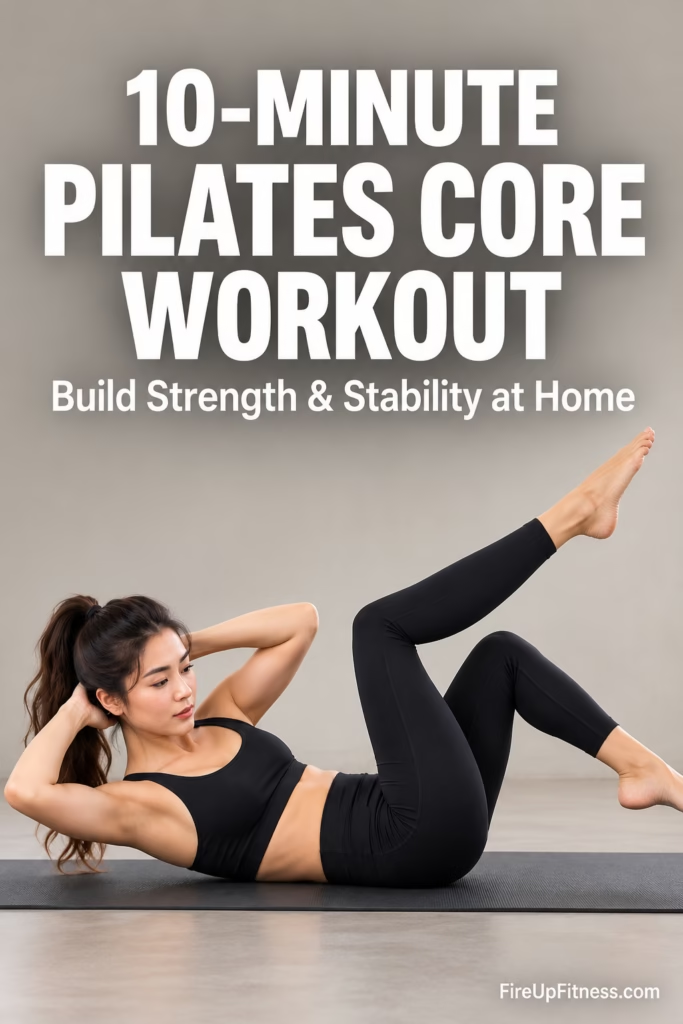
4. Double-Knee Crunch With Toe Tap
This final movement in the first section combines an abdominal curl with a coordinated leg movement.
Start with your knees bent toward your chest and your shoulders lifted.
Bring your elbows toward your knees, then slowly lower your head and shoulders while tapping your toes toward the mat.
Curl upward again as you draw your knees back toward your chest.
Suggested repetitions: 8–10.
The goal is to make the upward and downward phases equally controlled. Avoid throwing your shoulders forward to complete the crunch.
Once finished, lower your head, relax your legs, and take a short breathing break.
Part 2: Strengthen Your Abs With Pilates Leg Stretches
Now that your abdominal muscles are working, the routine moves into a series of leg extensions.
These exercises challenge your ability to keep your torso steady while your legs change position. You may notice your abs working harder as your legs move farther away from your body.
5. Single-Leg Stretch
Lie on your back and draw your knees toward your chest.
Lift your head and shoulders, then extend one leg outward while keeping the opposite knee close to your body.
Switch legs in a smooth, alternating motion.
The original routine emphasizes lengthening through each leg while maintaining abdominal engagement.
Suggested repetitions: 10–16 alternating stretches.
Make it easier: Keep your extended leg higher above the floor or rest your head on the mat.
6. Single Straight-Leg Stretch
This variation changes the direction of the leg movement.
Extend both legs toward the ceiling. Bring one leg toward your upper body while lowering the other leg away from you.
Switch sides, keeping your pelvis as stable as possible.
Rather than trying to stretch your legs farther, concentrate on maintaining control through your midsection.
Suggested repetitions: 8–12 alternating stretches.
A slight bend in the knees is fine, particularly when your hamstrings feel tight.
7. Alternating Single-Leg Extensions
Bring both knees back toward your chest and place your hands behind your head.
Lift your shoulders slightly, then extend one leg forward while keeping the other knee bent.
Return to the starting position and switch legs.
This movement may look similar to the earlier single-leg stretch, but your hands remain behind your head, and the emphasis is on controlling each extension without shifting your torso.
Suggested repetitions: 10–12 alternating extensions.
Keep your breathing steady and avoid extending your leg so low that your back begins to arch.
8. Pilates Bicycle Twist
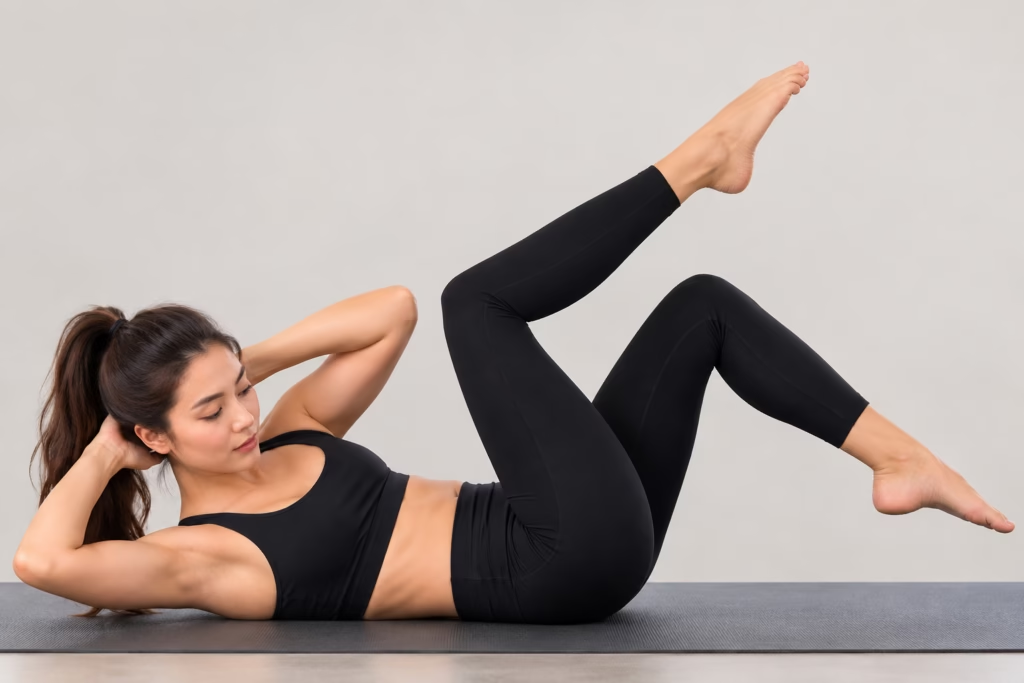
For the final exercise in this section, combine your leg extensions with a gentle upper-body rotation.
As you extend one leg forward, rotate your rib cage toward the opposite bent knee.
Return through the center before switching sides.
Unlike fast bicycle crunches, this Pilates variation should feel deliberate and controlled.
Suggested repetitions: 10–16 alternating twists.
Form reminder: Think about bringing your shoulder toward the opposite knee rather than pulling your elbow across your body.
Rest your head and legs on the mat for a few breaths before continuing.
Part 3: Challenge Your Core With Reaches and Leg Lowering
The final section combines reaching movements with straight-leg control.
Your abdominal muscles may already feel tired, so this is a good time to shorten your range of motion or take additional breaks.
9. Pilates Toe Reach Crunch
Lie on your back and extend both legs toward the ceiling.
Reach your arms upward, then curl your head and shoulders away from the mat as you bring your fingertips toward your toes.
Slowly lower your upper body and repeat.
You don’t need to reach all the way to your feet. Even a small, controlled curl can challenge your abdominal muscles.
Suggested repetitions: 8–10.
Keep your legs as steady as possible and avoid swinging your arms to lift yourself.
10. Alternating Cross-Body Toe Reaches
Keep your legs extended upward and place your hands behind your head.
Reach one arm toward the opposite foot, allowing your upper torso to rotate slightly.
Lower back toward the mat, then repeat with your other arm.
This exercise combines abdominal curling with rotation, giving your obliques another challenge.
Suggested repetitions: 8–12 alternating reaches.
Keep the movement comfortable and avoid forcing your shoulder or neck into a deeper twist.
11. Double Straight-Leg Lower and Lift
This is one of the most challenging movements in the routine.
Start with both legs extended toward the ceiling and your hands behind your head.
Slowly lower your legs together, stopping when you can no longer maintain comfortable control of your lower back and pelvis.
Lift your legs back toward the ceiling without swinging them.
Suggested repetitions: 6–10.
You may find that lowering your legs only a short distance is enough to challenge your abs.
Make it easier: Bend your knees, lower one leg at a time, or keep your head resting on the mat.
12. Pilates Double-Leg Stretch
Finish with a classic Pilates movement that coordinates your arms, legs, and core.
Begin by hugging both knees toward your chest.
Lift your head and shoulders slightly, then extend your arms and legs away from your body.
Circle your arms outward and bring them back toward your knees as you draw your legs in.
Continue with a steady rhythm, keeping your movements smooth.
Suggested repetitions: 8–10.
Form reminder: Keep your legs higher if extending them closer to the floor makes your back uncomfortable.
When you’ve finished, lower your head, relax your shoulders, and hug your knees toward your chest. Take several slow breaths before getting up.
How to Complete the Full Pilates Routine in 10 Minutes
You don’t need to watch the clock during every repetition. The easiest approach is to move through the exercises in order, allowing approximately three minutes for each section.
| Section | Duration |
|---|---|
| Toe taps and abdominal curls | 3 minutes |
| Recovery break | 15 seconds |
| Leg stretches and bicycle twists | 3 minutes |
| Recovery break | 15 seconds |
| Toe reaches, leg lowering, and double-leg stretch | 3 minutes |
| Final relaxation | 30 seconds |
| Total | 10 minutes |
These are suggested timings based on the original workout sequence, not exact timestamps from the video.
Adjust the number of repetitions as needed. Maintaining control is more important than completing every movement within a strict time limit.
How to Make This Pilates Workout More Beginner-Friendly
One common mistake with Pilates is assuming that a slow workout must also be easy.
Moving slowly can actually make an exercise feel harder because your muscles spend more time controlling each position.
For beginners, a few small adjustments can make a big difference.
Keep your knees bent. Bent-knee movements reduce the demand on your abdominal muscles and make it easier to stabilize your pelvis.
Support your head. Many exercises involve holding an abdominal curl. Rest your head whenever your neck becomes tired or uncomfortable.
Use a smaller range of motion. You don’t need to lower your legs close to the floor or lift your shoulders very high to benefit from these movements.
Exhale during the effort. A comfortable exhale as you curl or draw your legs inward can help you coordinate breathing with movement.
Rest when your form changes. A short pause is more useful than continuing with uncontrolled repetitions.
The goal isn’t to make every exercise look perfect immediately. It’s to develop the strength and coordination that allow you to move more confidently over time.
How Often Should You Do a 10-Minute Pilates Core Workout?
For many beginners, two or three sessions per week are a reasonable starting point.
That gives your abdominal muscles time to recover while allowing you to practice the movements regularly.
As your strength improves, you can gradually increase the challenge by extending your legs farther, reducing unnecessary movement through your torso, or completing additional controlled repetitions.
You can also combine this routine with walking, resistance training, or gentle stretching to support a more balanced fitness plan.
There’s no need to train your abs intensely every day. Recovery is part of building strength.
What Results Can You Expect From 10 Minutes of Pilates?
A short Pilates routine won’t change your body overnight, but regular practice can help you develop meaningful improvements in muscular endurance and movement control.
At first, you might notice that holding your shoulders off the mat feels difficult or that extending both legs makes it harder to keep your pelvis steady.
With practice, those same movements may begin to feel smoother and more manageable.
You may also find it easier to recognize when you’re using your abdominal muscles instead of relying on momentum.
Pilates can strengthen your core, but abdominal exercises alone don’t selectively remove fat from your midsection. Visible muscle definition depends on several factors, including genetics, overall body composition, and lifestyle.
For this routine, a more useful way to measure progress is to notice how well you can control each movement.
Frequently Asked Questions About Pilates Core Workouts
Is 10 minutes of Pilates enough for beginners?
Ten minutes can be a useful starting point for developing a regular exercise habit and practicing core-strengthening movements. As your fitness improves, you can gradually add more time or increase the difficulty.
Can I do this Pilates abs workout without equipment?
Yes. All 12 exercises are performed on the floor. An exercise mat is recommended for comfort, but no weights, resistance bands, or Pilates machines are needed.
Is this Pilates routine suitable for beginners?
Some movements are beginner-friendly, while others, especially double-leg lowering and straight-leg stretches, are more demanding. Beginners should use bent-knee variations, rest their heads when necessary, and take breaks.
Should my abs feel sore after Pilates?
Mild muscle soreness can occur after an unfamiliar workout, but soreness isn’t necessary for progress. Sharp pain, especially in your back or neck, is a reason to stop and adjust the movement.
Can Pilates help improve posture?
Strengthening the muscles that support your trunk may contribute to better postural control. However, posture also depends on mobility, daily habits, and overall strength, so Pilates works best as part of a balanced movement routine.
Final Thoughts: A Stronger Core Starts With Consistent Movement
You don’t need to spend an hour doing abdominal exercises to make core training part of your routine.
This 10-minute Pilates core workout at home gives you a focused sequence of 12 mat exercises that work your abdominal muscles through controlled leg movements, twists, and reaches.
Some days, you may complete the entire routine without stopping. Other days, you may need to bend your knees, rest your head, or take an extra breathing break.
Both approaches are perfectly reasonable.
What matters is practicing with intention, respecting your current strength, and allowing yourself to improve gradually.