3 Simple Strength Exercises for Women Over 60
Staying strong after 60 doesn’t require lifting heavy weights, spending hours at the gym, or following complicated workout routines. Sometimes, the simplest movements can make the biggest difference in how comfortably you move through your day.
Think about the everyday activities you want to continue enjoying: getting out of a chair without struggling, carrying groceries, climbing stairs, gardening, or going for a walk without feeling unsteady. These activities depend on muscle strength, balance, and mobility.
As we age, our bodies naturally lose some muscle mass and strength. This process, known as sarcopenia, can gradually make ordinary tasks more challenging. The good news is that strength training can help women over 60 maintain and build muscle, support bone health, and stay independent for longer.
You don’t need expensive equipment to get started. These three simple strength exercises for women over 60 can be done at home using a sturdy chair, a little floor space, and your own body weight.
Why Strength Training Matters for Women Over 60
Walking, stretching, and staying active are all important, but strength training offers benefits that these activities may not provide on their own.
After menopause, changes in hormones, combined with the natural aging process, can contribute to declining muscle mass and bone density. Without regular resistance exercise, muscles may gradually become weaker.
Adding gentle strength exercises to your weekly routine can help:
- Maintain muscle strength: Keep your legs, arms, and core strong enough for everyday activities.
- Support healthy bones: Weight-bearing and resistance exercises can help maintain bone strength.
- Improve balance and stability: Stronger muscles support better control during standing, walking, and changing positions.
- Make daily tasks easier: Activities such as getting up from a chair, carrying shopping bags, and climbing stairs may feel more manageable.
- Support joint function: Strengthening the muscles around your joints can help improve movement and stability.
- Maintain independence: Staying physically capable can help you continue doing the activities you enjoy.
You don’t have to do everything at once. Starting with a few comfortable movements and gradually increasing your repetitions can help you build a routine that feels manageable.
1. Chair Squats for Stronger Legs
Chair squats are one of the most practical strength exercises for women over 60 because they train a movement you perform throughout the day: sitting down and standing up.
This exercise strengthens the thighs, glutes, and hips while encouraging better control of your lower body.
A sturdy chair provides a helpful reference point, making this movement suitable for many beginners.
How to do chair squats
- Place a sturdy, non-rolling chair against a wall to prevent it from moving.
- Stand in front of the chair with your feet approximately hip-width apart.
- Keep your chest lifted and your shoulders relaxed.
- Slowly bend your knees and push your hips backward as though you’re about to sit.
- Lower yourself until your bottom gently touches the chair.
- Press through your feet to return to standing.
- Repeat the movement slowly, keeping your knees aligned with your toes.
Start with: 5–8 repetitions, working toward 10–12 as you become stronger.
Make it easier
Begin seated and use your hands on the armrests to help push yourself up. Slowly reduce how much assistance you need as your legs become stronger.
Why this exercise is helpful
Chair squats strengthen the muscles needed for standing, sitting, and climbing stairs. Practicing this movement can also improve confidence when getting up from low seating.
Helpful tip: Avoid dropping quickly into the chair. Lower yourself with control and stand up at a comfortable pace.
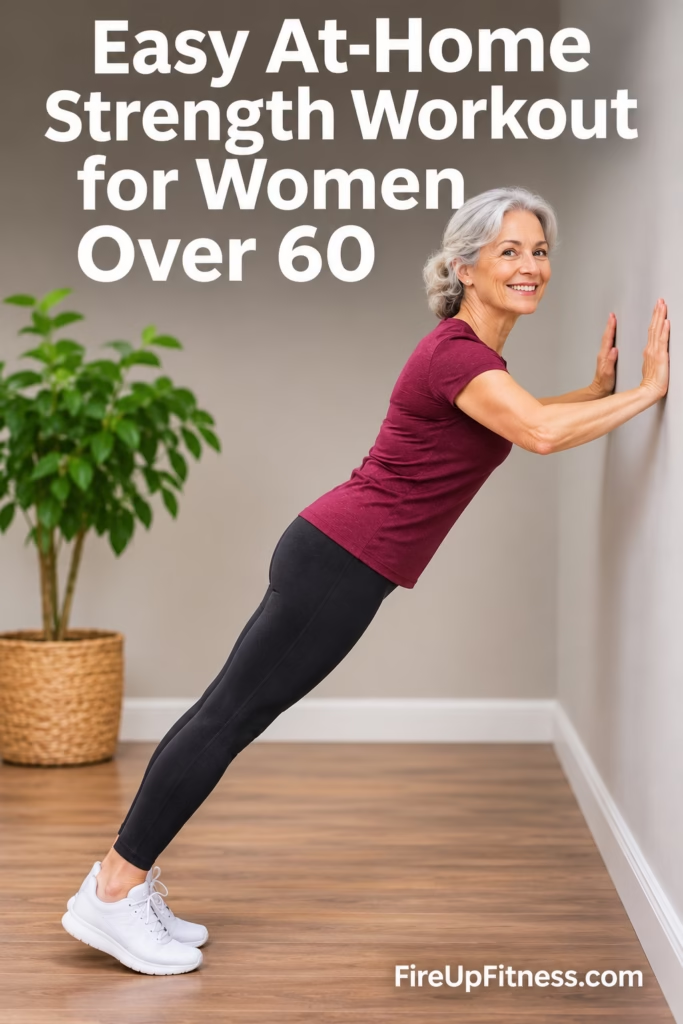
2. Wall Push-Ups for Upper Body Strength
Upper body strength is important for everyday activities such as opening doors, carrying groceries, moving household items, and pushing yourself up from a seated position.
Wall push-ups offer a gentle way to strengthen your chest, shoulders, and arms without getting down on the floor.
Because you perform the exercise while standing, you can adjust the difficulty simply by changing how far your feet are from the wall.
How to do wall push-ups
- Stand facing a sturdy wall, approximately an arm’s length away.
- Place your palms flat against the wall at shoulder height, slightly wider than shoulder-width apart.
- Keep your feet firmly planted on the floor.
- Bend your elbows slowly, bringing your chest toward the wall.
- Keep your body in a straight line without allowing your hips to sag.
- Push gently through your palms to return to the starting position.
- Continue at a slow, comfortable pace.
Start with: 8–10 repetitions.
Make it easier
Move your feet closer to the wall. This reduces the amount of body weight your arms need to support.
As you gain strength, you can gradually step farther away to make the movement more challenging.
Why this exercise is helpful
Wall push-ups work several upper body muscles together, including the chest, shoulders, and triceps. They also engage the core muscles that help stabilize your body.
Helpful tip: Keep your shoulders relaxed and your elbows angled slightly downward rather than flaring straight out to the sides. Stop if you experience shoulder or wrist pain.
3. Standing Heel Raises for Stronger Calves and Stability
Strong calf muscles help support walking, climbing stairs, and maintaining control when you rise onto your toes.
Standing heel raises are a simple exercise that strengthens the lower legs while gently challenging your standing stability.
You can perform them beside a kitchen counter or behind a sturdy chair for support.
How to do standing heel raises
- Stand upright with your feet hip-width apart.
- Lightly hold a sturdy countertop or the back of a stable chair.
- Keep your knees straight but not locked.
- Slowly lift both heels off the floor, rising onto the balls of your feet.
- Pause briefly at the top.
- Lower your heels back to the floor with control.
- Repeat without rushing.
Start with: 10 repetitions, gradually working toward 15.
Make it easier
Keep both hands on the counter for support and lift your heels only as high as feels comfortable.
You don’t need to rise very high to begin strengthening your calves.
Why this exercise is helpful
Heel raises strengthen the calf muscles, which play an important role in walking and controlling ankle movement. They may also help improve standing stability when practiced safely.
Helpful tip: Avoid bouncing or rocking forward. Keep your movements slow and use support whenever needed.
A Simple 10-Minute Strength Workout for Women Over 60
You can combine all three exercises into a short routine that fits easily into your morning or afternoon.
| Exercise | Beginner target |
|---|---|
| Chair squats | 5–8 repetitions |
| Wall push-ups | 8–10 repetitions |
| Standing heel raises | 10 repetitions |
| Rest between exercises | 30–60 seconds |
| Total rounds | 1–2 |
Begin with 2–3 minutes of gentle marching in place, shoulder rolls, or comfortable walking to warm up your muscles.
Complete one round of the exercises, resting whenever necessary. If you feel comfortable and your technique remains steady, repeat the circuit.
Finish with a few minutes of slow walking and relaxed breathing.
The entire routine may take approximately 8–12 minutes, depending on your pace and rest breaks.
For beginners, two or three nonconsecutive days per week is a reasonable starting point. This gives your muscles time to recover between sessions.
How to Make Strength Training Safer After 60
Strength exercises should feel challenging enough to engage your muscles without causing sharp pain or leaving you excessively exhausted.
A few simple precautions can make your workouts more comfortable.
Focus on slow, controlled movements
Avoid rushing through repetitions. Moving slowly helps you maintain proper technique and notice how your body responds.
Use support when necessary
A wall, countertop, or sturdy chair can provide additional stability. There’s no benefit in removing support before you’re ready.
Breathe naturally
Exhale during the harder part of each movement and inhale as you return to the starting position. Avoid holding your breath.
Progress gradually
When your current repetitions feel easy, consider adding one or two more rather than dramatically increasing the workout.
Pay attention to your body
Mild muscle fatigue can be normal, but sharp pain, dizziness, chest discomfort, or unusual shortness of breath are signs to stop exercising. Seek urgent medical care for potentially serious symptoms such as chest pain.
Women with osteoporosis, recent fractures, joint replacements, significant balance difficulties, or certain heart conditions should ask a healthcare professional about appropriate modifications before starting a new routine.
How Long Does It Take to Notice Improvements?
Strength training doesn’t produce overnight changes, but regular practice can gradually improve how your muscles perform.
Some women may notice everyday movements becoming easier within a few weeks. More measurable strength improvements often develop over six to twelve weeks, although progress varies depending on fitness level, health, and consistency.
You might notice that:
- Standing up from a chair requires less effort.
- Carrying groceries feels more comfortable.
- Walking and climbing stairs become easier.
- You can complete more repetitions without becoming as tired.
- You feel more confident performing everyday movements.
These improvements matter more than how many repetitions someone else can complete.
Is Strength Training Enough to Stay Active After 60?
Strength training is an important part of healthy aging, but it works best alongside other forms of movement.
Walking supports cardiovascular health, stretching helps maintain flexibility, and balance exercises improve the ability to remain steady during daily activities.
For adults aged 65 and older, physical activity guidelines generally recommend muscle-strengthening activities at least twice a week, along with regular aerobic activity and exercises that challenge balance.
The three movements in this routine are a helpful starting point, but they don’t train every major muscle group. As you become more comfortable, consider adding gentle resistance-band rows, hip-strengthening movements, and other exercises suited to your abilities.
The goal is to build a balanced routine that supports your entire body.
Frequently Asked Questions
Can a 60-year-old woman build muscle without lifting weights?
Yes. Bodyweight exercises such as chair squats and wall push-ups can help build strength, particularly for beginners. Over time, adding resistance bands or light dumbbells may help you continue progressing.
How many days a week should women over 60 do strength exercises?
At least two days per week is generally recommended. Beginners can start with two nonconsecutive days and gradually increase their activity based on comfort and recovery.
Are chair exercises effective for building strength?
Yes. Chair-based exercises can help strengthen muscles, especially for people who are new to exercise or need additional support. As strength improves, movements can be made more challenging.
Should women over 60 exercise every day?
Daily gentle movement can be beneficial, but you don’t need to perform the same strength exercises every day. Allowing recovery time between challenging sessions helps your muscles adapt.
Final Thoughts: Staying Strong Starts With Small Steps
Growing older doesn’t mean you have to give up the activities that make life enjoyable.
Strength can be developed at any age, and even small improvements can make a meaningful difference in everyday comfort and independence.
These three simple strength exercises for women over 60 offer an approachable way to begin. Chair squats help strengthen your legs, wall push-ups work your upper body, and standing heel raises support your lower legs and stability.
You don’t need to complete a perfect workout or push yourself beyond your limits. Start with what feels comfortable, practice regularly, and give your body time to become stronger.
The goal isn’t to exercise like you did at 30. It’s to build the strength that helps you keep doing what you love at 60, 70, and beyond.