Day 3 of the 10-Day Pilates Challenge: Upper Body Workout
Strong arms, better posture, and a more stable core begin with controlled, intentional movement. Day 3 of our 10-Day Pilates Challenge focuses on building upper body strength through Pilates exercises that work your arms, shoulders, chest, upper back, and abdominal muscles.
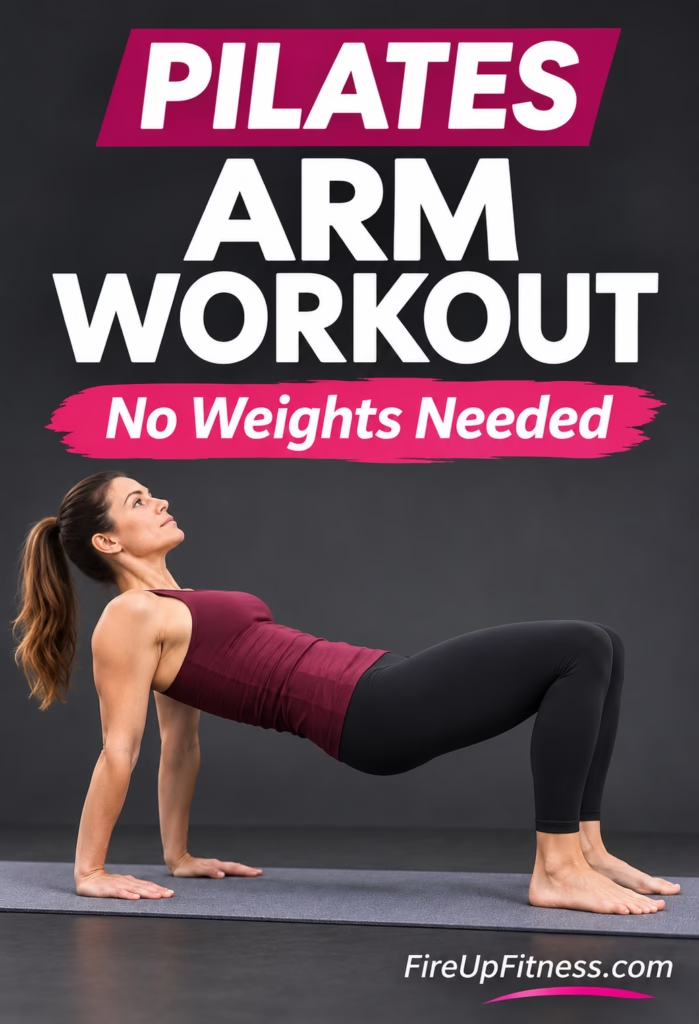
Today’s intermediate upper body Pilates workout uses your body weight to challenge your muscles without dumbbells or additional equipment. You’ll move through modified planks, shoulder taps, reverse plank variations, back-strengthening exercises, and core stability movements.
One of the most valuable parts of this workout is its focus on posture. Many of us spend hours sitting, looking at our phones, or working at computers. Strengthening the muscles that support your shoulders and spine can help improve postural awareness and make everyday movements feel more comfortable.
You’ve already made it through the Day1 and Day 2 of the challenge. Today, we’ll continue building strength, coordination, and consistency.
You can also complete this workout on its own whenever you want a focused upper body Pilates session.
Day 3: Intermediate Upper Body Pilates Workout
This workout combines upper body strengthening exercises with core stability and posture-focused movements.
Workout overview:
- Fitness level: Intermediate
- Equipment: Exercise mat
- Main focus: Arms, shoulders, chest, upper back, and core
- Workout style: Bodyweight Pilates
- Final exercise: 30-second forearm plank
- Cool-down: Gentle shoulder, back, and triceps stretches
The exercises are organized into four sections, beginning with modified plank movements and progressing into reverse planks, back extensions, and forearm stability work.
Follow Along With the Day 3 Pilates Workout Video
Follow the Day 3 workout video as you move through each exercise. The instructor demonstrates the movements and provides breathing and alignment cues to help you maintain proper form.
The written instructions below offer additional guidance so you can understand each exercise and make adjustments when needed.
Part 1: Modified Plank Exercises for Arms and Core
The first section focuses on shoulder stability, upper body strength, and abdominal control.
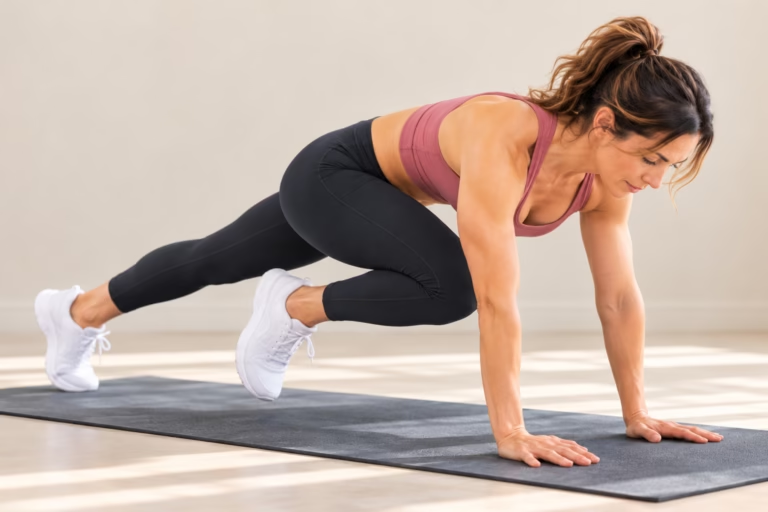
You’ll begin in a modified plank position with your knees resting on the mat. Although these movements may appear simple, keeping your hips and spine stable while moving your arms requires considerable core engagement.
1. Modified Plank With Alternating Arm Reaches
Begin on your hands and knees, positioning your wrists directly beneath your shoulders. Walk your knees backward until your hips are extended and your body forms a straight line from your shoulders to your knees.
How to do it:
- Gently tuck your tailbone and engage your abdominal muscles.
- Exhale as you extend your right arm forward, reaching toward shoulder height.
- Keep your hips level without shifting or rotating.
- Inhale as you return your hand beneath your shoulder.
- Repeat with your left arm and continue alternating.
The main challenge is keeping your body steady as you lift each arm. Your shoulders work to support the movement while your obliques and deep abdominal muscles help prevent rotation.
Form tip: Focus on maintaining a stable pelvis rather than lifting your arm as high as possible.
2. Modified Plank Shoulder Taps
Stay in your modified plank position for the next exercise.
Shoulder taps challenge your upper body while encouraging your abdominal muscles to keep your torso steady.
How to do it:
- Keep your hands beneath your shoulders and your knees resting on the mat.
- Exhale as you lift your left hand to touch your right shoulder.
- Inhale as you return your hand to the floor.
- Repeat with your right hand, touching your left shoulder.
- Continue alternating while keeping your hips stable.
Keep your ribs gently drawn toward your hips and avoid allowing your shoulders to rise toward your ears.
Try to relax your legs and let the tops of your feet rest comfortably on the mat.
3. Modified Plank Side Crunch — Right Side
This exercise introduces lateral flexion, helping strengthen the oblique muscles along the sides of your abdomen.
How to do it:
- Begin in your modified plank position.
- Engage your core and keep your shoulders steady.
- Exhale as you bring your right knee toward your right elbow.
- Gently shorten through the right side of your waist.
- Inhale as you return your knee to the mat.
Continue repeating on the same side.
Think about drawing your side ribs toward your hip rather than simply lifting your knee.
Move slowly and avoid dropping your knee heavily onto the floor.
4. Modified Plank Side Crunch — Left Side
Repeat the same movement on your left side.
Bring your left knee toward your left elbow as you exhale, then return to the starting position while inhaling.
Keep your abdominal muscles engaged and your shoulders relaxed.
Avoid unnecessarily squeezing your glutes or hamstrings. The focus should remain on your core and upper body.
5. Modified Pilates Push-Ups
The final exercise in this section is a modified push-up that targets your chest, shoulders, and triceps.
Unlike a narrow triceps push-up, this variation uses a slightly wider hand position.
How to do it:
- Begin in a modified plank with your knees on the mat.
- Position your hands slightly wider than shoulder-width apart.
- Bend your elbows backward at approximately a 45-degree angle.
- Inhale as you lower your chest toward the floor.
- Exhale as you press through your palms to return to the starting position.
Keep your abdominal muscles engaged and avoid allowing your lower back to arch excessively.
Lower only as far as you can while maintaining control.
Modification: Perform smaller push-ups until you develop enough strength to increase your range of motion.
Part 2: Reverse Plank Exercises for Upper Body Strength
Next, you’ll move into reverse plank variations.
These exercises strengthen your arms and shoulders while challenging the muscles along the back of your body. They also encourage an open chest position and greater awareness of your spinal alignment.
6. Reverse Plank Hip Lifts
Sit on your mat with your legs extended in front of you.
Place your hands behind you, directly beneath your shoulders, with your fingertips pointing toward your feet.
How to do it:
- Sit tall and gently draw your shoulders away from your ears.
- Press firmly through your palms.
- Exhale as you lift your hips toward the ceiling.
- Squeeze your glutes at the top while keeping your chest open.
- Inhale as you slowly lower your hips toward the mat.
Aim to create a long line through your body when your hips are lifted.
Reverse plank hip lifts strengthen the upper back, shoulders, and glutes while encouraging better full-body alignment.
7. Reverse Plank Knee Crunches
Remain in your reverse plank position with your hips lifted.
This variation adds an abdominal challenge while requiring your shoulders and arms to support your body.
How to do it:
- Lift your hips into a reverse plank.
- Keep your arms straight and your chest open.
- Exhale as you bend one knee and draw it toward your torso, bringing your knee above your hip.
- Inhale as you extend your leg back to the starting position.
- Alternate legs while maintaining a steady pelvis.
Avoid allowing your hips to drop or rotate as you move.
Your abdominal muscles help control the knee movement, while your shoulders, triceps, and posterior chain work to maintain the reverse plank.
8. Pilates Triceps Dips
Bend your knees and place your feet firmly on the mat.
Keep your hands behind you with your chest lifted.
How to do it:
- Lift your hips slightly off the floor.
- Inhale as you bend your elbows straight backward.
- Lower your hips toward the mat while keeping your chest open.
- Exhale as you press through your palms to straighten your arms.
- Repeat with slow, controlled movements.
This exercise primarily strengthens your triceps while also challenging your shoulders.
Avoid rounding your upper back or allowing your shoulders to collapse forward.
Form tip: Keep the movement small if you experience discomfort in your wrists or shoulders. Stop if the discomfort persists.
Part 3: Pilates Back Exercises for Posture
The third section focuses on the posterior chain, particularly the muscles supporting your spine, shoulder blades, and upper back.
Strengthening these muscles can help balance a routine that involves plenty of forward-facing activities, such as typing, driving, and using a phone.
9. Prone Y Raises With Arm and Leg Lifts
Lie face down on your mat with your legs extended behind you.
Reach your arms forward and slightly outward to form a Y shape.
How to do it:
- Gently engage your abdominal muscles and stabilize your pelvis.
- Exhale as you lift your arms and legs slightly away from the mat.
- Lengthen through your spine without forcing a deep backbend.
- Keep your neck long and your gaze directed slightly forward and down.
- Inhale as you lower your arms and legs with control.
Focus on lengthening your body rather than lifting as high as possible.
This exercise strengthens your back extensors, glutes, and shoulder-supporting muscles.
10. Prone T Raises
Remain lying on your stomach, but extend your arms out to the sides in a T position.
Keep your lower body relaxed on the mat.
How to do it:
- Position your arms straight out from your shoulders.
- Keep your head hovering slightly above the mat with your neck long.
- Exhale as you lift your arms away from the floor.
- Gently draw your shoulder blades together.
- Inhale as you lower your hands.
The movement should come primarily from your upper back and shoulder blades.
Prone T raises strengthen the muscles between your shoulder blades, including the rhomboids and middle trapezius.
These muscles play an important role in shoulder stability and postural control.
11. Prone Bent-Arm Reaches
Stay lying face down and bend your elbows to approximately 90 degrees beside your body.
How to do it:
- Engage your core and keep your pelvis stable.
- Lift your arms and legs slightly away from the mat.
- Exhale as you extend your arms forward.
- Inhale as you bend your elbows back toward your shoulders.
- Keep your arms hovering at approximately the same height throughout the movement.
Avoid lifting your shoulders toward your ears.
This exercise strengthens your upper back, shoulders, and spinal stabilizers while encouraging controlled movement.
Once finished, press back into child’s pose to gently stretch your back.
Part 4: Forearm Pilates Exercises for Core Stability
The final strength section combines shoulder stability with controlled abdominal movements.
You’ll perform two single-leg forearm pike variations before finishing with a 30-second plank.
12. Single-Leg Forearm Pike — Right Side
Begin on your forearms and knees, with your elbows directly beneath your shoulders.
Extend your right leg behind you, placing your toes on the mat. Keep your left knee bent beneath your hip.
How to do it:
- Press evenly through your forearms and right toes.
- Engage your abdominal muscles.
- Exhale as you lift your hips toward the ceiling, raising your bent left knee off the mat.
- Gently round through your abdominal area as your hips rise.
- Inhale as you lower your left knee back to the mat.
Imagine a string gently pulling your tailbone toward the ceiling.
Avoid pushing excessively through your shoulders or allowing your neck to tense.
13. Single-Leg Forearm Pike — Left Side
Switch sides, extending your left leg behind you and keeping your right knee bent beneath your hip.
Repeat the same controlled movement.
Exhale as you lift your hips and bent knee, then inhale as you lower.
Focus on engaging your abdominal muscles to initiate the movement rather than relying on momentum.
Keep your forearms firmly planted and your shoulders stable.
14. Forearm Plank Hold
Finish today’s workout with a 30-second forearm plank.
How to do it:
- Position your elbows directly beneath your shoulders.
- Extend both legs behind you, resting on your toes.
- Keep your body aligned from your head to your heels.
- Gently tuck your pelvis and engage your abdominal muscles.
- Maintain steady breathing throughout the 30-second hold.
Avoid letting your lower back sag or lifting your hips excessively.
A forearm plank strengthens your abdominal muscles while challenging your shoulders and overall muscular endurance.
Modification: Lower your knees to the mat if maintaining a full plank becomes too difficult.
Cool-Down: Gentle Stretches for Your Shoulders and Back
After completing the strength exercises, take a few minutes to release tension and relax your upper body.
The Day 3 workout finishes with gentle stretches for your back, shoulders, sides, and triceps.
Child’s Pose With Side Reaches
Sit your hips back toward your heels and extend your arms forward.
Walk both hands toward the left side of your mat, allowing a gentle stretch along the right side of your torso.
Return to the center and repeat on the opposite side.
Cross-Body Shoulder Stretch
Sit comfortably with your spine tall.
Bring your right arm across your chest and gently support it with your left hand.
Hold the stretch without pulling forcefully, then switch arms.
Seated Side Bend
Sit upright and place one hand beside you.
Reach your opposite arm overhead and gently lean to the side.
Keep your chest open and avoid rounding forward.
Repeat on the other side.
Overhead Triceps Stretch
Raise your right arm overhead and bend your elbow, allowing your hand to move behind your head.
Use your opposite hand to gently guide your elbow into a comfortable stretch.
Keep your chest lifted and shoulders relaxed.
Repeat with your left arm.
Benefits of This Upper Body Pilates Workout
Today’s routine combines several important elements of upper body conditioning. Rather than isolating one muscle group, many exercises require your arms, shoulders, back, and abdominal muscles to work together.
1. Strengthens Your Arms and Shoulders
Modified push-ups, shoulder taps, reverse planks, and triceps dips challenge your upper body using your own body weight.
Practicing these movements consistently can help develop muscular strength and endurance.
2. Supports Better Posture
Reverse plank exercises and prone back extensions strengthen muscles that help support your shoulders and spine.
Building strength in these areas can improve postural awareness and make it easier to maintain comfortable alignment during everyday activities.
3. Improves Core Stability
The modified plank variations and forearm exercises require your abdominal muscles to stabilize your torso while your arms or legs move.
This helps develop the strength and coordination needed for controlled movement.
4. Encourages Shoulder Control
Several exercises focus on maintaining proper shoulder positioning while moving through different ranges of motion.
This can help improve your awareness of how your shoulder blades move and support your upper body.
5. Builds Muscular Endurance
Holding plank positions and performing repeated bodyweight movements challenge your muscles to maintain effort over time.
As your strength improves, you may find these exercises easier to perform with consistent technique.
Tips for Getting the Most Out of Day 3
Today’s intermediate Pilates workout includes several demanding movements, particularly the reverse plank variations and modified push-ups.
Keep these suggestions in mind as you practice:
- Move slowly. Controlled repetitions help you maintain alignment and avoid relying on momentum.
- Focus on your breathing. Exhale during the challenging portion of each exercise and inhale as you return.
- Keep your shoulders relaxed. Avoid unnecessary tension around your neck.
- Maintain a stable pelvis. Prevent excessive hip rotation during plank variations.
- Modify when needed. Reduce your range of motion or take a short break when your form begins to deteriorate.
- Respect your wrists and shoulders. Several exercises place weight through these joints. Stop or adjust movements that cause pain.
Remember that good technique matters more than completing every repetition.
Frequently Asked Questions
Is this upper body Pilates workout suitable for beginners?
Day 3 is designed as an intermediate workout. However, beginners can try individual exercises using modifications, shorter holds, and additional rest.
Start with movements you can perform comfortably and gradually build your strength.
Do I need weights for this Pilates arm workout?
No. The entire routine uses bodyweight resistance.
An exercise mat is the only equipment needed.
Can Pilates help improve upper body posture?
Pilates can strengthen muscles that support your shoulders and spine while improving movement awareness.
Exercises such as reverse planks, prone Y raises, and T raises are particularly useful for developing upper back strength.
Can I do Day 3 without completing Days 1 and 2?
Yes. Although this workout is part of the 10-Day Pilates Challenge, it can also be completed as a standalone upper body session.
How often should I practice upper body Pilates?
The appropriate frequency depends on your experience, workout intensity, and recovery needs.
Many people can benefit from upper body strengthening exercises at least twice per week, allowing sufficient recovery between challenging sessions.
Day 3 Complete: Keep Building Your Pilates Strength
You’ve completed Day 3 of the 10-Day Pilates Challenge!
Today’s workout challenged your arms, shoulders, upper back, and core through a combination of modified planks, reverse plank variations, back-strengthening exercises, and stability work.
Some movements may have felt particularly demanding, especially the triceps dips, reverse plank knee crunches, and final forearm plank. That’s a normal part of learning new exercises and gradually developing muscular endurance.
Progress doesn’t require perfect repetitions or pushing through discomfort. It comes from practicing consistently, paying attention to your technique, and recognizing when your body needs rest.
Take a moment to appreciate the effort you’ve put into today’s session. Here is Day 1 and Day 2 Pilates challenges if you have missed these.
Coming Up Next: Day 4 — Core Pilates Workout
Tomorrow, we’ll shift our attention toward strengthening the abdominal muscles and improving core control.
Three days complete, seven more to go. Keep building your strength, one Pilates session at a time.