6 Lower Ab Exercises for Women at Home | Stronger Core
A stronger core doesn’t always require long workouts, complicated equipment, or endless crunches. Sometimes, a few carefully chosen exercises performed with good control can make a noticeable difference in how strong and stable your midsection feels.
The lower abdominal area can be particularly challenging to engage during workouts. You might notice your hip flexors doing most of the work during leg raises or your lower back arching when you try certain ab exercises.
The good news is that you can improve your core strength with simple movements performed right at home.
These 6 lower ab exercises for women at home focus on strengthening the abdominal muscles, improving pelvic control, and building stability. All you need is an exercise mat and about 10 to 15 minutes.
Why Lower Ab Exercises Matter
Your abdominal muscles work together to support your spine, stabilize your pelvis, and help your body move efficiently.
Although people often refer to the “lower abs” as a separate muscle group, the rectus abdominis is one continuous muscle extending from your rib cage toward your pelvis. You cannot completely isolate its lower portion, but certain exercises emphasize movements that challenge the lower abdominal region.
Strengthening your core can help you:
- Improve abdominal strength and endurance.
- Support better balance and stability.
- Develop greater control over your pelvis and lower back.
- Make everyday movements such as bending, lifting, and reaching feel more controlled.
- Build a foundation for other exercises, including Pilates and strength training.
The goal isn’t to perform as many repetitions as possible. Slow, controlled movements are often more useful than rushing through an ab workout.
6 Best Lower Ab Exercises for Women at Home
These six exercises require no gym equipment and can be adjusted to match your fitness level.
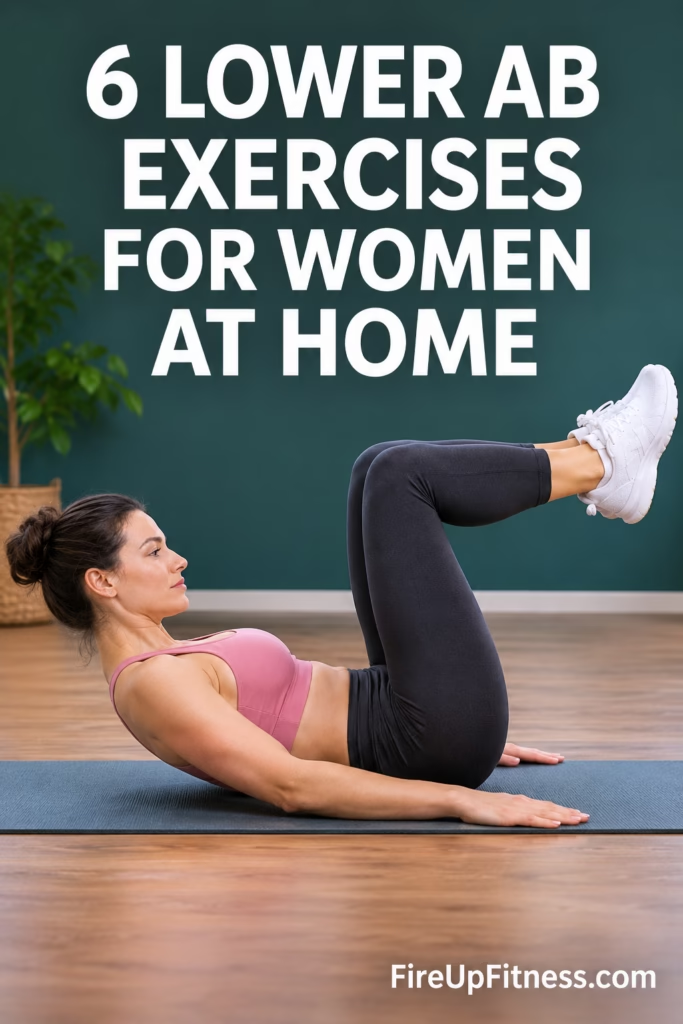
1. Reverse Crunches
Reverse crunches are an effective way to challenge your abdominal muscles while focusing on controlled pelvic movement.
Unlike traditional crunches, which involve lifting your upper body, reverse crunches involve gently curling your pelvis toward your rib cage.
How to do reverse crunches:
- Lie on your back with your knees bent and feet lifted off the floor.
- Position your knees above your hips, keeping them bent at approximately 90 degrees.
- Rest your arms beside your body with your palms facing down.
- Tighten your abdominal muscles and gently curl your pelvis upward, lifting your tailbone slightly off the mat.
- Slowly lower your hips without swinging your legs.
Repetitions: 10–12
Form tip: Think about bringing your pelvis toward your ribs rather than throwing your knees toward your chest. Keep the movement small and controlled.
2. Bent-Knee Leg Raises
Bent-knee leg raises are a beginner-friendly alternative to straight-leg raises. Bending your knees shortens the lever, making it easier to maintain control of your lower back.
How to do bent-knee leg raises:
- Lie flat on your back with your arms resting at your sides.
- Bend your knees and place your feet on the mat.
- Gently tighten your abdominal muscles while keeping your pelvis steady.
- Lift both feet until your knees are positioned above your hips.
- Slowly lower your feet toward the floor without allowing your lower back to arch.
- Lightly touch the floor and repeat.
Repetitions: 10–12
Form tip: Exhale as you lift your legs and inhale as you lower them. Reduce the range of motion if you feel your back lifting excessively off the mat.
3. Dead Bug Exercise
The dead bug is one of the most useful exercises for developing core stability and coordination.
It challenges your abdominal muscles to keep your trunk steady while your arms and legs move in opposite directions.
How to do the dead bug:
- Lie on your back with your arms extended toward the ceiling.
- Lift your legs into a tabletop position, keeping your knees bent at 90 degrees.
- Gently engage your abdominal muscles and maintain a comfortable, stable position through your lower back.
- Slowly extend your right arm behind your head while lowering your left leg toward the floor.
- Return to the starting position.
- Repeat with your left arm and right leg.
Repetitions: 8–10 per side
Form tip: Move slowly enough that your hips and lower back remain stable. Beginners can keep their arms still and practice moving one leg at a time.
4. Heel Taps
Heel taps are a simple but effective exercise for strengthening your core without requiring large movements.
They are especially helpful for women who want to improve abdominal control before progressing to more challenging exercises.
How to do heel taps:
- Lie on your back with your knees bent and lifted above your hips.
- Keep your arms relaxed beside your body.
- Engage your abdominal muscles and maintain a steady pelvis.
- Slowly lower your right foot until your heel lightly touches the mat.
- Bring your right leg back to the starting position.
- Repeat with your left leg, alternating sides.
Repetitions: 12–16 total
Form tip: Keep your knees bent throughout the movement. The challenge comes from controlling your legs without allowing your pelvis to tilt or your back to arch.
5. Flutter Kicks
Flutter kicks introduce a more demanding challenge because your abdominal muscles must stabilize your pelvis while your legs alternate.
This exercise also works the hip flexors, so proper positioning is important.
How to do flutter kicks:
- Lie on your back with your legs extended.
- Rest your arms at your sides.
- Engage your core and lift both legs slightly off the floor, only as low as you can comfortably control.
- Raise one leg a little higher while lowering the other.
- Continue alternating your legs using small, controlled movements.
- Keep your breathing steady throughout.
Duration: 20–30 seconds
Form tip: Avoid lifting your head or straining your neck. Raise your legs higher or bend your knees slightly if your lower back begins to arch.
Beginners can skip this exercise initially and build strength with heel taps and dead bugs before progressing.
6. Toe Reach With Legs Raised
The toe reach combines abdominal curling with controlled leg positioning, challenging your upper and lower abdominal regions together.
It also encourages coordination between your trunk and pelvis.
How to do toe reaches:
- Lie on your back with your legs raised toward the ceiling and your knees slightly bent.
- Extend your arms upward toward your feet.
- Gently engage your abdominal muscles.
- Exhale and lift your shoulders slightly off the mat, reaching your hands toward your toes.
- Keep your legs steady as you lift.
- Slowly lower your shoulders back to the mat.
Repetitions: 10–12
Form tip: Avoid pulling your head forward or forcing your hands to touch your toes. Focus on lifting through your upper torso rather than straining your neck.
10–15 Minute Lower Ab Workout Routine
Now that you know the exercises, you can combine them into a simple home workout.
| Exercise | Reps or time |
|---|---|
| Reverse crunches | 12 reps |
| Bent-knee leg raises | 12 reps |
| Dead bug | 8 per side |
| Heel taps | 16 total |
| Flutter kicks | 20–30 seconds |
| Toe reaches | 12 reps |
How to follow the routine:
Complete each exercise in order, resting for 15–30 seconds between movements.
Beginners can start with one round. Once the exercises feel comfortable, gradually increase to two rounds. More experienced exercisers can complete three rounds if they can maintain proper form.
Depending on your pace and rest periods, the workout will take approximately 10–15 minutes for two rounds.
You can perform this routine two or three times per week, allowing recovery time between sessions.
Common Mistakes to Avoid During Lower Ab Workouts
Lower ab exercises may look simple, but small technique mistakes can make them less comfortable and reduce their effectiveness.
Letting your lower back arch excessively
When your legs move away from your body, your abdominal muscles must work to keep your pelvis stable.
If your back begins arching beyond your comfortable range, shorten the movement or bend your knees. You don’t need to force your entire lower back flat against the floor.
Moving too quickly
Swinging your legs or relying on momentum reduces the amount of control required from your abdominal muscles.
Instead, use deliberate movements and pay attention to how your body responds during each repetition.
Holding your breath
Breathing naturally helps you maintain control without creating unnecessary tension.
Try exhaling during the most challenging part of each exercise and inhaling as you return to the starting position.
Choosing exercises that are too difficult
Straight-leg movements can be demanding, particularly when you’re still developing core strength.
There is nothing wrong with beginning with bent-knee variations. Progressing gradually is more useful than forcing difficult exercises before you’re ready.
How Often Should Women Train Their Lower Abs?
For most women, performing focused abdominal exercises two to three times per week is a practical starting point.
Your core also works during everyday activities and other exercises, including walking, carrying groceries, resistance training, and Pilates.
You don’t need a separate abdominal workout every day to make progress.
Consistency, appropriate difficulty, and gradual progression are more important than training frequency alone.
As your strength improves, you can increase repetitions, extend the time under tension, or choose more challenging variations.
Can Beginners Do These Lower Ab Exercises?
Yes. Most of these movements can be modified for beginners.
Start with dead bugs, heel taps, and bent-knee leg raises to develop control before attempting exercises that require keeping your legs extended.
A comfortable exercise mat can provide cushioning for your back, and taking short breaks between sets is perfectly fine.
Women recovering from pregnancy, managing pelvic floor symptoms, or experiencing persistent back discomfort may need individualized modifications. Stop any exercise that causes pain, pelvic heaviness, or uncomfortable abdominal doming, and consider guidance from a qualified healthcare professional.
How Long Does It Take to Build Stronger Abs?
The time needed to notice improvements depends on your starting strength, consistency, exercise technique, and overall activity level.
You may first notice that movements feel easier, you can complete more controlled repetitions, or your pelvis stays steadier during leg exercises.
These are meaningful signs of progress, even when there are no obvious visible changes.
Remember that abdominal exercises strengthen the muscles underneath your midsection, but they do not selectively remove fat from the lower belly. Core strength and abdominal appearance are different outcomes.
Focus on improving your movement quality and gradually increasing the challenge rather than judging your progress only by appearance.
Final Thoughts
Building a stronger core doesn’t have to involve complicated workouts or expensive equipment.
These six lower ab exercises for women at home provide a simple way to challenge your abdominal muscles, develop better pelvic stability, and improve control during everyday movement.
Start with the exercises that feel manageable, pay attention to your technique, and increase the difficulty as your strength develops.
Even a short workout performed consistently can become a valuable part of your fitness routine.
The goal is simple: build a stronger, more stable core, one controlled repetition at a time.