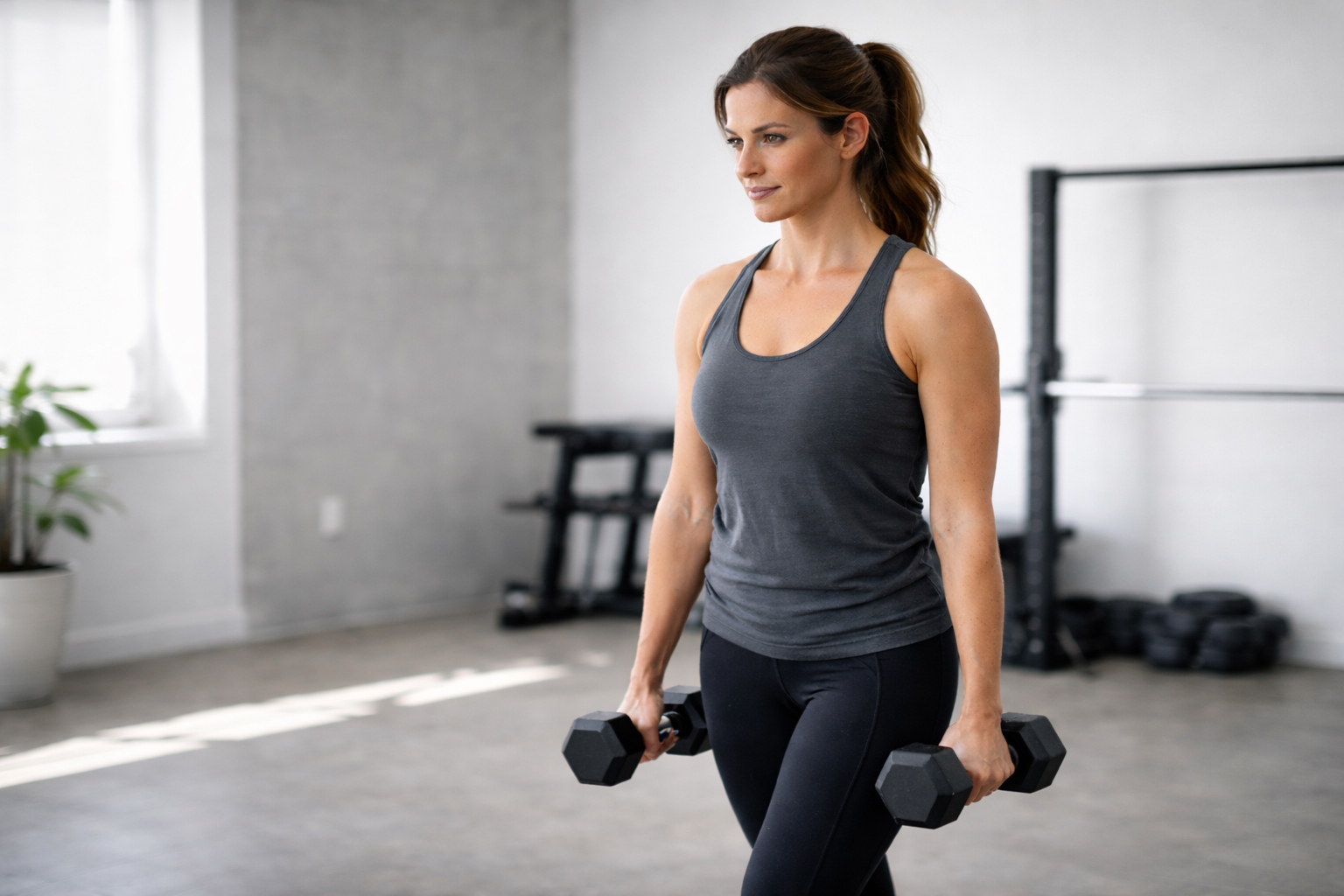
The 3 Basic Exercises to Build a Workout
You don’t need a gym membership, expensive equipment, or a complicated workout plan to build a stronger body. Sometimes, the simplest exercises are the ones that make the biggest difference.
Many popular gym workouts are built around basic movement patterns such as squatting, pushing, and bending at the hips. Learning these movements can help you improve your strength, balance, coordination, and confidence before moving on to more challenging exercises.
The good news? You can practice these movements right at home, even with limited space and minimal equipment.
Whether you’re new to fitness, returning after a long break, or looking for a simple strength training routine for women over 40, these three basic exercises are a great place to start.
Why Basic Exercises Matter
It’s easy to think that a workout needs to be complicated to be effective. But building strength starts with learning how to move your body properly.
Simple strength exercises can help you:
- Build stronger legs, glutes, arms, and shoulders.
- Improve balance and everyday stability.
- Support better posture and core strength.
- Make daily activities like lifting, carrying, and climbing stairs easier.
- Develop confidence with strength training.
- Maintain muscle strength as you get older.
You don’t need to do dozens of different exercises. A few well-chosen movements, performed consistently with proper form, can provide a strong foundation for your fitness routine.
Here are three exercises worth learning.
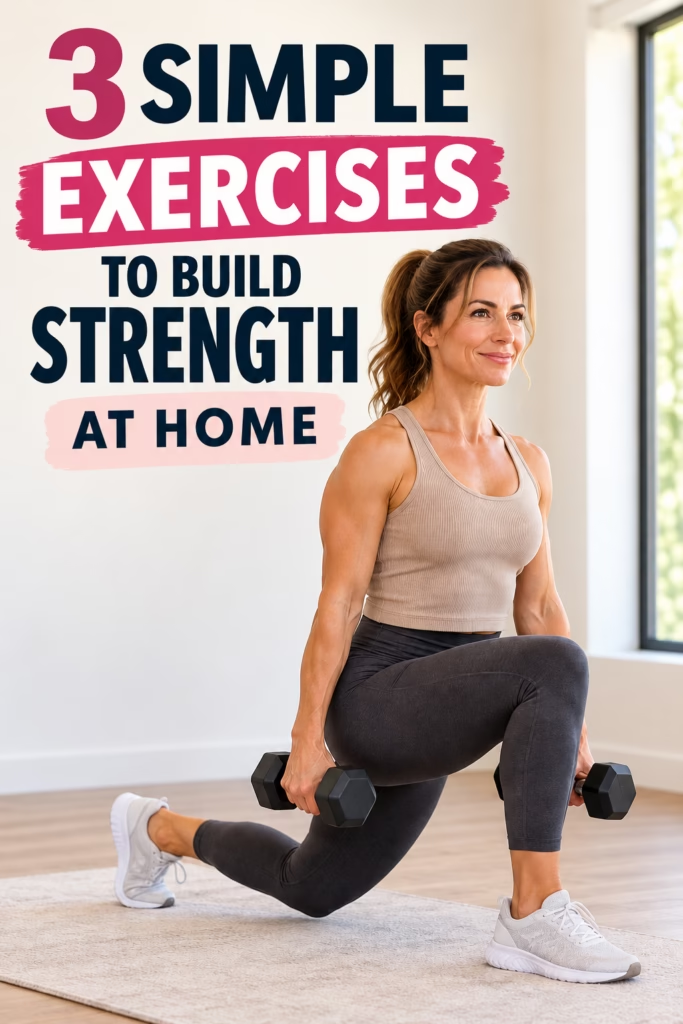
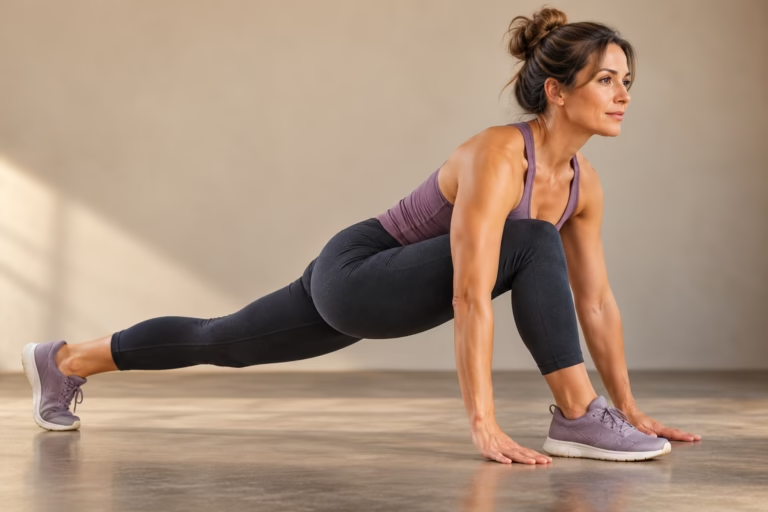
1. Split Squats for Stronger Legs and Glutes
Split squats are one of the best beginner-friendly lower-body exercises for building strength and improving balance.
Unlike regular squats, split squats place your feet in a staggered position, allowing you to work each leg more independently.
This movement primarily targets your quadriceps and glutes while also engaging your hamstrings, calves, and core for stability.
How to Do Split Squats
- Stand tall with one foot forward and the other foot behind you.
- Keep your feet about hip-width apart from side to side to help maintain balance.
- Engage your core and keep your chest lifted.
- Slowly bend both knees, lowering your back knee toward the floor.
- Keep most of your weight supported through your front foot.
- Push through your front foot to return to the starting position.
- Complete your repetitions before switching legs.
Beginner recommendation: Start with 8–10 repetitions on each leg for 2 sets.
Make it easier: Hold onto a sturdy chair or countertop for balance. You can also reduce how far you lower your body.
Make it harder: Hold a dumbbell in each hand or slow down the lowering portion of the exercise.
Why Split Squats Are Worth Trying
Split squats can help improve single-leg strength, coordination, and lower-body stability. These benefits are especially useful for everyday activities such as walking uphill, climbing stairs, and getting up from a low seat.
For women over 40, strengthening the legs and glutes is also an important part of maintaining mobility and independence as the years go by.
2. Half-Kneeling Shoulder Press for Upper-Body Strength
The half-kneeling shoulder press is a simple upper-body exercise that challenges more than just your arms.
Because you’re pressing from a kneeling position, your core and hips must work to keep your body stable.
This makes it a useful exercise for building shoulder strength while practicing balance, posture, and controlled movement.
How to Do a Half-Kneeling Shoulder Press
- Kneel on a comfortable exercise mat with your right knee on the floor.
- Place your left foot in front, keeping both knees bent at approximately 90 degrees.
- Hold a light dumbbell in your right hand at shoulder height.
- Keep your torso upright and gently engage your abdominal muscles.
- Press the dumbbell overhead without leaning backward.
- Slowly lower the weight to shoulder height.
- Repeat, then switch sides.
Beginner recommendation: Perform 8–10 repetitions on each arm for 2 sets.
Make it easier: Practice the movement without weights or use a very light dumbbell. A seated shoulder press is another option when kneeling feels uncomfortable.
Make it harder: Gradually increase the resistance while maintaining good posture and control.
Benefits of the Half-Kneeling Shoulder Press
This movement strengthens your shoulders and triceps while challenging your core to resist unwanted movement.
It can also help you practice the stability needed for everyday overhead activities, such as placing objects on shelves.
One important tip is to avoid arching your lower back as you lift. Keep your ribs stacked over your hips and move slowly.
3. Kettlebell Deadlifts for Glutes and Hamstrings
The kettlebell deadlift is a fantastic exercise for learning how to bend and lift using your hips.
It focuses on the muscles along the back of your body, particularly your glutes and hamstrings, while also engaging your back and core muscles.
This exercise teaches a movement pattern known as the hip hinge, which is useful when picking up objects from the floor.
How to Do a Kettlebell Deadlift
- Stand with your feet approximately hip-width apart.
- Place a kettlebell on the floor between your feet.
- Keep your knees slightly bent and push your hips backward.
- Maintain a neutral spine as you lower your torso.
- Reach down and grasp the kettlebell handle with both hands.
- Brace your core and push through your feet to stand tall.
- Squeeze your glutes gently at the top without leaning backward.
- Lower the kettlebell with control by pushing your hips back again.
Beginner recommendation: Start with 8–12 repetitions for 2 sets using a manageable weight.
Make it easier: Practice the hip hinge without weights. You can also elevate the kettlebell on a stable platform to reduce how far you need to bend.
Make it harder: Increase resistance gradually once you can maintain proper form throughout the movement.
Why Kettlebell Deadlifts Are Effective
Deadlifts strengthen several important muscle groups at once, making them an efficient addition to a home strength workout.
Practicing the hip hinge can also help you develop better awareness of how to lift everyday objects while managing the load on your back.
The goal isn’t to lift the heaviest kettlebell possible. Focus on controlled movement, a comfortable range of motion, and steady progress.
A Simple 15-Minute Strength Workout at Home
Now that you know the three exercises, you can combine them into a beginner-friendly full-body workout.
| Exercise | Repetitions | Sets |
|---|---|---|
| Split Squats | 8–10 per leg | 2 |
| Half-Kneeling Shoulder Press | 8–10 per arm | 2 |
| Kettlebell Deadlifts | 8–12 | 2 |
Rest for approximately 30–60 seconds between exercises, or longer when needed.
Start with 3–5 minutes of gentle marching, arm circles, and bodyweight hip hinges to warm up.
Move slowly through each exercise and pay attention to your breathing. Exhale during the harder portion of the movement and inhale as you return to the starting position.
Depending on your pace and rest periods, the workout may take around 15–20 minutes.
Try this routine two or three times per week on nonconsecutive days, giving your muscles time to recover between sessions.
Can You Do These Exercises Without Equipment?
Absolutely. Although two of these exercises are commonly performed with weights, you can begin by practicing the movements without additional resistance.
For example, bodyweight split squats are already challenging for many beginners. The half-kneeling press can be practiced without a dumbbell to learn proper positioning, and the kettlebell deadlift can begin as a bodyweight hip hinge.
As your strength improves, adding light resistance can help you continue making progress.
The most important thing is to choose an exercise variation that matches your current fitness level.
Tips for Getting Better Results
Consistency matters more than trying to make every workout exhausting.
Start with manageable repetitions, take breaks when needed, and focus on learning the correct technique before increasing resistance.
Remember that progress isn’t always about lifting heavier weights. You may notice that your balance improves, your movements feel smoother, or everyday activities become easier.
These are meaningful signs that your strength and coordination are developing.
For beginners, especially women returning to exercise after 40, it’s worth giving your body time to adapt. Avoid pushing through sharp pain, and modify any movement that causes discomfort.
Final Thoughts
Building strength doesn’t have to be complicated.
Split squats, half-kneeling shoulder presses, and kettlebell deadlifts are three practical exercises that target major muscle groups while helping improve balance, stability, and movement control.
Together, they provide a simple starting point for a home workout routine, although a more complete long-term program should also include pulling exercises and other movement patterns.
Start with what you can comfortably manage, focus on good form, and gradually build your strength.
You don’t need a perfect workout plan to begin. You just need a few effective exercises and the consistency to keep showing up.