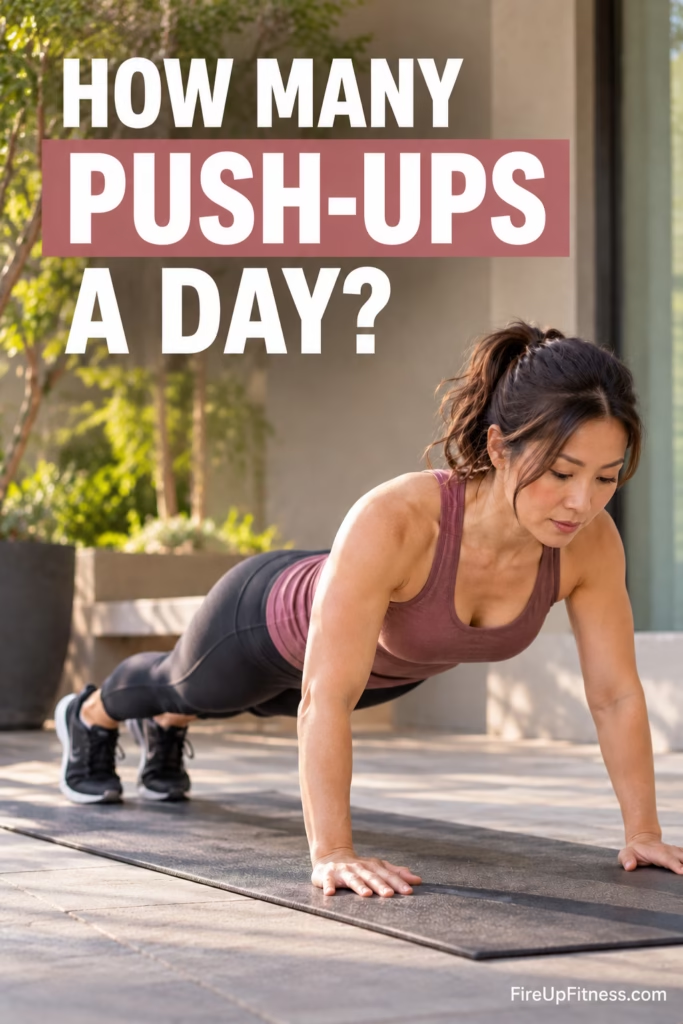
How Many Push-Ups a Day? A Guide for Women
How many push-ups should you do a day to build stronger arms, improve upper body strength, and feel more confident in your fitness routine?
The answer might surprise you. You don’t need to complete 50 push-ups every morning or spend hours exercising to make progress. Even a few well-performed push-ups can help you build strength when you practice consistently.
Push-ups are one of the most practical upper body exercises for women because they work several muscles at once, require no equipment, and can be modified for almost any fitness level.
Whether you’re learning your first push-up, returning to exercise after a break, or looking for a new challenge after 40, this guide will help you find a realistic starting point.
We’ll cover how many push-ups a day to aim for, beginner-friendly variations, proper technique, and a simple routine you can follow at home.
Why Push-Ups Are Worth Adding to Your Workout
Push-ups might look like a basic exercise, but they offer benefits that go beyond strengthening your arms.
1. Build Stronger Arms and Shoulders
Every push-up challenges your triceps, shoulders, and chest muscles.
Over time, consistent practice can improve upper body strength, making everyday activities such as carrying groceries, pushing a heavy door, or lifting household items feel easier.
You don’t need heavy dumbbells to begin building stronger arms. Your body weight provides resistance, and you can adjust the difficulty as you improve.
2. Strengthen Your Core
Push-ups aren’t just an arm workout.
Your abdominal muscles, back, and hips work together to keep your body stable throughout the movement.
This makes push-ups a useful addition to a core strengthening workout, especially when you’re looking for exercises that train multiple muscle groups at once.
The key is maintaining a stable body position rather than allowing your hips to sag.
3. Support Better Posture
Spending long hours sitting, working at a computer, or looking down at your phone can leave your upper body feeling stiff.
Push-ups strengthen several muscles involved in shoulder and trunk stability.
When combined with upper back exercises and gentle stretching, they can support better muscular balance and postural control.
4. Support Healthy Aging
Strength training becomes increasingly important as we get older.
Maintaining muscle strength helps support everyday movement, physical independence, and overall mobility.
For women over 40, push-ups offer a convenient way to challenge the upper body without needing a gym membership.
And there’s no requirement to begin with traditional floor push-ups. Wall and incline variations can be equally valuable starting points.
5. Make Exercise Easier to Fit Into Your Day
One of the biggest advantages of push-ups is their convenience.
You can practice them in your living room, bedroom, or home workout space.
A short session may take only five to ten minutes, making push-ups especially useful on busy days when a longer workout isn’t practical.
How Many Push-Ups a Day Should Women Do?
The ideal number depends more on your current strength, technique, and recovery than your age.
Instead of chasing a large number immediately, start with an amount you can complete comfortably while maintaining proper form.
Here’s a simple guide.
| Fitness level | Suggested starting target | Recommended approach |
|---|---|---|
| Beginner | 3–8 push-ups | 1–2 sets using a wall or incline |
| Building strength | 8–15 push-ups | 2 sets with comfortable rest |
| Intermediate | 15–25 push-ups | 2–3 sets |
| Advanced | 25–40+ push-ups | Multiple sets with progressive difficulty |
These are flexible practice targets, not daily requirements or official fitness standards. Choose a variation that suits your ability, and divide repetitions into manageable sets.
For building strength, 2–3 push-up workouts per week with recovery between challenging sessions is a practical starting point. Light technique practice can be done more often if it doesn’t interfere with recovery.
Remember, five controlled push-ups are more useful than twenty rushed repetitions with poor technique.
Push-Ups Per Day Chart by Age
Many women wonder whether their push-up goals should change in their 30s, 40s, 50s, or beyond.
Age can influence recovery and physical capacity, but there isn’t a universal number of push-ups every woman should perform at a particular age.
Your current fitness level matters much more.
| Age group | Suggested starting variation | Beginner practice target |
|---|---|---|
| 20–29 | Incline or floor push-ups | 5–10 reps |
| 30–39 | Incline or floor push-ups | 5–10 reps |
| 40–49 | Wall or incline push-ups | 4–10 reps |
| 50–59 | Wall or incline push-ups | 3–8 reps |
| 60+ | Wall push-ups or a comfortable incline | 3–8 reps |
These are illustrative starting options, not age-based limits or validated norms. A strong woman in her 60s may comfortably perform more traditional push-ups than a beginner in her 20s.
The best goal is one that challenges you without causing pain or compromising your technique.
How to Do a Proper Push-Up
Before increasing your repetitions, it’s worth learning the basic movement.
A push-up performed with good technique helps you challenge the intended muscles while reducing unnecessary strain.
Step-by-Step Instructions
- Start in a high plank position with your hands slightly wider than shoulder-width apart.
- Extend your legs behind you and keep your body aligned from head to heels.
- Tighten your abdominal muscles and gently engage your glutes.
- Bend your elbows and slowly lower your chest toward the floor, keeping your elbows at a comfortable angle rather than flaring them straight out.
- Lower only as far as you can while maintaining control.
- Press through your palms to return to the starting position.
- Repeat without rushing.
Beginner tip: If a full floor push-up feels too challenging, place your hands on a sturdy countertop or wall. You’ll practice a similar movement with less resistance.
Avoid holding your breath. Inhale as you lower and exhale as you push upward.
5 Push-Up Variations for Women
Not every push-up needs to look the same.
Changing your hand position or body angle allows you to adjust the challenge and keep your routine interesting.
Here are five variations worth trying.
1. Wall Push-Ups for Beginners
Wall push-ups are a gentle introduction to upper body strength training.
They’re especially helpful when you’re new to exercise or returning after a long break.
How to do it:
- Stand facing a wall, approximately an arm’s length away.
- Place your palms against the wall at shoulder height.
- Keep your feet planted and your body straight.
- Bend your elbows to bring your chest toward the wall.
- Push back to the starting position.
Try: 2 sets of 8–12 repetitions.
Move your feet closer to the wall if you need an easier version.
2. Incline Push-Ups for Upper Body Strength
Incline push-ups are a great next step after wall push-ups.
They allow you to practice the traditional push-up movement while reducing the amount of body weight you need to press.
How to do it:
- Place your hands on a sturdy countertop or stable elevated surface.
- Walk your feet backward until your body forms a straight line.
- Bend your elbows and lower your chest toward the surface.
- Keep your core engaged throughout the movement.
- Push upward until your arms are extended.
Try: 2 sets of 6–10 repetitions.
As your strength improves, gradually use a lower surface.
3. Knee Push-Ups for Building Strength
Knee push-ups offer another way to practice pressing strength before moving to traditional floor push-ups.
How to do it:
- Kneel on an exercise mat.
- Place your hands slightly wider than shoulder-width apart.
- Move your knees backward so your body forms a straight line from head to knees.
- Slowly lower your chest toward the mat.
- Press upward without allowing your hips to collapse.
Try: 2 sets of 5–10 repetitions.
Keep your movements controlled, and use padding beneath your knees for comfort.
4. Traditional Push-Ups for Full-Body Stability
Once you’ve built a comfortable foundation, traditional push-ups offer a greater strength challenge.
They engage your chest, triceps, shoulders, and core while requiring you to stabilize your body.
How to do it:
- Begin in a high plank.
- Position your hands slightly wider than your shoulders.
- Keep your neck neutral and abdominal muscles engaged.
- Lower your body in a controlled motion.
- Press back to the starting position.
Try: 2–3 sets of 5–12 repetitions, depending on your ability.
Stop the set when you can no longer maintain good technique.
5. Close-Grip Push-Ups for Triceps Strength
Close-grip push-ups increase the challenge for your triceps.
This variation is better suited to women who can already perform regular push-ups comfortably.
How to do it:
- Begin in a high plank position.
- Place your hands somewhat closer together than usual, keeping your wrists comfortable.
- Bend your elbows, allowing them to travel closer to your sides.
- Lower your chest with control.
- Push upward to complete the repetition.
Try: 2 sets of 5–8 repetitions.
You can also perform this variation against an elevated surface to make it easier.
A Simple 4-Week Push-Up Challenge for Women
Looking for an easy way to stay consistent?
This beginner-friendly 4-week push-up challenge focuses on gradual improvement rather than doing as many repetitions as possible.
| Week | Workout goal | Frequency |
|---|---|---|
| Week 1 | 2 sets of 5 wall or incline push-ups | 2–3 days |
| Week 2 | 2 sets of 6–8 push-ups | 2–3 days |
| Week 3 | 2 sets of 8–10 push-ups | 2–3 days |
| Week 4 | 3 sets of 6–10 push-ups or try a harder variation | 2–3 days |
Rest approximately 60–90 seconds between sets, or longer when needed.
Take a recovery day between challenging sessions. If the next week’s target feels too difficult, repeat your current week before progressing.
Helpful reminder: Progress doesn’t always mean completing more repetitions. Using a lower incline, improving your range of motion, or performing each push-up with better control also counts.
How Long Does It Take to See Push-Up Results?
It’s natural to wonder when your hard work will begin to make a difference.
Some women notice that push-ups feel easier after a few weeks of regular practice. Others need more time, especially when starting from a lower fitness level.
Here’s a realistic picture of what you might experience.
After 1–2 Weeks
You may become more comfortable with the movement and develop better awareness of your core and shoulder positioning.
Your technique may improve even before you notice a major increase in repetitions.
After 3–4 Weeks
With consistent practice, you may find yourself completing additional repetitions or using a more challenging variation.
Everyday pushing movements might also begin to feel easier.
After 6–8 Weeks and Beyond
Continued strength training can lead to more noticeable improvements in muscular endurance and upper body strength.
Changes in muscle appearance vary from person to person and depend on training, nutrition, recovery, and individual differences.
There is no fixed timeline, so focus on what your body can do rather than expecting identical results each week.
Common Push-Up Mistakes to Avoid
Sometimes improving your technique makes a bigger difference than adding more repetitions.
Here are a few common mistakes worth watching for.
Letting your hips sag: Keep your abdominal muscles engaged and maintain a stable body position. Switch to an incline if necessary.
Flaring your elbows too far outward: Allow your elbows to bend at a comfortable angle rather than pointing directly sideways.
Rushing through repetitions: Slow, controlled movements help you maintain proper positioning and make each repetition more purposeful.
Doing too much too soon: Increasing repetitions or difficulty too quickly can leave your muscles and joints feeling overworked.
Ignoring discomfort: Muscle effort is expected, but sharp pain in your wrists, shoulders, or elbows is a reason to stop and adjust the exercise.
Frequently Asked Questions About Push-Ups
Is Doing 10 Push-Ups a Day Enough?
Ten push-ups can be a useful starting point, especially for beginners.
Whether they’re enough to improve strength depends on how challenging they feel. Once ten repetitions become easy, try adding another set or moving to a harder variation.
Can Women Over 40 Do Push-Ups Every Day?
Yes, many women over 40 can include push-ups in their regular exercise routine.
However, challenging strength sessions generally benefit from recovery time. Two or three sessions per week is a sensible starting point, with additional easy practice as tolerated.
Wall and incline push-ups are excellent options for building strength gradually.
Are Wall Push-Ups Effective?
Absolutely. Wall push-ups train the chest, shoulders, and triceps using a lighter level of resistance.
They’re especially useful for beginners who want to develop confidence and proper technique before progressing to lower inclines.
Do Push-Ups Help Improve Core Strength?
Yes. Your abdominal and trunk muscles work to stabilize your body throughout a push-up.
However, push-ups shouldn’t be your only core exercise. Combining them with movements such as bird dogs, dead bugs, and planks can create a more balanced routine.
What Should I Do If I Can’t Perform One Push-Up?
Start with wall push-ups.
Practice a few comfortable repetitions, then gradually increase the challenge as your strength improves.
There’s no need to rush toward floor push-ups. Building strength at your own pace is what matters.
Should I Do Push-Ups Before or After My Workout?
If improving push-up strength is your main goal, practice them near the beginning of your strength workout after warming up.
When push-ups are simply an additional exercise, you can include them later in your routine.
Final Thoughts: Start Small and Build Strength
You don’t need an impressive push-up count to make meaningful progress.
Maybe you’re starting with three wall push-ups. Maybe you can already complete fifteen traditional push-ups. Both are worthwhile starting points.
The most important thing is finding a level that works for you, practicing with good technique, and allowing your body time to adapt.
Strong arms, better stability, and greater confidence are built one consistent workout at a time.
Choose your starting variation, try the four-week challenge, and celebrate every extra repetition that feels a little easier.