Stair Workout at Home: Easy Cardio & Strength Exercises
You don’t need a treadmill, expensive exercise equipment, or a large home gym to get an effective workout. Sometimes, one of the best pieces of fitness equipment is already built into your home: the stairs.
A stair workout at home can challenge your legs, raise your heart rate, strengthen your lower body, and add variety to a routine that has started to feel repetitive. And because you can adjust your speed, number of steps, repetitions, and rest periods, stair exercises can work for many different fitness levels.
Even a relatively short staircase can be useful. You can walk the stairs for cardio, use the bottom step for controlled strength exercises, or alternate between stair climbing and recovery periods to create a simple interval workout.
The important part is safety. Stairs add an extra challenge because you’re exercising on an elevated surface. Start slowly, pay attention to your footing, and choose controlled movements over speed—especially when you’re new to stair workouts.
Here’s how to turn an ordinary staircase into a challenging cardio and lower-body workout.
Why Use Stairs for Exercise?
Walking on flat ground is great exercise, but climbing stairs asks your lower-body muscles to work harder because you’re repeatedly lifting your body against gravity.
Your glutes, quadriceps, hamstrings, calves, and core all contribute as you climb. At the same time, continuous stair walking can quickly increase your heart rate.
That makes stair training an easy way to combine cardio and lower-body strength work without needing a room full of equipment.
Stair workouts can also be convenient. There’s no commute to the gym, and you don’t necessarily need a long workout. A few focused rounds can fit into a busy day.
Before Starting Your Stair Workout
Stair exercise requires more attention to balance and coordination than walking on a flat surface.
Choose stairs that are dry, clear, well-lit, and free from loose objects. Wear supportive shoes with good traction, and avoid carrying anything while exercising.
If a handrail is available, use it whenever you need additional stability.
Beginners should start with walking rather than running or jumping. There is no benefit in making an exercise more difficult before you can perform the easier version safely and comfortably.
A short warm-up can also help prepare your body. Spend about 5 minutes walking around your home or outside, followed by gentle ankle circles, calf raises, and easy marching.
Once you feel warm, you’re ready to begin.
1. Walk Up the Stairs
One of the simplest stair exercises is also one of the most effective: walking up the stairs at a steady pace.
Anyone who has climbed several flights knows how quickly stair walking can increase your breathing and heart rate.
Start at the bottom of the staircase and walk upward at a comfortable but purposeful pace. Step with your entire foot whenever possible rather than balancing on the edge of the step.
Keep your chest lifted and look toward the steps ahead instead of staring straight down at your feet.
Once you reach the top, slow down.
Walking downstairs requires control, so treat the descent as recovery rather than trying to move quickly.
Beginner Option
Walk up one flight, carefully return to the bottom, and rest for 30–60 seconds.
Repeat for 5–10 rounds, depending on the length of your staircase and your current fitness level.
As your endurance improves, gradually add another round or shorten your recovery period.
You don’t have to race to make stair walking challenging.
2. Try Faster Stair Climbs
Once regular stair walking feels comfortable, you can increase the intensity by climbing at a slightly faster pace.
Think quick and controlled, not all-out speed.
Pump your arms naturally and maintain an upright posture as you climb. Your feet should land securely on each step.
Climb quickly for approximately 15–30 seconds, then walk slowly or rest for 30–60 seconds.
Repeat several times.
These short bursts can turn a basic staircase into a simple cardio interval workout.
Important Safety Tip
Running or sprinting on stairs significantly increases the risk of missing a step or losing your balance.
For most home exercisers, especially beginners, fast controlled walking is a safer alternative to stair sprinting and can still provide a demanding workout.
Save maximum-effort running for a safer surface.
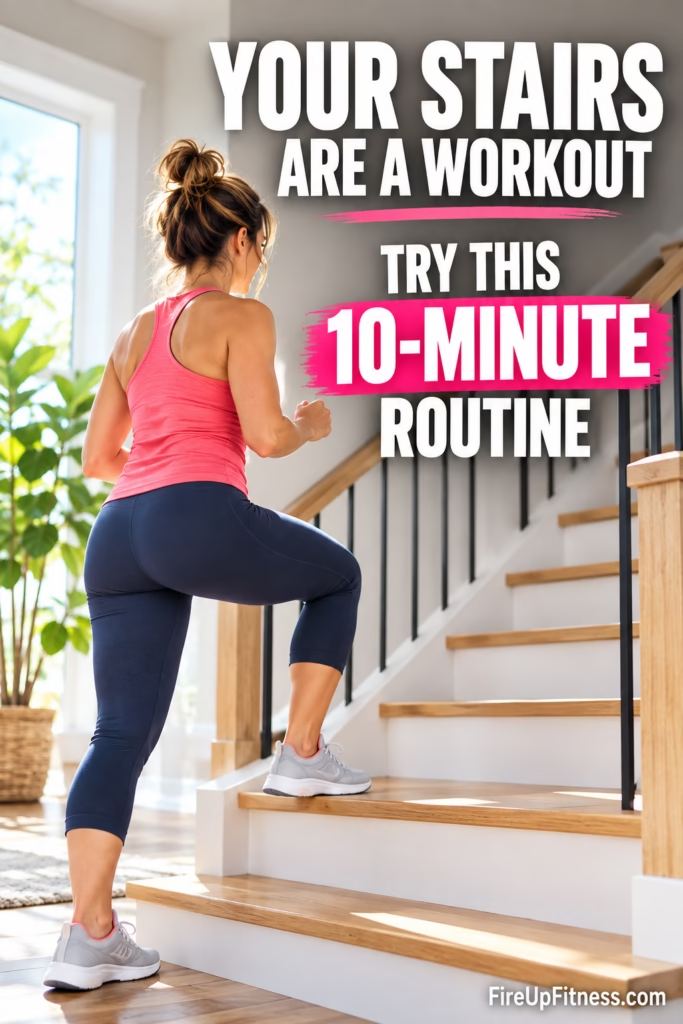
3. Do Stair Step-Ups
You don’t need an entire staircase for this exercise. The bottom step is enough.
Step-ups are excellent for working your thighs and glutes while also challenging balance and coordination.
Stand facing the bottom stair.
Place your right foot firmly on the step. Push through that foot and bring your body upward. Lightly tap your left foot onto the step before carefully returning it to the floor.
Continue for 8–12 repetitions, then switch sides.
Keep your movements slow and controlled.
Make It Easier
Use the handrail for balance and perform fewer repetitions.
Make It Harder
Once you’ve mastered the movement, perform alternating step-ups continuously for 30–45 seconds.
You can gradually increase the duration as your endurance improves.
4. Add Stair Calf Raises
Your calves work hard every time you climb stairs, but you can also target them directly.
For a safer variation, stand on a flat stair or landing near a handrail. Keep your feet securely positioned and hold the rail for balance.
Slowly raise your heels until you’re standing on the balls of your feet.
Pause briefly.
Lower your heels with control.
Repeat 10–15 times.
Avoid letting your heels hang far over the edge of the stair, particularly when you’re exercising alone. Keeping more of your foot supported makes the exercise safer.
5. Try Stair Toe Taps
Toe taps provide another way to increase your heart rate without running up an entire staircase.
Stand facing the bottom step.
Lightly tap your right foot onto the step and return it to the floor. Then tap your left foot.
Continue alternating feet.
Beginners can perform this slowly for 20–30 seconds.
As your coordination improves, gradually increase your pace while keeping each movement controlled.
Rest for 30 seconds and repeat.
This exercise can work especially well between strength exercises when you want to keep your body moving.
6. Use the Bottom Step for Incline Push-Ups
Stair workouts don’t have to focus entirely on your legs.
The bottom few steps can also help you perform an easier version of a push-up.
Place your hands securely on a step approximately shoulder-width apart. Walk your feet backward until your body forms a relatively straight line from your head through your hips.
Bend your elbows and slowly lower your chest toward the step.
Push through your palms to return to the starting position.
Aim for 8–12 repetitions.
The higher your hands are positioned, the easier the push-up generally becomes. Beginners can therefore use a higher step if needed.
This is an easy way to add some upper-body work to an otherwise lower-body-focused routine.
7. Stair Hops and Jumps: An Optional Advanced Exercise
Jumping exercises can make a stair workout significantly more demanding, but they aren’t necessary for getting a good workout.
For beginners, adults who have balance concerns, or anyone uncomfortable with jumping, skip this section entirely. Stair walking, step-ups, and toe taps are excellent alternatives.
More experienced exercisers who already perform plyometric training may use a low, stable bottom step for controlled jumps.
Stand close to the step with your feet approximately hip-width apart. Bend your knees slightly, jump onto the step, and land softly with your knees slightly bent.
Instead of jumping backward, carefully step down one foot at a time.
Perform a small number of quality repetitions.
Stop when your landing becomes noisy, unstable, or difficult to control.
The goal isn’t to see how high or fast you can jump. Good technique is more important.
Create Your Own Stair Interval Workout
You probably won’t want to walk continuously up and down your stairs for 30 or 45 minutes—and you don’t need to.
Interval training lets you alternate harder periods with easier periods.
Here’s a simple example.
15-Minute Stair Workout at Home
Warm-up – 3 minutes
Walk around your home, march in place, and gently move your ankles and legs.
Round 1 – Stair Walking
Walk steadily up the stairs for 30–60 seconds.
Carefully walk back down and recover.
Round 2 – Step-Ups
Perform alternating step-ups for 30 seconds.
Rest for 30 seconds.
Round 3 – Faster Stair Climb
Walk briskly up the stairs for 20–30 seconds.
Walk slowly during your recovery.
Round 4 – Incline Push-Ups
Perform 8–12 controlled repetitions.
Rest as needed.
Round 5 – Toe Taps
Alternate feet for 30 seconds.
Rest for 30 seconds.
Repeat the circuit 2–3 times, depending on your fitness level.
Finish with several minutes of easy walking.
This gives you a combination of cardio, leg work, and upper-body exercise in one compact routine.
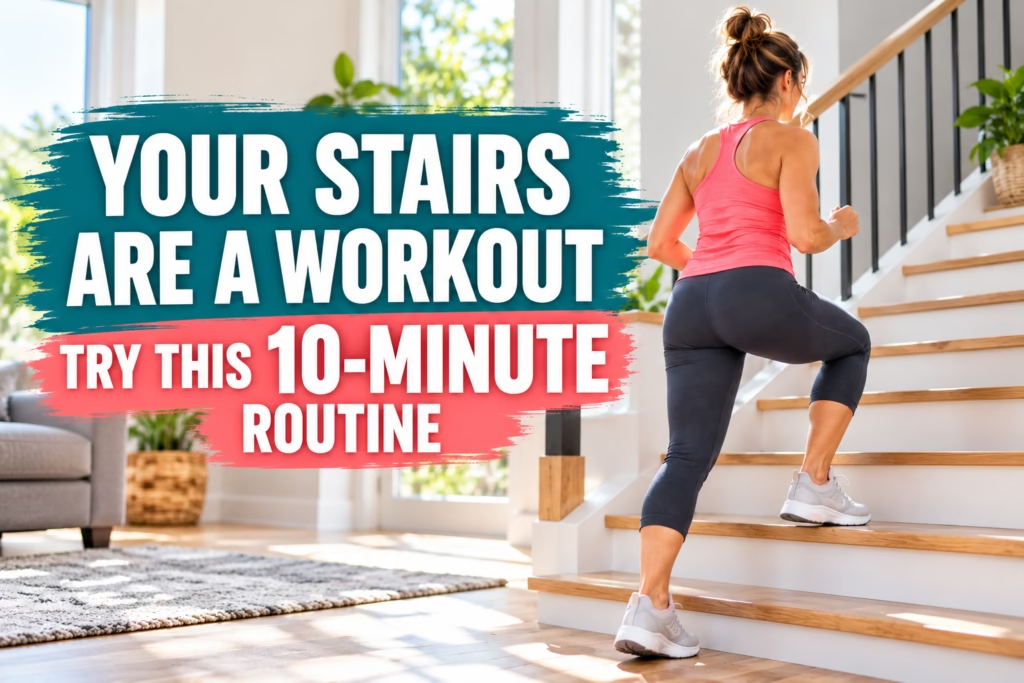
Beginner 10-Minute Stair Workout
New to stair exercises? You don’t need to start with a complicated routine.
Try this:
2 minutes: Easy walking and warm-up
1 minute: Slow stair walking
1 minute: Rest or walk on flat ground
1 minute: Step-ups
1 minute: Recovery
1 minute: Stair walking
1 minute: Toe taps
1 minute: Easy stair walking
1 minute: Cool-down walking
Ten minutes might not sound like much, but consistency matters more than trying to complete an exhausting workout on your first day.
Once 10 minutes becomes comfortable, progress to 12 or 15 minutes.
How to Make Stair Workouts More Challenging
Your body adapts when you perform the same workout repeatedly.
That doesn’t mean you need to start jumping or sprinting.
There are safer ways to progress.
You can:
- Add another round.
- Walk for slightly longer intervals.
- Shorten your rest periods.
- Increase your pace gradually.
- Add more step-ups.
- Combine stair exercises with squats, wall push-ups, or other bodyweight exercises.
Change one variable at a time.
For example, if you normally complete five stair-walking rounds, try six before dramatically increasing your speed.
Small increases can make a big difference over several weeks.
How Often Should You Do Stair Workouts?
How often you train depends on your overall exercise routine, fitness level, and how your body responds.
A beginner might start with 1–2 stair workouts per week, leaving recovery time between sessions.
More experienced exercisers may include stair climbing as part of their regular cardio or strength routine.
Remember that stairs can place significant demand on the calves, thighs, and glutes. Muscle fatigue is a good reason to give your lower body time to recover.
You can alternate stair days with walking, upper-body workouts, stretching, yoga, or other lower-impact activities.
Stair Workout Safety Tips
Stair workouts can be effective, but safety should always come before intensity.
Use a sturdy staircase with even steps and a secure handrail. Remove toys, clothing, rugs, and anything else that could become a tripping hazard.
Don’t exercise on wet or slippery stairs.
Keep your movements controlled, especially when coming downstairs. Fatigue can affect coordination, so don’t wait until your legs are completely exhausted before stopping.
And don’t feel pressured to perform jumping exercises simply because they’re included in a workout.
No-jumping stair workouts can still be challenging.
If you experience dizziness, unusual shortness of breath, chest discomfort, sharp pain, or feel unstable, stop exercising. Anyone with medical conditions, significant joint or balance concerns, or a history of falls should consider getting individualized medical or exercise guidance before beginning a demanding stair routine.
Can Stair Workouts Help With Fat Loss?
Stair climbing can be one useful part of a fat-loss routine because it provides physical activity while challenging large muscles in your lower body.
But there’s no single exercise that specifically burns belly, thigh, or hip fat.
Fat loss is influenced by your overall activity, eating habits, sleep, recovery, and other individual factors.
Instead of viewing stairs as a shortcut, think of them as another practical tool for becoming more active.
A 10- or 15-minute stair session that you actually do regularly can be much more valuable than an elaborate workout plan that you rarely complete.
No Stairs? Try These Alternatives
You can still create a similar workout without a full staircase.
A sturdy aerobic step can be used for step-ups and toe taps. You can also use an appropriate low platform designed for exercise.
For cardio, combine step-ups with marching, brisk walking, or other low-impact movements.
Avoid using unstable household furniture, boxes, or stools as substitutes for exercise steps.
Final Thoughts
A good workout doesn’t always require special equipment.
With a safe staircase and a little creativity, you can create a stair workout at home that challenges your cardiovascular fitness and strengthens your legs, glutes, and core.
Start with simple stair walking and controlled step-ups. Once those exercises feel comfortable, gradually increase the duration or pace and experiment with interval training.
You don’t have to sprint.
You don’t have to jump.
And you definitely don’t have to exhaust yourself on your first workout.
Start with 10 minutes, focus on secure footing and good form, and build from there.
The stairs you walk past every day might just become one of the most convenient workout tools in your home.