12-Minute One-Dumbbell Triceps Workout for Women
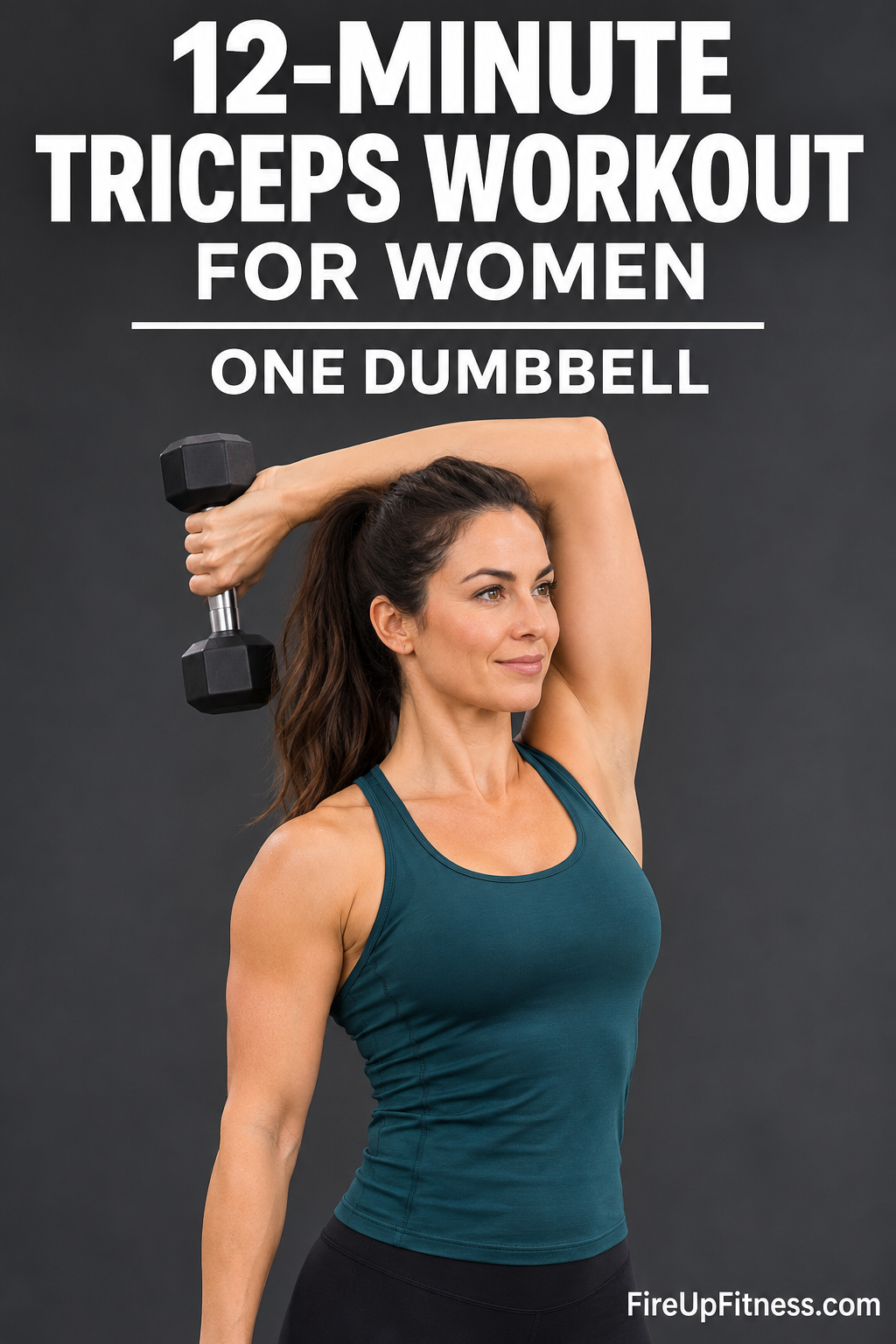
You don’t need a full set of weights or a long gym session to give your arms a challenging workout. Sometimes, one dumbbell and 12 focused minutes are enough to make your triceps work harder than you might expect.
The triceps are the muscles along the back of your upper arms. They help straighten your elbows and support everyday movements such as pushing a door open, lifting objects, and getting up from the floor.
Yet, it’s easy to overlook them when planning an arm workout. Biceps curls often get most of the attention, while the triceps receive only a few repetitions at the end.
This 12-minute triceps workout for women takes a different approach.
Instead of another long list of arm exercises, you’ll follow a simple, timed routine using just one dumbbell. The workout combines controlled extensions, floor presses, and single-arm movements to challenge your triceps from different positions.
There are no push-ups, complicated equipment changes, or lengthy rest periods. Just six exercises, two rounds, and a straightforward plan you can follow at home.
Why Train Your Triceps?
Your triceps make up a substantial portion of your upper-arm muscle mass. Strengthening them helps develop balanced arm strength alongside your biceps and shoulders.
The triceps brachii consists of three heads:
- Long head: Runs along the back of your upper arm and crosses both the shoulder and elbow joints.
- Lateral head: Located along the outer back portion of your upper arm.
- Medial head: Lies deeper beneath the other two heads and contributes to elbow extension.
All three work together when you straighten your elbow against resistance.
A balanced triceps workout uses different arm positions to challenge these muscles. For example, overhead extensions place the long head in a more lengthened position, while close-grip presses allow you to train the triceps through a pressing movement.
You don’t need a separate exercise for every muscle head. A few well-chosen movements performed consistently can provide an effective strength-training session.
Can You Get a Good Triceps Workout With Just One Dumbbell?
Absolutely. One dumbbell is enough to create meaningful resistance, especially when you use controlled repetitions and choose a weight that challenges you.
A single dumbbell also offers several practical advantages.
It’s convenient. You don’t need multiple pairs of weights or a large workout space.
It allows unilateral training. Single-arm exercises let you work each side independently, making differences in strength or control easier to notice.
It’s easy to adjust. You can change the number of repetitions, movement speed, or rest periods without changing equipment.
It works well at home. Most of the exercises require only enough space to stand comfortably or lie on an exercise mat.
The key is selecting a dumbbell that allows you to maintain good form while making the final few repetitions feel challenging.
Your 12-Minute One-Dumbbell Triceps Workout Plan
This arm workout routine uses six exercises performed in two rounds.
Each exercise lasts 40 seconds, followed by 20 seconds of rest.
| Workout detail | Plan |
|---|---|
| Total workout | 12 minutes |
| Equipment | One dumbbell and an exercise mat |
| Exercises | 6 |
| Work interval | 40 seconds |
| Rest interval | 20 seconds |
| Rounds | 2 |
| Difficulty | Beginner to intermediate |
| Main focus | Triceps strength and muscular endurance |
For single-arm exercises, work for 20 seconds on each side within the 40-second interval.
The 12 minutes cover the main workout. Allow another three minutes for a gentle warm-up beforehand.
How Heavy Should Your Dumbbell Be?
For beginners, a light dumbbell around 2–5 pounds may be a reasonable starting point, although the appropriate weight depends on your experience and strength.
More experienced exercisers may prefer a heavier weight.
Since you’ll use the same dumbbell throughout the workout, choose a weight you can control during the most demanding exercise, rather than one that only feels challenging during your strongest movement.
It’s perfectly fine to shorten an interval or reduce your repetitions when necessary.
Warm Up Your Arms Before Starting
Spend approximately three minutes preparing your shoulders, elbows, and upper body.
Try the following movements:
- Arm circles: 30 seconds forward and 30 seconds backward.
- Gentle elbow bends and extensions: 30 seconds.
- Shoulder rolls: 30 seconds.
- Standing arm reaches: 30 seconds.
- Light practice repetitions: 30 seconds of your first triceps exercise without a dumbbell.
Move comfortably without forcing your joints through an uncomfortable range of motion.
Once your arms feel ready, grab your dumbbell and begin.
6 One-Dumbbell Triceps Exercises for Women
1. Two-Hand Overhead Triceps Extension
40 seconds work · 20 seconds rest
The overhead triceps extension is a useful starting exercise because it trains your triceps with your arms raised.
This position places the long head of the triceps under greater stretch than many arms-at-your-sides variations.
How to do it:
- Stand with your feet approximately hip-width apart.
- Hold one dumbbell securely with both hands, supporting one end of the weight.
- Raise the dumbbell overhead with your arms extended.
- Keep your upper arms relatively steady beside your head.
- Slowly bend your elbows to lower the weight behind your head.
- Straighten your elbows to return to the starting position.
Continue for 40 seconds.
Form tip: Keep your ribs down and avoid arching your lower back. Lower the dumbbell only as far as your shoulders and elbows comfortably allow.
Beginner modification: Perform the exercise seated on a sturdy chair with back support, using a lighter weight.
2. Single-Arm Triceps Kickback
20 seconds per arm · 20 seconds rest
Triceps kickbacks are a useful addition to an at-home arm workout because they challenge elbow extension with your upper arm positioned behind your torso.
This exercise requires relatively little weight when performed with control.
How to do it:
- Stand with your feet staggered and knees slightly bent.
- Hinge forward at your hips while keeping your back neutral.
- Rest your free hand on a sturdy chair or bench for support.
- Hold the dumbbell in your working hand.
- Bend your elbow to approximately 90 degrees, keeping your upper arm close to your torso.
- Straighten your elbow, extending the dumbbell behind you.
- Pause briefly before returning to the starting position.
Perform 20 seconds on one arm, then switch sides.
Form tip: Keep your upper arm steady. The movement should come primarily from your elbow rather than swinging your shoulder.
Beginner modification: Use a lighter dumbbell and shorten the range of motion if needed.
3. One-Dumbbell Close-Grip Floor Press
40 seconds work · 20 seconds rest
This exercise introduces a pressing movement to your triceps routine.
Unlike an isolation exercise, the close-grip floor press also involves your chest and shoulders, making it a practical upper-body strength movement.
How to do it:
- Lie on your back on an exercise mat.
- Bend your knees and place your feet flat on the floor.
- Hold one dumbbell securely with both hands over the center of your chest.
- Keep your elbows relatively close to your body.
- Slowly lower the dumbbell toward your chest, bending your elbows.
- Stop when your upper arms comfortably contact the floor or reach your available range.
- Press the dumbbell upward until your elbows are straight without forcefully locking them.
Continue for 40 seconds.
Form tip: Keep your wrists aligned and maintain a secure grip throughout the movement. Avoid flaring your elbows widely.
Beginner modification: Use a lighter dumbbell and practice the pressing movement slowly.
4. Single-Arm Floor Triceps Extension
20 seconds per arm · 20 seconds rest
This floor-based triceps exercise provides a different challenge from the overhead extension.
It also allows you to concentrate on one arm at a time without having to balance in a standing position.
How to do it:
- Lie on your back with your knees bent and feet flat.
- Hold the dumbbell in your right hand with your arm extended above your shoulder.
- Keep your upper arm relatively steady.
- Slowly bend your elbow, bringing the dumbbell toward the side of your head.
- Stop before the weight reaches your face or the floor.
- Straighten your elbow to return to the starting position.
- Continue for 20 seconds, then switch arms.
Form tip: Move slowly and keep the dumbbell under control, especially during the lowering phase.
Beginner modification: Reduce the lowering range and use a lighter weight.
5. Cross-Body Triceps Extension
20 seconds per arm · 20 seconds rest
The cross-body triceps extension changes the direction of the movement while keeping the focus on straightening your elbow.
It’s another way to work one arm independently with a single dumbbell.
How to do it:
- Lie on your back with your knees bent.
- Hold the dumbbell in your right hand, extending your arm upward.
- Keep your upper arm steady and gently bend your elbow.
- Lower the dumbbell diagonally toward the area beside your opposite shoulder.
- Stop at a comfortable point without allowing the dumbbell to touch your body.
- Straighten your elbow to return to the starting position.
- Perform 20 seconds on each arm.
Form tip: Use a slow, controlled motion. Avoid rotating your torso or moving your shoulder excessively to complete the repetition.
Beginner modification: Practice the movement without weight first to become familiar with the path of your arm.
6. Single-Arm Neutral-Grip Floor Press
20 seconds per arm · 20 seconds rest
Finish the round with a single-arm pressing exercise.
Although this movement also works your chest and shoulders, your triceps contribute as you straighten your elbow.
Because you’re holding the dumbbell on one side, your torso must also resist unwanted rotation.
How to do it:
- Lie on your back with your knees bent and feet planted.
- Hold the dumbbell in your right hand above your shoulder.
- Rotate your wrist so your palm faces inward toward the center of your body.
- Keep your elbow relatively close to your side.
- Lower the dumbbell slowly until your upper arm gently contacts the floor.
- Press the weight upward while keeping your torso stable.
- Continue for 20 seconds before switching arms.
Form tip: Keep your shoulders and hips level. Avoid twisting your body as you press the dumbbell upward.
Beginner modification: Choose a lighter dumbbell and keep your free arm extended along the floor for stability.
Complete 12-Minute Triceps Workout Schedule
Follow this sequence twice.
| Exercise | Work | Rest |
|---|---|---|
| Two-Hand Overhead Triceps Extension | 40 sec | 20 sec |
| Single-Arm Triceps Kickback | 40 sec | 20 sec |
| One-Dumbbell Close-Grip Floor Press | 40 sec | 20 sec |
| Single-Arm Floor Triceps Extension | 40 sec | 20 sec |
| Cross-Body Triceps Extension | 40 sec | 20 sec |
| Single-Arm Neutral-Grip Floor Press | 40 sec | 20 sec |
Round 1: Minutes 0–6
Round 2: Minutes 6–12
Each round includes four minutes of exercise and two minutes of rest, including the final 20-second transition.
You can use the last rest interval of Round 1 to prepare for Round 2. Beginners may take additional rest as needed, even if that extends the workout beyond 12 minutes.
The goal isn’t to complete as many repetitions as possible. Focus on controlled movements and maintaining good technique throughout both rounds.
How to Make This Triceps Workout More Effective
1. Choose a Weight That Challenges You
A dumbbell that’s too light may not provide enough resistance to improve strength over time.
However, using a weight that’s too heavy can cause your elbows to flare, your shoulders to compensate, or your movements to become rushed.
Aim for a weight that feels moderately challenging while still allowing you to complete repetitions with good control.
2. Control the Lowering Phase
Rather than allowing the dumbbell to drop quickly, take approximately two seconds to lower it.
This encourages controlled movement and helps you avoid relying on momentum.
3. Keep Your Upper Arms Stable During Extensions
For triceps isolation exercises, excessive movement at the shoulders can shift some of the work away from your intended target.
Your upper arms don’t need to remain perfectly motionless, but try to avoid swinging them to lift the weight.
4. Train Both Arms Evenly
Single-arm exercises can reveal differences between your right and left sides.
Start with your less-strong arm and match the number of controlled repetitions on the opposite side.
Avoid doing extra repetitions on your stronger side simply because it feels easier.
5. Increase the Challenge Gradually
As you become stronger, you can progress by:
- Increasing the dumbbell weight.
- Completing more controlled repetitions within each interval.
- Reducing unnecessary pauses during the working period.
- Adding a third round when you have more time.
You don’t need to make every workout harder. Consistency and gradual progression matter more than pushing to exhaustion.
How Often Should Women Train Their Triceps?
For many beginners, training the triceps twice per week is a reasonable starting point.
Your triceps also work during other upper-body exercises, including chest presses and some shoulder presses. Consider that additional training when planning your weekly routine.
For example:
| Day | Workout |
|---|---|
| Monday | 12-Minute Triceps Workout |
| Tuesday | Lower-body workout |
| Wednesday | Walking or mobility |
| Thursday | Full-body strength workout |
| Friday | Rest or light activity |
| Saturday | 12-Minute Triceps Workout |
| Sunday | Rest |
Adjust the schedule according to your overall training volume and recovery.
If your arms remain unusually sore or fatigued, allow additional recovery time before another demanding session.
Common Mistakes to Avoid During Triceps Exercises
Using momentum: Swinging the dumbbell reduces your control over the movement. Slow down and focus on deliberate repetitions.
Choosing a weight that’s too heavy: Heavy weights aren’t necessary for every exercise. Kickbacks and single-arm extensions often require less resistance than pressing movements.
Allowing the elbows to flare excessively: During extensions and close-grip presses, keep your elbows in a comfortable, controlled position.
Rushing between exercises: Use the 20-second rest intervals to reposition yourself safely, particularly when moving from standing exercises to the floor.
Ignoring joint discomfort: Muscle fatigue is expected, but sharp pain in your elbows, shoulders, or wrists is a reason to stop and reassess the movement.
Frequently Asked Questions
Is one dumbbell enough for a triceps workout?
Yes. A single dumbbell can provide enough resistance for an effective triceps workout, especially when you combine two-handed movements with single-arm exercises.
Can beginners do this 12-minute arm workout?
Yes. Beginners can use a lighter dumbbell, perform fewer repetitions, and take additional rest when needed.
You can also start with one round instead of two.
Will triceps exercises make my arms stronger?
Yes. Consistent resistance training can strengthen your triceps, particularly when the exercises become progressively more challenging over time.
Can I do this workout without push-ups?
Absolutely. All six exercises use a dumbbell, so push-ups aren’t required.
What dumbbell weight should women use for triceps?
There is no single ideal weight. Beginners may start with approximately 2–5 pounds, while experienced exercisers may use more resistance.
Choose a weight based on your ability to perform each exercise safely and with good technique.
Can I train my triceps every day?
Daily challenging triceps workouts generally aren’t necessary. Your muscles need adequate recovery, particularly when you’re using progressively heavier resistance.
Two or three appropriately spaced sessions per week may be sufficient for many women.
Do triceps exercises help improve the appearance of your arms?
Strengthening the triceps can increase muscle strength and, with appropriate training, contribute to muscle development. Changes in appearance depend on several factors, including training consistency, genetics, and overall body composition.
Follow Along With a One-Dumbbell Triceps Workout
Prefer following a workout on video? This 10-minute beginner-friendly triceps routine from Fit with Frank uses just one dumbbell and offers another way to practice arm-strengthening exercises at home. Watch the demonstration, choose a comfortable weight, and follow along at your own pace.
Final Thoughts
A productive arm workout doesn’t need to involve dozens of exercises or an entire collection of dumbbells.
With one weight and 12 minutes, you can challenge your triceps through overhead extensions, controlled floor presses, and single-arm movements that encourage balanced strength.
The key is to make every repetition count.
Start with a manageable dumbbell, move slowly, and give yourself time to become comfortable with the exercises. As your strength improves, gradually increase the challenge rather than rushing through the routine.
Save this 12-minute one-dumbbell triceps workout for your next upper-body training day. It’s a simple, practical way to build stronger arms at home without turning a short workout into a complicated one.