5 Isometric Glute Exercises for Women at Home
Strong glutes aren’t built only through squats, lunges, and endless repetitions. Sometimes, holding a position without moving can be surprisingly challenging. Your muscles begin working harder, your legs may start to shake, and suddenly, a simple 20-second hold feels much longer than expected.
That’s the idea behind isometric glute exercises.
Instead of repeatedly lifting and lowering your body, you hold a position while your glute muscles remain engaged. This type of strength training can help improve muscular endurance, hip stability, and body control without jumping or complicated movements.
The best part? You can do an effective glute workout at home with just an exercise mat and a little floor space.
This beginner-friendly routine includes five isometric glute exercises that target different areas of your glutes. Whether you’re adding them to your regular lower-body workout or trying static holds for the first time, these movements offer a simple way to challenge your muscles.
What Are Isometric Glute Exercises?
Isometric exercises involve creating muscular tension without noticeable movement at the joints.
For example, during a regular glute bridge, you repeatedly raise and lower your hips. During an isometric glute bridge, you lift your hips and hold that position.
Your muscles continue producing force even though you’re not moving.
This type of training can be useful for developing strength at the positions being trained, improving muscular endurance, and practicing controlled muscle engagement.
Your glutes consist of three main muscles:
- Gluteus maximus: The largest glute muscle, responsible primarily for extending your hips and helping generate lower-body power.
- Gluteus medius: Located along the outer pelvis, this muscle helps move your leg sideways and stabilize your hips.
- Gluteus minimus: A deeper muscle that assists with hip movement and pelvic stability.
A balanced glute strengthening workout should challenge these muscles through different movements and positions.
Isometric holds provide another way to train them, particularly when combined with traditional resistance exercises.
Benefits of Isometric Glute Exercises for Women
1. Improve Glute Strength and Muscular Endurance
Holding a challenging position requires your muscles to maintain tension over time.
With consistent practice and appropriate progression, isometric training can help improve your ability to produce and sustain muscular force.
2. Support Hip and Pelvic Stability
Your glutes play an important role in keeping your pelvis stable when you walk, climb stairs, or stand on one leg.
Exercises such as single-leg bridge holds and side-lying hip abduction holds challenge the muscles involved in maintaining that stability.
3. Offer a Low-Impact Workout Option
Most isometric glute exercises involve little movement once you’re in position.
This makes them a useful option for women who prefer low-impact workouts without jumping or rapid changes in direction.
However, low-impact doesn’t necessarily mean easy or suitable for every joint condition. Choose comfortable positions and adjust the intensity when necessary.
4. Improve Body Awareness
Static holds give you time to notice how your hips, pelvis, and abdominal muscles are working together.
This can help you develop better control during other strength exercises.
5. Add Variety to Your Glute Workout Routine
Traditional repetitions and static holds challenge your muscles differently.
Combining both methods can make your glute workout routine more varied while helping you develop strength through different positions.
How to Do This 15-Minute Isometric Glute Workout
You don’t need heavy weights or specialized gym equipment for this routine.
Start with bodyweight resistance and focus on holding each position with proper alignment.
Workout details
| Workout feature | Plan |
|---|---|
| Exercises | 5 |
| Hold duration | 20 seconds |
| Rest between holds | 10 seconds |
| Rounds | 3 |
| Between-round rest | 45 seconds |
| Equipment | Exercise mat, optional mini resistance band |
| Difficulty | Beginner-friendly |
For single-sided exercises, hold each side for 20 seconds.
The workout takes approximately 15 minutes, including short transitions and a warm-up.
Before beginning, spend two or three minutes warming up with gentle marching, hip circles, or comfortable bodyweight hip movements.
5 Best Isometric Glute Exercises at Home
1. Isometric Glute Bridge Hold
The glute bridge hold is a great starting point because it strengthens the gluteus maximus while encouraging stability through your hips and pelvis.
Unlike a traditional glute bridge workout, where your hips move up and down, this variation focuses on maintaining tension at the top.
How to do it:
- Lie on your back with your knees bent and feet flat on the floor.
- Position your feet approximately hip-width apart.
- Rest your arms comfortably beside your body.
- Gently tighten your abdominal muscles and squeeze your glutes.
- Lift your hips until your shoulders, hips, and knees form a relatively straight line.
- Hold the position for 20 seconds while breathing steadily.
- Slowly lower your hips to the mat.
Beginner modification: Lift your hips slightly lower and begin with a 10-second hold.
Form tip: Avoid pushing your hips excessively high or arching your lower back. Focus on maintaining tension through your glutes rather than your spine.
Muscles worked: Gluteus maximus, hamstrings, and trunk stabilizers.
2. Single-Leg Glute Bridge Hold
Once you’re comfortable with a regular glute bridge, the single-leg variation adds a greater stability challenge.
By supporting your body primarily through one leg, you increase the demand on the working hip and the muscles that help keep your pelvis level.
How to do it:
- Lie on your back with both knees bent and feet flat on the floor.
- Lift your hips into a comfortable glute bridge position.
- Slowly lift your right foot off the floor while keeping your knee bent.
- Maintain level hips and avoid allowing your pelvis to drop.
- Hold for 20 seconds.
- Lower your right foot and hips with control.
- Repeat with your left leg.
Beginner modification: Keep both feet on the floor and gradually shift a little more weight onto one leg without lifting the other foot.
Form tip: Keep your pelvis level. If your hips begin twisting or dropping, return to the two-legged bridge.
Muscles worked: Gluteus maximus, gluteus medius, hamstrings, and core stabilizers.
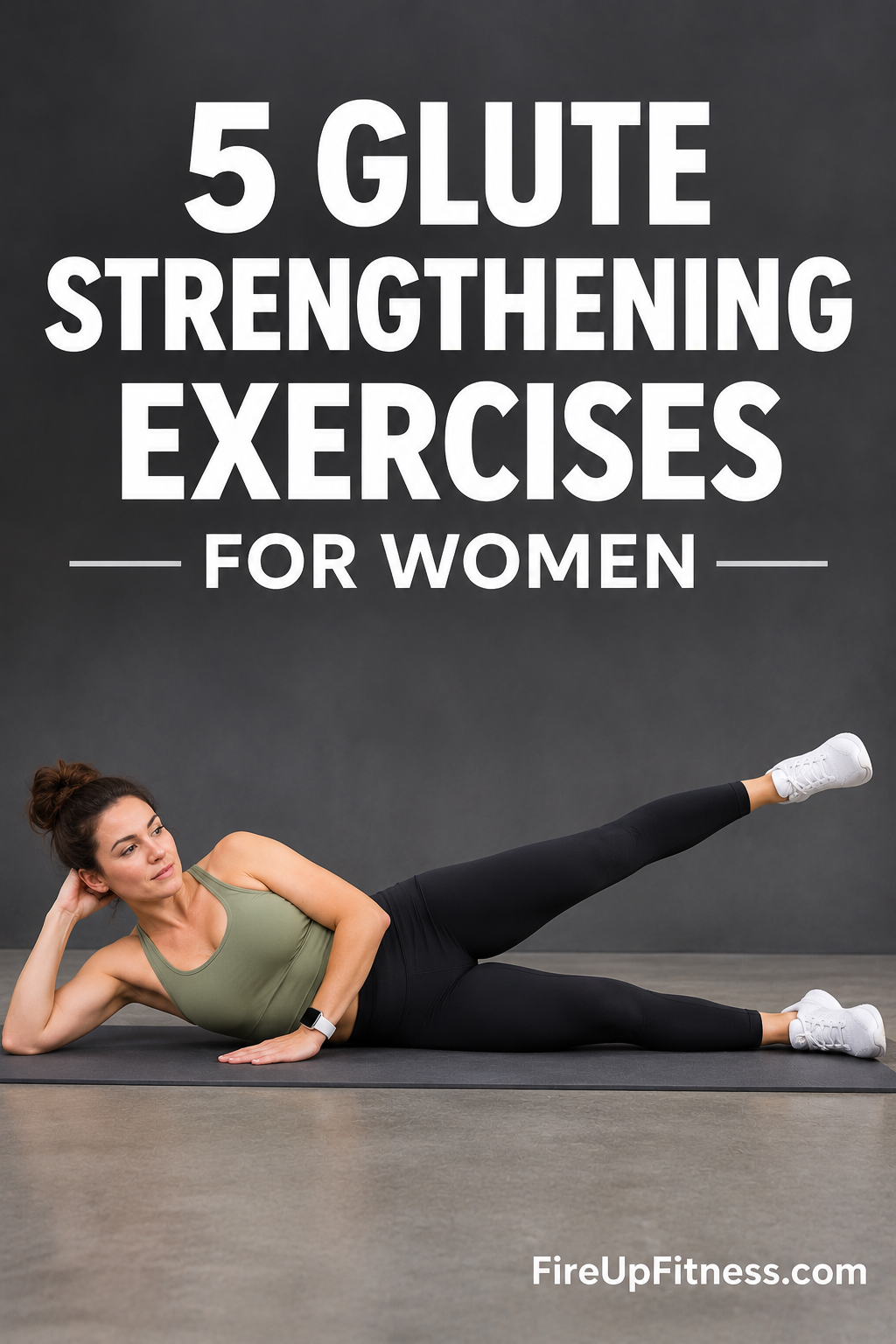
3. Side-Lying Hip Abduction Hold
This exercise emphasizes the muscles along the outer side of your hips, particularly the gluteus medius and minimus.
These muscles help stabilize your pelvis during walking, standing, and single-leg movements.
How to do it:
- Lie on your right side with your legs extended.
- Support your head comfortably on your lower arm.
- Stack your hips and keep your torso steady.
- Slowly lift your left leg approximately 8–12 inches above your bottom leg, or to a comfortable height.
- Keep your toes generally facing forward rather than turning toward the ceiling.
- Hold for 20 seconds.
- Lower your leg slowly and repeat on the opposite side.
Beginner modification: Bend your bottom knee for additional support and begin with a shorter hold.
Form tip: Avoid rolling your hips backward or lifting your leg excessively high. A small, controlled hold is enough to challenge the outer glutes.
Muscles worked: Gluteus medius and gluteus minimus.
4. Quadruped Hip Extension Hold
The quadruped hip extension hold challenges your gluteus maximus while requiring your core to stabilize your torso.
It is similar to a donkey kick, but instead of performing repeated kicks, you maintain the lifted position.
How to do it:
- Begin on your hands and knees.
- Position your wrists beneath your shoulders and knees beneath your hips.
- Gently engage your abdominal muscles.
- Keeping your right knee bent at approximately 90 degrees, lift your right thigh behind you.
- Stop when your thigh is approximately in line with your torso, or earlier if needed.
- Hold for 20 seconds without arching your lower back.
- Lower your knee and repeat with your left leg.
Beginner modification: Lift your knee only a few inches off the floor and hold for 10 seconds.
Form tip: Keep your hips facing the mat. Avoid rotating your pelvis or using your lower back to lift your leg higher.
Muscles worked: Gluteus maximus and trunk stabilizers.
5. Standing Hip Abduction Hold
Finish your isometric glute workout with a standing exercise that challenges your outer glutes and balance.
This movement is especially useful because it trains hip stability while you’re upright, similar to many everyday activities.
How to do it:
- Stand beside a sturdy chair or wall.
- Place one hand lightly on the support.
- Keep your feet facing forward and your torso upright.
- Shift your weight onto your left leg.
- Slowly lift your right leg out to the side.
- Hold the position for 20 seconds without leaning your torso.
- Lower your foot and repeat on the opposite side.
Beginner modification: Lift your leg only a few inches and use the chair for additional balance.
Form tip: Keep your hips level and avoid leaning away from your lifted leg. Both your supporting hip and lifted leg muscles contribute to stability.
Muscles worked: Gluteus medius, gluteus minimus, and supporting hip stabilizers.
Your 15-Minute Isometric Glute Workout Plan
Follow the exercises in this order for a simple glute workout at home.
| Exercise | Hold time |
|---|---|
| Glute Bridge Hold | 20 seconds |
| Single-Leg Glute Bridge Hold | 20 seconds per side |
| Side-Lying Hip Abduction Hold | 20 seconds per side |
| Quadruped Hip Extension Hold | 20 seconds per side |
| Standing Hip Abduction Hold | 20 seconds per side |
Rest for 10 seconds between holds, allowing additional transition time when switching sides or positions.
Complete three rounds, resting for 45 seconds between rounds.
The working holds total 11 minutes across three rounds. With rest periods, transitions, and a brief warm-up, plan for approximately 15–18 minutes.
How to Progress Your Isometric Glute Exercises
One advantage of isometric training is that you can adjust the difficulty without learning completely new movements.
Start with shorter holds and gradually increase the challenge as your strength improves.
| Experience level | Hold duration | Rounds |
|---|---|---|
| Beginner | 10–15 seconds | 1–2 |
| Developing strength | 20 seconds | 2–3 |
| More experienced | 30–40 seconds | 2–3 |
These are suggested starting points, not strict requirements.
Once you can maintain a position comfortably for 30–40 seconds, consider adding resistance rather than continuously extending the hold.
For example, you might use a mini resistance band during standing hip abductions or place a suitable weight across your hips during a glute bridge hold.
Always choose a resistance level that allows you to maintain proper technique.
Are Isometric Glute Exercises Better Than Regular Glute Workouts?
Isometric exercises and traditional repetitions both have benefits, but they train your muscles in slightly different ways.
During dynamic exercises, such as regular glute bridges, your muscles produce force while changing length as your joints move.
During isometric exercises, your muscles produce force while you hold a relatively fixed position.
Isometric training can improve strength, particularly around the joint angles being trained, and can develop muscular endurance.
Dynamic resistance training helps build strength through movement and may be more practical for developing strength across a larger range of motion.
For a balanced lower body workout at home, consider combining both approaches.
For example, you could perform 10–12 regular glute bridges followed by a 15–20-second bridge hold.
This combination challenges your muscles through movement and sustained tension.
Common Mistakes to Avoid During Glute Holds
Holding Your Breath
It’s easy to hold your breath when your muscles begin working harder.
Instead, breathe steadily throughout each exercise. Avoid prolonged breath-holding, particularly if you have blood pressure concerns.
Holding the Position Too Long
Longer holds aren’t automatically better.
Once your technique begins to deteriorate, the exercise becomes less useful. Start with manageable durations and progress gradually.
Arching Your Lower Back
During glute bridges and quadruped hip extensions, avoid lifting your hips or legs by excessively arching your lower spine.
Keep your abdominal muscles gently engaged and focus on movement and stability through your hips.
Ignoring Muscle Fatigue
Mild shaking can occur during challenging isometric holds, especially when you’re new to the exercises.
However, stop if you experience sharp pain, dizziness, numbness, or unusual joint discomfort.
Using Too Much Resistance
Adding a strong resistance band before mastering the bodyweight version can make it difficult to maintain proper alignment.
Build control first, then increase resistance gradually.
How Often Should Women Do Isometric Glute Workouts?
For beginners, two or three sessions per week is a reasonable starting point.
You can perform this routine on its own or add a few isometric holds to the end of your regular glute workout.
A simple weekly schedule might look like this:
| Day | Activity |
|---|---|
| Monday | Isometric glute workout |
| Tuesday | Walking or gentle mobility |
| Wednesday | Upper-body strength workout |
| Thursday | Isometric glute workout |
| Friday | Light activity or rest |
| Saturday | Full-body strength training |
| Sunday | Rest or stretching |
Your ideal schedule depends on your overall activity level and how challenging the sessions feel.
Allow adequate recovery between demanding glute workouts, especially when you are beginning a new strength training routine.
Frequently Asked Questions
Can isometric exercises build glute muscle?
Yes. Challenging isometric contractions can contribute to muscle growth when the intensity, training volume, and progression are sufficient. However, combining static holds with progressive dynamic resistance training is generally a more complete approach to glute development.
Are isometric glute exercises good for beginners?
Yes. Many isometric glute exercises can be adapted by reducing hold duration, adjusting body position, or using additional support.
Can I do isometric glute exercises every day?
Gentle holds may be manageable on many days, but challenging strength sessions require recovery. Beginners can start with two or three focused sessions per week.
Do I need resistance bands for this workout?
No. All five exercises can be performed using bodyweight resistance. Bands are optional for increasing difficulty as your strength improves.
Are isometric glute exercises good for hip stability?
They can help strengthen muscles involved in stabilizing the pelvis and hips. Exercises such as single-leg bridge holds and standing hip abduction holds are particularly relevant to this goal.
How long should I hold an isometric glute exercise?
Beginners can start with 10–20 seconds. As your strength and control improve, you may gradually progress to 30–40 seconds or introduce additional resistance.
Final Thoughts
You don’t need endless repetitions or complicated equipment to challenge your glutes.
These five isometric glute exercises for women offer a simple way to build strength, improve hip stability, and develop better control over your lower-body movements.
Start with shorter holds, focus on steady breathing, and choose positions you can maintain comfortably.
As the exercises become easier, gradually increase the duration or resistance while keeping your technique consistent.
The next time you finish a regular glute workout, try adding a 20-second glute bridge hold. It’s a simple way to experience how challenging a movement can become even when you’re standing—or lying—completely still.