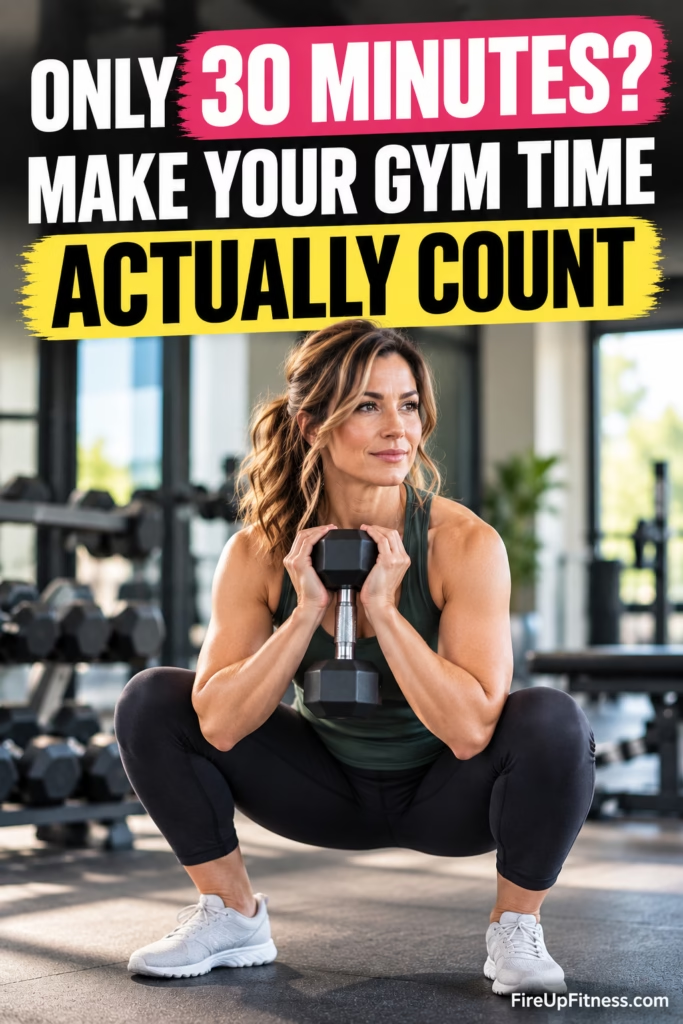
How to Make Your Gym Workouts More Effective
Some days, simply making it to the gym feels like an accomplishment.
Between work, school, family responsibilities, appointments, errands, cooking, and everything else that fills the day, finding a long stretch of uninterrupted time for exercise isn’t always realistic.
You may have only 30 or 40 minutes before you need to move on to the next thing.
And that’s exactly why how you use your gym time matters just as much as how much time you spend there.
Think about it.
You arrive at the gym with good intentions, but then you check a few messages. You spend several minutes deciding what exercise to do first. Someone starts a conversation. The machine you planned to use is occupied. You take a quick break that somehow becomes ten minutes.
Suddenly, most of your available workout time is gone.
The solution isn’t necessarily spending longer at the gym.
It’s becoming more intentional with the time you already have.
A focused workout can feel completely different from one filled with interruptions. You move with purpose, concentrate on your form, keep your momentum, and leave knowing you used your available time well.
Here are practical ways to make your gym workouts more effective, focused, and productive—especially when life is busy.

1. Turn Off Electronic Notifications
Your phone can be one of your most useful workout tools—and one of your biggest distractions.
You might use it for music, a timer, workout tracking, or exercise instructions. That’s perfectly reasonable.
The problem starts when every notification gets your attention.
A message appears.
You check it.
While you’re there, you notice another message.
Then you open your email.
Maybe you check social media for “just a second.”
Five minutes later, you’re still holding your phone.
How This Improves Your Workout
Imagine you’re performing several sets of an exercise.
You finish your first set and plan to rest briefly before starting again. Instead, you see a notification and begin answering a message.
Your short rest period turns into several minutes.
Now you’ve lost your rhythm, your concentration has shifted somewhere else, and you have to mentally restart the workout.
Compare that with putting your phone on Do Not Disturb or Focus mode before exercising.
You finish your set, take your planned rest, and continue.
The workout flows.
You stay mentally connected to what you’re doing.
And those small pockets of saved time can add up over the course of your gym session.
Unless you’re waiting for an important call or need to remain reachable for family reasons, consider silencing unnecessary notifications until you’re finished.
Your workout doesn’t need more screen time. It needs more focused time.
2. Choose Workout Clothes That Actually Fit
It sounds simple, but uncomfortable workout clothing can become a surprisingly big distraction.
Leggings that keep sliding down.
A shirt that constantly rides up.
Shoes that rub your feet.
A sports bra that doesn’t feel supportive.
Shorts that require adjusting every few minutes.
Each individual interruption may seem insignificant, but together they can make it harder to concentrate on your workout.
How This Improves Your Workout
Imagine doing squats while thinking more about your waistband than your movement.
Instead of concentrating on your knees, hips, posture, breathing, and control, you’re wondering whether you’ll need to adjust your clothes again when you stand up.
Now imagine doing the same exercise in clothing that stays comfortably in place.
Your attention can remain where it belongs—on your movement.
You don’t need expensive gym clothes or the latest fitness trends.
You need clothes that allow you to bend, squat, reach, walk, lift, and stretch comfortably without constantly thinking about what you’re wearing.
The right workout clothing almost becomes invisible once you start exercising.
And that’s exactly what you want.
3. Walk Into the Gym Knowing What You Want to Accomplish
One of the easiest ways to waste gym time is walking through the door without knowing what you’re going to do.
You warm up.
Then you look around.
Maybe you’ll train legs.
Or perhaps you’ll do upper body.
You walk toward one machine, change your mind, check your phone for exercise ideas, and eventually settle on something.
You may still get a workout, but valuable minutes disappear simply because you’re making decisions that could have been made beforehand.
How This Improves Your Workout
Suppose you have 35 minutes available.
If you spend the first 10 minutes deciding which exercises to perform, you’ve already used almost one-third of your available time.
But when you arrive knowing that today’s focus is lower body strength, upper body strength, cardio, or another specific goal, you can begin almost immediately.
That doesn’t mean your plan has to be complicated.
You simply need direction.
Know which area you’re training, which exercises you intend to perform, and what you’ll do if certain equipment isn’t available.
A few minutes of planning before leaving home can save considerably more time once you’re inside the gym.
4. Set Realistic Fitness Goals
There’s a big difference between wanting to “get fit” and knowing what you’re actually working toward.
Vague goals can make workouts feel random.
Specific goals give your training direction.
Your goal might be to:
- become stronger
- improve cardiovascular endurance
- lose body fat
- maintain muscle as you get older
- improve mobility
- feel more energetic
- become consistent with exercise
- gradually lift heavier weights
Your reason for exercising influences how you use your gym time.
How This Improves Your Workout
Imagine two people walking into the same gym.
One says:
“I’m just going to exercise for a while.”
The other says:
“My goal is to become stronger, so I’m going to focus on controlled strength exercises and gradually improve over time.”
The second person has a much easier time deciding what deserves attention.
Having a clear goal also makes it easier to say no to exercises that don’t fit today’s purpose.
You don’t have to try every machine simply because it’s there.
Your workout should serve your goals—not become a tour of the gym.
5. Find a Quieter Area When You Need More Focus
Gyms can be social places, and there’s nothing wrong with saying hello or enjoying the company of people you know.
For some people, workout partners make exercise much more enjoyable.
But when your gym time is limited, long conversations can quickly consume the time you intended to spend exercising.
You may also find it difficult to concentrate in a busy area where people are constantly moving around you.
How This Improves Your Workout
Suppose you’re trying to perform several floor exercises, but you’re positioned in one of the busiest parts of the gym.
People keep walking around you.
Someone stops to talk.
Equipment is constantly being moved nearby.
You may spend more time repositioning yourself than exercising.
Moving to a quieter open area can completely change the experience.
You can concentrate on your breathing, technique, repetitions, and rest periods without constantly being interrupted.
This is particularly useful for stretching, mobility work, core exercises, dumbbell movements, and other exercises that don’t require large machines.
You don’t need to hide from everyone.
You simply want to create an environment where it’s easier to focus.
6. Stop Trying to Do Everything in One Gym Session
When time is limited, there’s often a temptation to cram as much as possible into one workout.
A little cardio.
Some legs.
A few arm exercises.
Abs.
Glutes.
More cardio.
Another machine because you haven’t used it recently.
Before long, your workout has no clear direction.
More exercises don’t automatically mean better results.
How This Improves Your Workout
Imagine you have 40 minutes.
You could rush through 12 different exercises, spending only a little time on each one.
Or you could choose fewer exercises that match your goal and perform them with greater concentration and control.
The second approach may allow you to pay more attention to your technique and progress.
You don’t need to leave the gym having trained every muscle from every possible angle.
There will be another workout.
Focus on what matters today.
7. Keep Your Rest Periods Intentional
Rest is an important part of exercise, especially during strength training.
But unplanned rest is different from purposeful recovery.
One of the most common gym time-wasters happens between sets.
You finish an exercise.
You sit down.
You check your phone.
You answer a message.
You look around.
Then you realize several minutes have passed.
How This Improves Your Workout
Let’s say you intended to take a short rest between sets.
Without paying attention, that break could easily become much longer than necessary.
Using a timer or simply staying aware of your rest periods keeps your workout moving.
That doesn’t mean rushing.
Some exercises require more recovery than others, particularly when you’re lifting challenging weights.
The goal isn’t to rest as little as possible.
The goal is to make your rest intentional rather than accidental.
When it’s time to recover, recover.
When it’s time to exercise, exercise.
8. Have a Backup Exercise Ready
Few things interrupt a workout faster than discovering that the equipment you planned to use is occupied.
You can stand nearby waiting.
You can repeatedly check whether the person is finished.
Or you can adapt.
Having alternatives in mind makes busy gym days much easier.
How This Improves Your Workout
Suppose you planned to use a particular machine, but someone has just started several sets.
Waiting could cost you 10 minutes.
Instead, you choose another exercise that trains the same general muscle group and continue your workout.
You haven’t abandoned your plan.
You’ve simply adjusted it.
Learning a few alternative exercises can be incredibly useful in crowded gyms.
It also removes some of the frustration that comes from expecting your workout to go exactly according to plan.
The equipment may change. Your goal doesn’t have to.
9. Keep Your Workout Equipment Close When Possible
Walking back and forth across a large gym can quietly consume a surprising amount of time.
Of course, some movement between areas is unavoidable.
But constantly switching between equipment on opposite sides of the gym can make a short workout much less efficient.
How This Improves Your Workout
Imagine performing one dumbbell exercise, walking across the gym for a machine, returning to the dumbbell area, and then walking somewhere else for your next movement.
You’re exercising—but you’re also spending a lot of your limited time simply moving between stations.
When practical, group exercises that use similar equipment or are located in the same general area.
For example, if several exercises require dumbbells, completing them while you’re already in the dumbbell area can reduce unnecessary wandering.
It’s a small change, but small changes matter when you have only 30 or 40 minutes.
10. Don’t Confuse Being Exhausted With Having a Good Workout
A productive workout doesn’t have to leave you completely drained.
Sweating heavily, feeling exhausted, or barely being able to walk out of the gym aren’t the only signs that exercise was worthwhile.
For many people—especially busy adults—the goal should be to exercise effectively without making the rest of the day miserable.
How This Improves Your Workout
Suppose you have work, errands, or family responsibilities after exercising.
Pushing yourself far beyond what you’re accustomed to might leave you so tired that everything else becomes harder.
A challenging but manageable workout may allow you to train consistently while still having energy for the rest of your life.
That’s an important distinction.
Fitness should support your life, not constantly compete with it.
11. Focus on Exercise Quality Instead of Racing Through Repetitions
When you’re short on time, you might feel tempted to perform every exercise as quickly as possible.
But faster isn’t automatically better.
Rushing can make your technique sloppy and reduce your ability to concentrate on the muscles you’re training.
How This Improves Your Workout
Consider performing 10 controlled squats compared with rushing through 20 while barely paying attention to your positioning.
The slower, more deliberate repetitions may allow you to concentrate on your posture, range of motion, balance, and muscle control.
Efficiency doesn’t mean moving recklessly.
It means removing wasted time, not removing the care you put into each exercise.
12. Track What You’re Doing
You don’t need a complicated spreadsheet or fitness app to track your workouts.
A simple note on your phone can be enough.
Record things such as:
- exercises performed
- weights used
- repetitions
- sets
- how difficult the exercise felt
- anything you want to change next time
How This Improves Your Workout
Imagine returning to the gym next week and trying to remember which dumbbells you used.
Was it 15 pounds?
20?
Did you perform eight repetitions or 12?
Instead of guessing every workout, you can quickly look at your previous session and continue from there.
Tracking also helps you recognize progress that may otherwise go unnoticed.
Maybe the weight that once felt challenging now feels manageable.
Maybe you can complete more repetitions with good form.
Maybe you’re becoming more consistent.
Those improvements matter.
13. Don’t Spend Your Workout Comparing Yourself to Other People
The gym makes comparison incredibly easy.
Someone beside you may be lifting much heavier weights.
Another person may be running faster.
Someone may look stronger, leaner, or more experienced.
But you don’t know their training history, genetics, goals, age, injuries, lifestyle, or how long they’ve been exercising.
Comparing yourself with them can distract you from the only progress that really matters—your own.
How This Improves Your Workout
Instead of wondering why someone else can lift twice as much as you, focus on whether you’re stronger than you were a few weeks ago.
Instead of matching someone else’s treadmill speed, choose a pace appropriate for your fitness level.
That keeps your workout safer, more purposeful, and much less stressful.
Use other people as inspiration when it helps.
But don’t turn someone else’s workout into your standard.
14. Learn the Gym Before Your Workout
If you’ve recently joined a new gym, give yourself time to learn where everything is located.
Knowing where the dumbbells, benches, cardio equipment, stretching area, lockers, and machines are can make future workouts much smoother.
How This Improves Your Workout
You don’t want to spend five minutes searching for a piece of equipment every time you change exercises.
Once you become familiar with the gym layout, you can move between exercises more efficiently.
If you’re unsure how a machine works, ask a qualified member of staff rather than experimenting with equipment you don’t understand.
A little familiarity can remove a lot of wasted time.
15. Arrive Ready to Exercise
Another easy way to make gym workouts more productive is to remove as many decisions as possible before you arrive.
Have your clothes ready.
Fill your water bottle.
Know what you’re training.
Pack anything you need.
Choose your music beforehand.
These small preparations may seem insignificant, but together they make it easier to begin exercising immediately.
How This Improves Your Workout
Think about two different gym visits.
On the first, you arrive and spend time looking for headphones, filling your water bottle, choosing music, checking messages, and deciding what you’re going to train.
On the second, you walk through the door already prepared.
Which workout is more likely to feel focused?
Preparation creates momentum.
And when you’re already busy, reducing unnecessary decisions can make exercise feel much easier to manage.
What If You Only Have 20 or 30 Minutes?
Don’t automatically assume it’s not worth going.
This is where many people get stuck.
They imagine that a “real workout” requires an hour, so when they only have 25 minutes available, they skip exercise completely.
But your schedule doesn’t have to be perfect for exercise to be worthwhile.
A shorter session gives you an opportunity to move your body, practice exercises, maintain your routine, and reinforce the habit of showing up.
And there’s another advantage.
Knowing that you have limited time often makes you more focused.
You aren’t wandering around wondering what to do.
You aren’t spending 15 minutes scrolling through your phone.
You know you have a small window, so you use it.
Sometimes less available time creates better concentration.
How to Make Gym Workouts More Effective After 40
As we get older, spending more time exercising isn’t necessarily the goal.
Training smarter becomes increasingly important.
For women over 40 in particular, strength training can be an important part of maintaining muscle and supporting everyday function as the years pass.
But recovery matters too.
You don’t need to punish your body every time you exercise.
Pay attention to how you feel, gradually progress your workouts, use good technique, and give your body appropriate recovery between challenging sessions.
Your workout should leave you feeling like you’re building yourself up—not constantly wearing yourself down.
The “Just One More Exercise” Trap
You’ve finished what you planned to do.
Then you think:
“Maybe I should do one more exercise.”
Then another.
Then a little cardio.
There’s nothing wrong with doing extra exercise when you genuinely have the time, energy, and reason for it.
But don’t assume a workout wasn’t effective simply because it was short.
Knowing when you’re finished is also part of efficient training.
When you’ve completed what you came to accomplish, it’s okay to leave.
You don’t earn extra fitness points for wandering around the gym looking for something else to do.
The Real Secret to a More Productive Gym Workout
Making your workouts more effective isn’t about finding a magical exercise.
It’s about reducing the little distractions that steal your time.
Think about how many minutes can disappear through:
- checking notifications
- long conversations
- deciding what to do next
- waiting unnecessarily for equipment
- adjusting uncomfortable clothing
- taking unplanned breaks
- searching for equipment
- wandering between areas
- comparing yourself with other people
Individually, these things seem small.
Together, they can consume a significant portion of your workout.
When you remove them, something changes.
A 30-minute workout actually becomes 30 minutes of purposeful exercise instead of 30 minutes spent partly exercising and partly distracted.
And for anyone balancing fitness with work, school, children, family, or a busy household, that difference matters.
Make the Time You Have Count
You don’t need your life to become less busy before you can become more consistent with exercise.
You also don’t need to spend endless hours at the gym.
Start with the time you realistically have.
Put your phone on Focus mode.
Wear clothes that let you move comfortably.
Know why you’re going to the gym before you arrive.
Have alternatives ready when equipment is busy.
Keep your breaks intentional.
Concentrate on your technique.
Track your progress.
Then leave knowing that you used your time well.
Some days you’ll have plenty of time.
Other days you’ll barely squeeze a workout into your schedule.
Both can count.
Because ultimately, the most productive gym workout isn’t necessarily the longest one.
It’s the one where you show up with a purpose, stay focused, and make the time you have count.
Save these tips for the next time you’re tempted to skip the gym because you think you don’t have enough time. You may be surprised by how much you can accomplish when you remove the distractions.