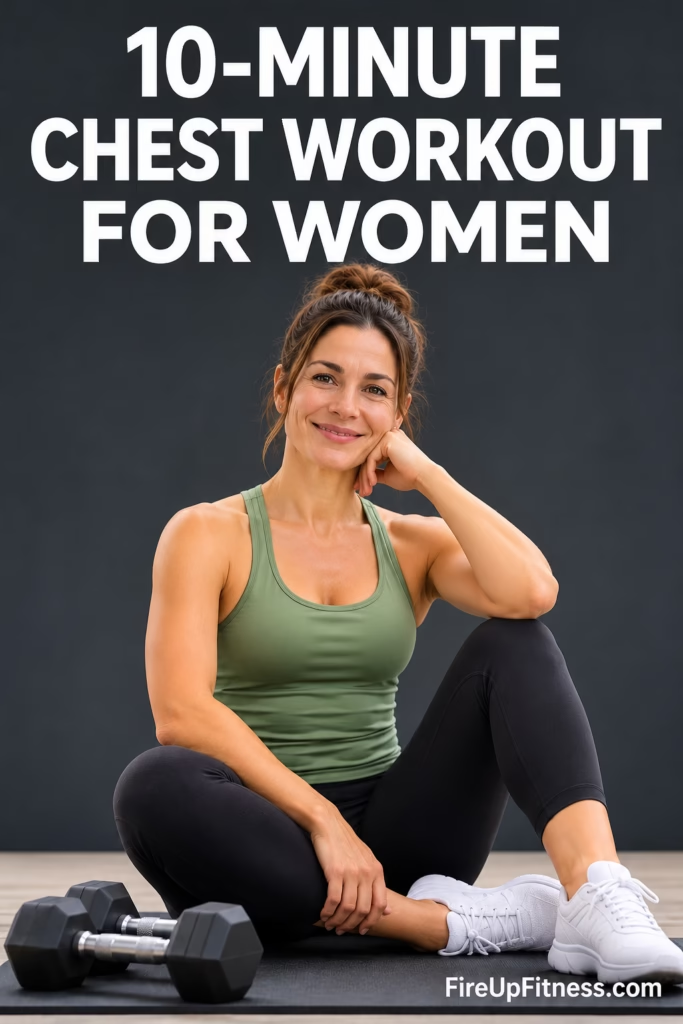
10-Minute Chest Workout for Women With Dumbbells at Home
A stronger chest can make everyday movements feel easier, improve upper-body strength, and help you feel more confident during workouts. And you don’t need a long gym session or complicated equipment to work these muscles.
This 10-minute chest workout for women uses dumbbells and bodyweight exercises to strengthen the chest, challenge the arms, and build better upper-body control. Everything happens on the floor, making it a convenient routine to do at home.
The workout combines traditional chest presses, slow-tempo movements, reverse-grip presses, chest flies, and push-ups. Each exercise challenges your chest muscles in a slightly different way, helping you get more from a short strength-training session.
While strengthening the pectoral muscles can improve the muscular support beneath the breasts, exercise cannot directly lift breast tissue or change its natural firmness. What this routine can do is help develop a stronger chest, support better posture, and improve your pressing strength.
Why Try This 10-Minute Chest Workout?
Your chest muscles, primarily the pectoralis major and pectoralis minor, contribute to many upper-body movements. They help you push, press, and bring your arms toward the center of your body.
Training these muscles regularly can help you:
- Build chest and upper-body strength.
- Improve your ability to perform push-ups.
- Strengthen muscles involved in everyday pushing movements.
- Develop better control during dumbbell exercises.
- Support balanced upper-body training when combined with back and shoulder exercises.
The best part is that this routine takes approximately 10 minutes, so you can complete it on its own or add it to another workout.
What You’ll Need
This at-home chest workout requires very little equipment:
- Dumbbells: Choose weights that challenge you while allowing controlled movement. You may want lighter weights for chest flies and reverse-grip presses.
- Exercise mat: Provides a comfortable surface for floor exercises and push-ups.
- A little floor space: Enough room to extend your arms comfortably.
The workout follows a simple interval format: 50 seconds of exercise followed by 15 seconds of rest. Each movement is performed twice before moving to the next exercise.
There are five exercises in total, giving you 10 working intervals.
Follow Along With the 10-Minute Chest Workout Video
Follow the instructor through each exercise, paying attention to the demonstrations, breathing cues, and rest periods. The video makes it easier to maintain the workout’s pace without watching a separate timer.
5 Chest Exercises for a Stronger Upper Body
1. Dumbbell Chest Press
2 rounds · 50 seconds each · 15 seconds rest
The dumbbell chest press is the first exercise in this routine. It primarily targets the pectoralis major while also engaging the triceps and front shoulders.
How to do it:
- Lie on your back with your knees bent and feet flat on the floor.
- Hold a dumbbell in each hand with your elbows bent and palms facing toward your feet.
- Position your upper arms at a comfortable angle away from your torso.
- Exhale as you press both dumbbells upward until your arms are extended without forcefully locking the elbows.
- Slowly lower the weights until your upper arms lightly touch the floor.
Keep your wrists straight and avoid bouncing your elbows against the mat.
During the second round, choose a weight that makes the final repetitions challenging without compromising your technique.
2. Slow-Tempo Dumbbell Chest Press
2 rounds · 50 seconds each · 15 seconds rest
This variation uses the same pressing movement but changes the speed. Slowing down each repetition increases the time your muscles spend working and makes it harder to rely on momentum.
How to do it:
- Return to the floor chest press position.
- Slowly raise the dumbbells, aiming for a controlled count of up to eight.
- Briefly pause at the top.
- Lower the weights over another slow count.
- Repeat at a pace you can maintain with good form.
You may complete fewer repetitions than during a regular chest press, and that’s perfectly fine.
Form tip: Keep your wrists aligned with your forearms. If your arms begin shaking excessively or you lose control of the weights, reduce the load or shorten the tempo.
3. Reverse-Grip Dumbbell Chest Press
2 rounds · 50 seconds each · 15 seconds rest
The reverse-grip chest press changes your hand position and pressing mechanics, providing a different challenge for your chest, shoulders, and triceps.
You may find this variation more demanding than the traditional press, so consider using slightly lighter dumbbells.
How to do it:
- Lie on your back with a dumbbell in each hand.
- Rotate your hands so your palms face toward your head, using an underhand grip.
- Keep your elbows at a comfortable angle away from your torso rather than flaring them outward.
- Press the dumbbells upward while maintaining a firm grip and straight wrists.
- Lower slowly and repeat.
Avoid forcing your wrists into an uncomfortable position. A neutral grip, with palms facing each other, is a useful alternative if the reverse grip feels awkward.
This exercise also develops pressing strength that can carry over to movements such as push-ups.
4. Dumbbell Chest Fly
2 rounds · 50 seconds each · 15 seconds rest
Chest flies focus on bringing your arms toward the midline of your body, one of the main actions of the pectoral muscles.
Unlike a chest press, the fly uses a wider arm movement, so lighter dumbbells are often more appropriate.
How to do it:
- Lie on your back and hold both dumbbells directly above your chest.
- Keep a slight bend in your elbows.
- Slowly open your arms outward in a wide arc.
- Stop when your upper arms gently reach the floor, without forcing a deeper stretch.
- Bring the dumbbells back together above your chest using a controlled squeezing motion.
Imagine gently hugging a large exercise ball as you bring your arms inward.
Form tip: Maintain the same slight elbow bend throughout the movement. Avoid lowering the weights too quickly or stretching your shoulders beyond a comfortable range.
5. Push-Ups
2 rounds · 50 seconds each · 15 seconds rest
The workout finishes with push-ups, a bodyweight exercise that challenges your chest, triceps, shoulders, and core.
After several rounds of dumbbell exercises, your chest muscles may already feel tired. Focus on controlled repetitions rather than trying to complete as many as possible.
How to do it:
- Place your hands on the mat slightly wider than shoulder-width apart.
- Extend your legs behind you into a plank position, or lower your knees for a modified push-up.
- Engage your abdominal muscles and keep your body aligned.
- Bend your elbows and lower your chest toward the mat.
- Exhale as you push through your palms to return to the starting position.
For knee push-ups, maintain a straight line from your head to your knees rather than letting your hips sag.
You can also perform a few full push-ups before switching to the knee variation. Both versions help strengthen your upper body.
How to Get Better Results From This Chest Workout
A short workout can be effective when the resistance and technique match your fitness level. These practical adjustments can help you make steady progress.
Choose Challenging but Manageable Dumbbells
The final few repetitions of each set should feel demanding, but you should still be able to control the movement.
You don’t need to use the same weight for every exercise. Chest presses generally allow heavier loads than chest flies, and slower repetitions may require lighter weights.
Focus on Muscle Control
Avoid rushing through repetitions simply to complete more of them.
Pay attention to how your chest muscles work as you press or bring your arms together. Maintain a comfortable range of motion and avoid using momentum to lift the dumbbells.
Make Time for Recovery
Try this chest workout two times per week to start, allowing approximately 48 hours between challenging sessions for the same muscle group.
As your strength improves, you can gradually increase resistance or incorporate the routine into a broader upper-body training plan.
For balanced development, include pulling exercises such as dumbbell rows alongside chest training.
Can Chest Exercises Help Lift the Breasts?
Chest workouts are sometimes described as breast-lifting or breast-firming exercises, but it’s important to understand what they can realistically accomplish.
The breasts are made primarily of glandular tissue, fat, and connective tissue rather than muscle. Exercise cannot directly tighten breast tissue or reverse natural changes associated with aging, pregnancy, or genetics.
However, the pectoral muscles sit beneath the breasts. Strengthening these muscles can develop the underlying chest area, while balanced upper-body training can support a more upright posture.
The most reliable benefits of this routine are improved muscle strength, pressing ability, and upper-body function.
Finish With a Gentle Chest Stretch
After completing your final push-ups, give your upper body a little time to relax.
Try a gentle doorway chest stretch:
- Stand in a doorway and place one forearm against the doorframe.
- Keep your elbow slightly below shoulder height.
- Slowly turn your body away until you feel a comfortable stretch across your chest.
- Hold for 20–30 seconds without bouncing.
- Repeat on the opposite side.
The stretch should feel gentle, not painful. Stop if you experience pinching or discomfort in your shoulder.
Final Thoughts
Building a stronger chest doesn’t require an hour of training or access to a gym. This 10-minute chest workout brings together five effective exercises that challenge your muscles through different pressing and arm movements.
Start with weights you can control, work through the intervals at your own pace, and gradually increase the challenge as you become stronger.
Some days, you may complete every interval with heavier dumbbells. Other days, lighter weights or modified push-ups may be the better choice. What matters is maintaining good technique and making strength training a regular part of your routine.
Ten focused minutes can be a meaningful addition to your fitness routine, especially when you keep showing up consistently.