Intermediate Pilates HIIT Workout | Day 5 Challenge
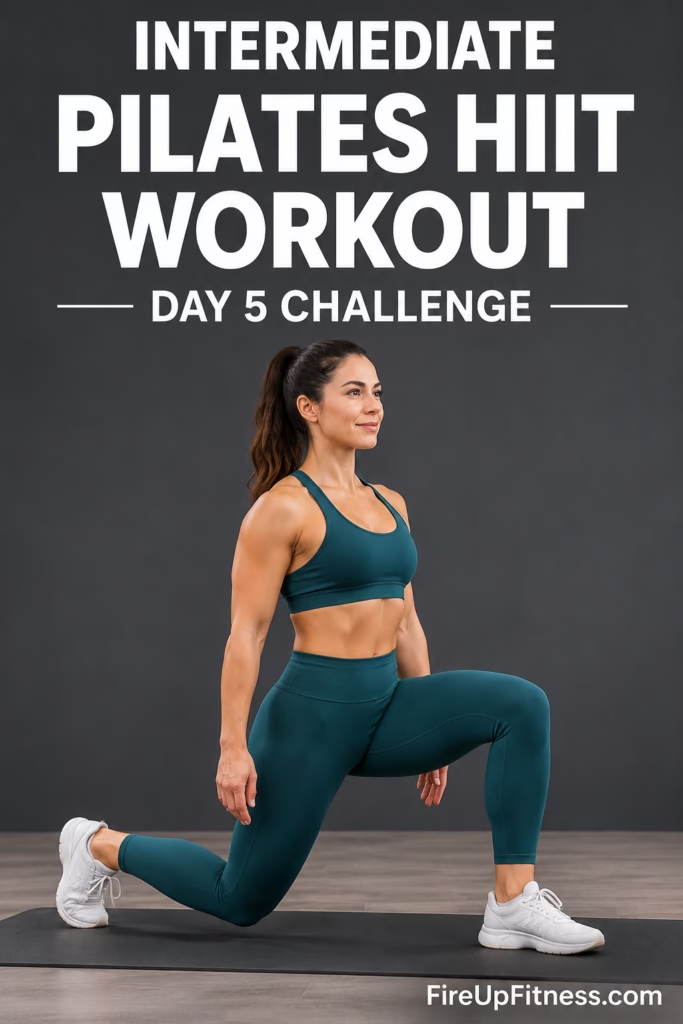
Five days into your Pilates challenge, and you’ve officially reached the halfway point! Today, we’re turning up the intensity with an intermediate Pilates HIIT workout that combines low-impact cardio, controlled strength exercises, and core-focused movements.
Unlike the previous days, Day 5 introduces repeated exercise rounds to challenge your muscular endurance and help you build strength through consistent, controlled movement.
This workout is challenging, but every exercise has a purpose. You’ll work your legs, glutes, arms, shoulders, and deep abdominal muscles while improving balance and stability.
The best part? You don’t need any equipment. Just your exercise mat, some space to move, and the determination to keep going.
Whether you’ve completed Days 1 through 4 or are joining this workout on its own, today’s session offers a complete full-body Pilates challenge.
Day 5 Pilates HIIT Workout Overview
Today’s workout uses Pilates-inspired movements performed in timed intervals. Instead of traditional high-impact HIIT exercises involving jumping, you’ll move through controlled strength exercises that keep your muscles working.
Here’s what to expect:
- Workout level: Intermediate
- Workout style: Low-impact Pilates HIIT
- Equipment: Exercise mat only
- Main focus: Full-body strength, core stability, balance, and muscular endurance
- Workout structure: Three rounds of the same exercise sequence
- Exercise intervals: Primarily 60 seconds, with 30-second push-up intervals
- Impact level: Low impact, with no jumping
The exercises are repeated across three rounds, giving you opportunities to improve your control, maintain proper alignment, and challenge your endurance as your muscles become tired.
Remember, this is a timed workout, not a race to complete as many repetitions as possible. Moving slowly with good technique is more important than rushing.
Watch the Day 5 Pilates HIIT Workout Video
Follow along with the complete Day 5 workout using the video below. The instructor guides you through each movement, explains proper form, and provides encouragement as you complete all three rounds.
Keep your mat nearby and follow the instructor’s breathing cues throughout the session. You can pause whenever you need additional recovery time.
Day 5 Workout: Three Rounds of Full-Body Pilates
Today’s workout is organized into three blocks, each targeting different muscle groups. You’ll complete all three blocks before repeating the sequence for a total of three rounds.
Block 1: Standing Pilates for Leg Strength and Balance
The first block focuses on lower-body strength, hip stability, coordination, and balance.
These standing exercises challenge your glutes, quadriceps, hamstrings, and the smaller stabilizing muscles that help control your movements.
1. Single-Leg Hip Hinge – Right Leg Extended
60 SECONDS
This exercise challenges your balance while strengthening the muscles that support your hips and legs.
How to do it:
- Stand tall with your feet hip-width apart.
- Shift your weight onto your left leg, keeping a slight bend in the knee.
- Hinge forward from your hips while extending your right leg straight behind you.
- Keep your back flat and create a long line from your head to your extended foot.
- Return to standing, lightly tapping your right toes on the floor for balance.
- Continue the movement with slow, controlled repetitions.
Form tip: Keep your hips square toward the floor instead of allowing one hip to rotate upward. Focus on stability rather than how high you can lift your leg.
2. Reverse Lunge Pulses – Right Leg Back
60 SECONDS
Reverse lunges strengthen the quadriceps and glutes while challenging lower-body endurance.
How to do it:
- Step your right leg backward into a lunge position.
- Keep your torso upright and your shoulders relaxed.
- Inhale as you lower your right knee toward the mat.
- Exhale and press through your left heel to rise.
- Straighten your back leg while maintaining a slight bend in the front knee.
- Continue lowering and rising with control.
Form tip: Keep your chest open and your spine neutral. You can lower your back knee only as far as feels comfortable.
3. Single-Leg Hip Hinge – Left Leg Extended
60 SECONDS
Now repeat the single-leg hinge on the opposite side.
Stand on your right leg while extending your left leg backward as you hinge forward.
Maintain a soft bend in your supporting knee and keep your hips level throughout the movement.
Focus on maintaining the same control and range of motion you used on the first side.
4. Reverse Lunge Pulses – Left Leg Back
60 SECONDS
Step your left leg backward and repeat the reverse lunge sequence.
Lower your left knee toward the floor, then press through your right heel to return to the raised position.
Keep your upper body tall, engage your core, and avoid rushing through the repetitions.
By the end of this block, your legs should feel thoroughly warmed up and ready for the next challenge.
Block 2: Mat Pilates for Arms, Glutes, and Core
The second block moves to the mat, combining upper-body strength with glute activation and oblique exercises.
Begin in a tabletop position with your wrists beneath your shoulders and your knees beneath your hips.
5. Arabesque Tricep Push-Up – Right Leg Extended
30 SECONDS
This Pilates-inspired push-up challenges your triceps, shoulders, chest, and core while your extended leg adds a balance component.
How to do it:
- Begin on your hands and knees.
- Extend your right leg straight behind you at hip height.
- Keep your elbows close to your body.
- Inhale as you bend your elbows and lower your chest toward the mat.
- Exhale as you press through your palms to return to the starting position.
- Keep your right leg extended throughout the exercise.
Form tip: Avoid allowing your lower back to arch. Lower only as far as you can comfortably control, and keep your weight balanced between both hands.
6. Kneeling Oblique Crunch – Right Side
60 SECONDS
This movement targets your obliques while improving core stability.
How to do it:
- Remain in your tabletop position with your right leg extended behind you.
- Exhale as you bring your right knee toward your right elbow.
- Gently shorten the right side of your waist as you crunch.
- Inhale and extend your leg straight behind you again.
- Return your hips to a square, level position.
- Repeat with controlled movement.
Form tip: Avoid shifting your entire torso to the left. Let your abdominal muscles control the movement while keeping your shoulders away from your ears.
7. Kneeling Leg Lift and Lower – Right Leg
60 SECONDS
This exercise focuses on your glutes while your abdominal muscles help stabilize your pelvis.
How to do it:
- Keep your right leg extended behind you.
- Inhale as you lower your right toes toward the floor.
- Exhale and lift your right leg to hip height or slightly higher.
- Keep your knee straight and your hips facing the mat.
- Lower your leg slowly and repeat.
Form tip: Lift from your hip rather than arching your lower back. A smaller movement with a stable pelvis is more effective than lifting higher with poor control.
8. Arabesque Tricep Push-Up – Left Leg Extended
30 SECONDS
Return your right knee beneath your hip and extend your left leg behind you.
Repeat the tricep push-up, keeping your elbows close to your torso and pressing evenly through both palms.
Maintain a long spine and controlled breathing.
9. Kneeling Oblique Crunch – Left Side
60 SECONDS
With your left leg extended, bring your left knee toward your left elbow as you exhale.
Lengthen your leg behind you as you inhale.
Keep your shoulders level and avoid transferring too much weight onto your right arm.
10. Kneeling Leg Lift and Lower – Left Leg
60 SECONDS
Finish the second block with controlled leg lifts on your left side.
Lower your left toes toward the mat, then lift your leg using your glutes while keeping your spine and pelvis stable.
Try to release unnecessary tension from your neck and shoulders.
Block 3: Pilates Core Strengthening Exercises
The final block of each round takes place on your back.
These exercises challenge your abdominal muscles, especially your ability to maintain a stable pelvis as your arms and legs move.
11. Straight-Leg Dead Bug
TIMED INTERVAL — FOLLOW THE VIDEO
This challenging dead bug variation strengthens your core through controlled arm and leg movements.
How to do it:
- Lie on your back with your shoulders resting on the mat.
- Bring your knees into tabletop, then extend your arms and legs toward the ceiling.
- Gently draw your ribs inward and maintain a comfortable pelvic tuck.
- Lower one arm behind your head and the corresponding leg toward the floor.
- Return both toward the ceiling.
- Alternate sides while keeping your lower back stable.
Form tip: The first two rounds use the arm and leg on the same side. In the final round, the instructor cues the right arm with the left leg. Follow the video for the variation being demonstrated.
Only lower your limbs as far as you can without excessively arching your lower back.
12. Pilates Arm Circles With Crunch
TIMED INTERVAL — FOLLOW THE VIDEO
This exercise combines abdominal strengthening with shoulder mobility.
How to do it:
- Lie on your back with your legs in tabletop.
- Reach both arms behind your head as you inhale.
- Exhale and lift your head and shoulders into a controlled abdominal crunch.
- Sweep your arms outward in a large circle, bringing your hands toward your hips.
- Inhale as you return your arms behind you and lower your upper body.
- Continue with smooth, deliberate repetitions.
Form tip: Think about drawing your ribs toward your hips rather than pulling your head forward. Keep your neck relaxed and avoid using momentum.
13. Pilates Scissor Kicks With Crunch
60 SECONDS
The final exercise challenges your abdominal endurance and leg control.
How to do it:
- Lie on your back and place your hands gently behind your head.
- Keep your elbows wide and lift your head and shoulders into a comfortable crunch.
- Extend both legs toward the ceiling.
- Slowly lower one leg toward the floor while keeping the opposite leg raised.
- Switch legs with control.
- Continue alternating while keeping your pelvis stable.
Form tip: Keep your legs as straight as comfortably possible and your lower back supported. Shorten the range of motion if your back begins to arch or you feel discomfort.
Repeat the Workout for Three Rounds
After completing all 13 exercises, you’ve finished your first round.
Today’s workout includes three complete rounds of the same sequence.
| Round | Focus |
|---|---|
| Round 1 | Learn the movements and establish proper technique |
| Round 2 | Maintain alignment while challenging muscular endurance |
| Round 3 | Stay controlled and consistent as fatigue increases |
You don’t need to move faster with each round. In fact, slowing down can help you maintain proper form when your muscles begin to tire.
Pay attention to your breathing, posture, and range of motion. Take short breaks whenever necessary.
The goal is to finish the workout with good movement quality, not simply to push through every interval without resting.
Day 5 Cooldown: Gentle Pilates Recovery Stretches
After your final round, spend a few minutes releasing tension from your hips and lower back.
The video finishes with gentle recovery movements to help your body transition out of the workout.
1. Knee Circles
Lie comfortably on your back and bring your knees toward your chest.
Slowly draw circles with your knees in one direction, allowing your hips to relax.
Reverse the direction and continue with gentle movements.
2. Supine Spinal Twist – Right Side
Extend your left leg along the mat and bend your right knee.
Guide your right knee across your body toward the left side.
Extend your right arm outward and gently rotate through your spine, keeping your right shoulder as close to the mat as comfortable.
Take a few slow breaths.
3. Supine Spinal Twist – Left Side
Return to the center and extend your right leg.
Bend your left knee and guide it across your body toward the right side.
Reach your left arm outward and relax into the stretch without forcing the rotation.
Breathe slowly and allow your hips, back, and shoulders to release tension.
Tips for Getting the Most Out of Day 5
This intermediate workout can feel demanding, especially during the second and third rounds. A few simple adjustments can help you maintain control.
Prioritize technique over speed. Slow, controlled repetitions allow you to concentrate on the muscles performing each movement.
Use your breath to support your movements. Exhale during the more challenging phase of an exercise and inhale as you return or reset, following the instructor’s cues.
Modify your range of motion. You don’t need to lower your leg all the way to the floor during core exercises or perform a deep push-up to benefit from the workout.
Keep your core engaged. Focus on maintaining a stable spine and pelvis, especially during single-leg movements and floor exercises.
Rest when necessary. A brief pause can help you regain control and return to the workout with better form.
Listen to your body. Muscle fatigue is expected during a challenging workout, but sharp pain, dizziness, or joint discomfort are reasons to stop or modify the exercise.
What Makes This Pilates HIIT Workout Effective?
This workout combines several types of movement into one session, making it a useful addition to a balanced fitness routine.
Builds Full-Body Strength
The reverse lunges and hip hinges challenge your lower body, while the arabesque push-ups strengthen your arms and shoulders.
Core exercises provide an additional challenge for the muscles supporting your trunk.
Improves Balance and Stability
Single-leg exercises require your hips, feet, and core muscles to work together to maintain alignment.
Practicing these movements regularly can improve balance and body awareness.
Challenges Muscular Endurance
Repeating the exercises across three rounds increases the amount of time your muscles spend working.
Over time, consistent training with appropriate recovery can help improve muscular endurance and strength.
Strengthens Core Control
Dead bugs, oblique crunches, and scissor kicks encourage you to stabilize your spine while moving your arms and legs.
This type of core training can support better control during other exercises and everyday activities.
Offers a Low-Impact Workout Option
Although today’s session is intense, it doesn’t rely on jumping or high-impact movements.
However, low impact doesn’t necessarily mean easy on every joint. Modify the lunges, push-ups, or other exercises according to your comfort and ability.
You’ve Reached the Halfway Point of Your 10-Day Pilates Challenge!
Day 5 is complete, and you’ve made it halfway through the 10-day Pilates challenge.
Today’s workout asked you to balance on one leg, challenge your upper-body strength, activate your glutes, and maintain core stability through three demanding rounds.
Some exercises may have felt easier than others, and that’s completely normal. Pilates is about developing strength, awareness, and control through consistent practice.
Take time to recover, drink some water, and appreciate the effort you’ve put into today’s session.
Tomorrow, we’ll move into Day 6: Advanced Full-Body Pilates Workout, featuring a new set of exercises without repeats.
The challenge continues, and every day is another opportunity to become stronger, more balanced, and more confident in your movement.
See you for Day 6!