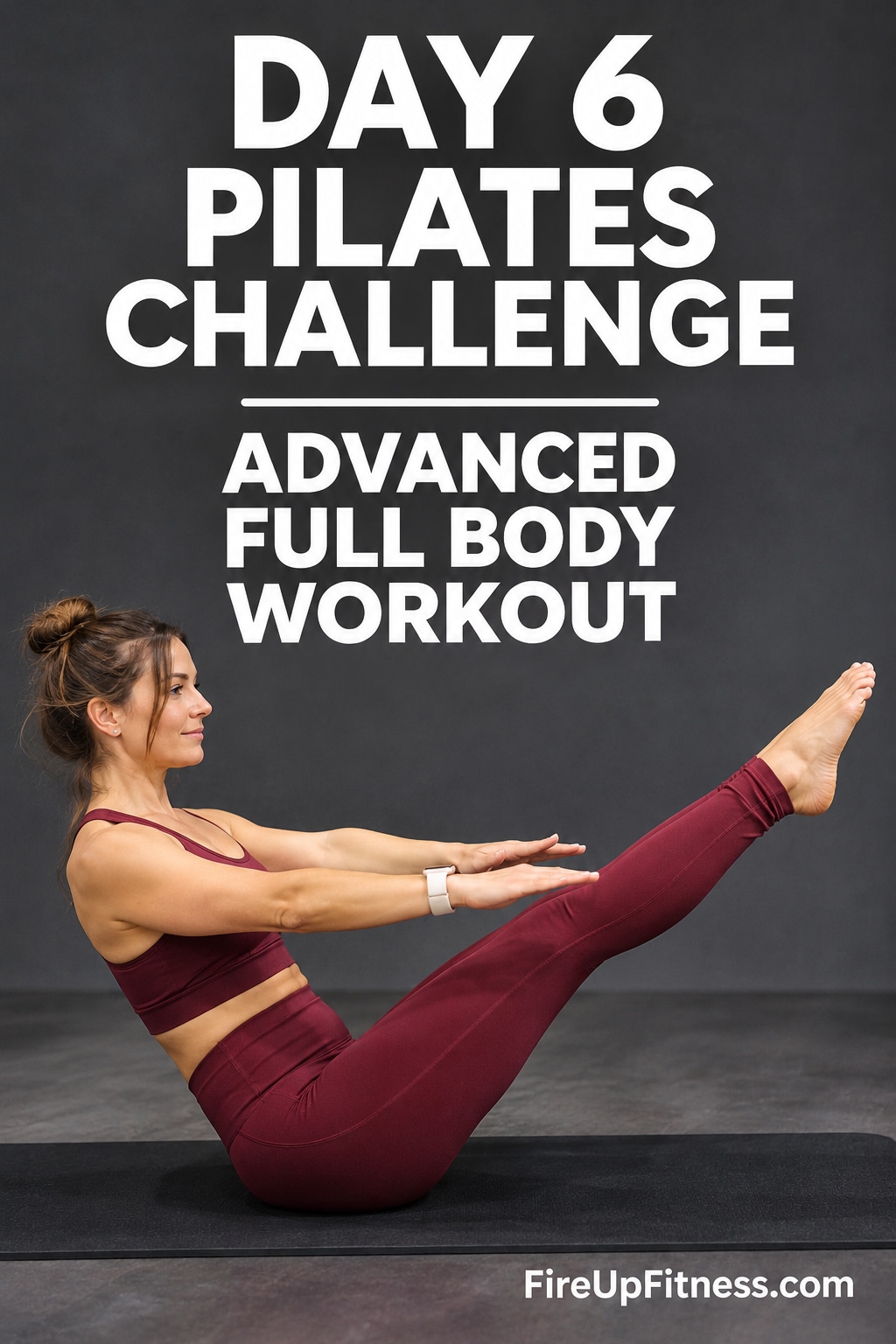
Day 6 Pilates Challenge: Advanced Full Body Workout
Welcome to Day 6 of our 10-Day Pilates Challenge! You’ve made it past the halfway point, and today we’re taking everything you’ve practiced so far to a more challenging level.
Over the past five days, you’ve been building core strength, improving your balance, and learning how to move with greater control. Today’s session brings those skills together in an advanced full body Pilates workout that challenges your shoulders, abs, legs, and glutes.
This workout introduces more demanding variations of familiar Pilates exercises. You’ll move through bird dogs, hovering knee lifts, side leg exercises, abdominal sequences, and full side planks. Each movement encourages you to maintain stability while your muscles work through a controlled range of motion.
The best part? You don’t need weights, resistance bands, or any special equipment. Just grab your exercise mat and get ready to challenge yourself.
This is an advanced session, so take breaks whenever you need them. You can also return to an earlier, less challenging workout in the series before attempting this one again.
Day 6 Pilates Workout: What to Expect
Today’s workout focuses on full-body strength, with extra attention to the muscles that support your spine, hips, and shoulders.
Workout overview:
- Challenge: Day 6 of 10
- Workout type: Advanced full body Pilates
- Fitness level: Advanced
- Equipment: Exercise mat only
- Main focus: Core, shoulders, glutes, and legs
- Workout style: Timed, controlled Pilates movements
- Cool-down: Gentle stretches for the legs, hips, and upper body
Unlike workouts that encourage you to complete as many repetitions as possible, this session emphasizes movement quality.
Keep your breathing steady, pay attention to your alignment, and focus on engaging the muscles responsible for each exercise.
Watch the Day 6 Advanced Full Body Pilates Workout
Follow along with the complete Day 6 workout video below. The instructor demonstrates each movement, explains proper positioning, and guides you through the timed intervals.
You can pause the video whenever you need extra recovery time. The goal is to complete each exercise with control rather than rush through the routine.
Day 6 Pilates Challenge: Step-by-Step Workout
Today’s routine begins with exercises on your hands and knees before progressing into forearm planks, side-lying movements, abdominal exercises, and advanced side planks.
1. Bird Dog With Spinal Flexion
We begin in a tabletop position to activate the core and prepare the shoulders, hips, and spine for the more challenging exercises ahead.
How to do it:
- Start on your hands and knees, keeping your wrists beneath your shoulders and knees beneath your hips.
- Extend your left arm forward and right leg backward.
- Inhale as you lengthen through your spine.
- Exhale and bring your left elbow and right knee toward each other underneath your body.
- Gently round through your spine as you draw your ribs toward your hips.
- Extend your arm and leg again, returning to a neutral spine.
- Continue for the guided interval, then repeat with your right arm and left leg.
What it works: Deep abdominal muscles, obliques, glutes, shoulders, and spinal stabilizers.
Focus on keeping your hips square to the mat as you extend. Your abdominal muscles should help prevent your torso from rotating.
2. Bird Dog Leg Lifts
Next, you’ll maintain the extended bird dog position while adding controlled leg lifts.
How to do it:
- Extend your left arm forward and right leg backward.
- Keep your spine neutral and your hips facing the floor.
- Lower your right toes toward the mat.
- Exhale and lift your right leg using your glutes.
- Keep your leg straight and your toes pointed.
- Continue lifting and lowering without arching your lower back.
- Repeat on the opposite side.
What it works: Glutes, core stabilizers, shoulders, and postural muscles.
The important part is keeping your lower back still. Your glutes should create the lifting movement rather than your spine.
3. Hovering Knee Bird Dog Leg Lifts
This advanced variation increases the challenge by removing some of your support from the mat.
How to do it:
- Return your supporting hand beneath your shoulder.
- Keep the opposite leg extended behind you.
- Tuck the toes of your supporting leg under.
- Lift the supporting knee slightly off the mat.
- Maintain a flat back while lifting and lowering your extended leg.
- Keep your abdominal muscles engaged and your hips steady.
- Repeat on the other side.
What it works: Quadriceps, glutes, shoulders, and deep core muscles.
This movement requires considerable stability. Press firmly through your hands and avoid allowing your lower back to arch.
For an easier variation, keep your supporting knee on the mat.
4. Forearm Bear Hover
Now we move into a forearm-supported exercise that challenges your abdominal muscles.
How to do it:
- Come onto your forearms with your elbows directly beneath your shoulders.
- Position your knees beneath your hips.
- Tuck your toes under and keep your knees hip-width apart.
- Exhale and lift both knees a few inches off the mat.
- Hold briefly while keeping your back stable.
- Inhale and lower your knees gently to the floor.
- Repeat for the 60-second interval.
What it works: Deep core muscles, quadriceps, shoulders, and hip stabilizers.
Try to initiate the movement through your hips while keeping your abdominal muscles engaged.
This variation places more demand on the core than the hands-supported version practiced earlier in the challenge.
5. Forearm Plank Knee Lifts
From the bear hover, you’ll transition into a full forearm plank.
How to do it:
- Keep your elbows beneath your shoulders.
- Walk your knees backward into a modified forearm plank position.
- Keep your toes tucked under.
- Exhale and lift your knees, extending both legs into a full forearm plank.
- Engage your quadriceps and abdominal muscles.
- Inhale and lower your knees toward the mat.
- Continue alternating between the modified and full plank positions.
What it works: Abdominals, shoulders, quadriceps, and full-body stabilizers.
Maintain a long line through your body as you lift. Avoid allowing your hips to sag or your lower back to arch.
After this sequence, sit your hips back into a comfortable shell stretch and take a few breaths.
Advanced Side Glute Pilates Series
The next part of Day 6 focuses on the glutes and side abdominal muscles.
Unlike the intermediate version, you’ll keep your hips elevated during the exercises. This creates an additional stability challenge for your core and supporting shoulder.
6. Elevated Side Leg Raises
How to do it:
- Lie on your left side, supporting your upper body on your left forearm.
- Keep your left elbow directly beneath your shoulder.
- Bend your bottom knee for support.
- Lift your hips away from the mat.
- Extend your top leg straight.
- Exhale and lift your top leg toward the ceiling.
- Inhale and lower your toes toward the floor.
- Repeat the movement before switching sides.
What it works: Glutes, obliques, shoulders, and hip stabilizers.
Keep your hips elevated and steady throughout the movement. Both glutes will be working: one to lift the moving leg and the other to help support your body.
7. Elevated Side Leg Pulses
Without lowering your hips, transition into small leg pulses.
How to do it:
- Maintain your elevated side-lying position.
- Keep your top leg straight.
- Lift and lower your leg through a small range of motion.
- Keep the movement controlled rather than swinging your leg.
- Maintain a steady position through your hips and torso.
- Complete the pulses on both sides.
These small movements create a sustained challenge for the outer hip muscles.
Keep your chest open and avoid leaning forward as your muscles begin to tire.
8. Internally Rotated Side Leg Pulses
The final exercise in the side glute sequence changes the rotation of your working leg.
How to do it:
- Stay in the elevated side-lying position.
- Rotate your top leg inward from the hip.
- Angle your toes toward the floor and your heel toward the ceiling.
- Perform small, controlled upward pulses.
- Keep your supporting hip lifted.
- Continue for the final 30 seconds on each side.
What it works: Glutes, hip stabilizers, and obliques.
The rotation changes how your hip muscles contribute to the movement. Keep the pulses small and avoid twisting your entire pelvis.
Once you’ve completed both sides, lower yourself onto your back for the abdominal series.
Advanced Pilates Ab Workout
The next exercises focus on maintaining pelvic and spinal stability while your legs move away from your body.
Because these movements use longer leg positions, they create a greater challenge for your abdominal muscles.
9. Double Leg Toe Taps
This exercise progresses from the single-leg toe taps practiced in the intermediate workout.
How to do it:
- Lie on your back with your hands supporting your head and your elbows open.
- Bring both legs into tabletop, with your knees bent at 90 degrees.
- Gently draw your ribs down and engage your abdominal muscles.
- Lower both feet toward the floor while maintaining the bend in your knees.
- Tap your toes lightly on the mat.
- Bring both knees back above your hips.
- Continue slowly through the guided interval.
What it works: Abdominal muscles, particularly those involved in controlling pelvic position.
Keep your shoulders relaxed against the mat and avoid letting your lower back arch as your legs move downward.
If maintaining control becomes difficult, perform one leg at a time.
10. Double Leg Stretch
Next, you’ll extend both legs to increase the challenge.
How to do it:
- Begin on your back with both knees in tabletop.
- Keep your abdominal muscles engaged.
- Extend both legs forward and away from your body.
- Straighten your knees and point your toes.
- Bring both legs back into tabletop.
- Repeat while maintaining a stable pelvis.
What it works: Rectus abdominis, deep abdominal stabilizers, and quadriceps.
As your legs extend, the longer lever increases the demand on your core.
Only lower your legs as far as you can comfortably maintain your spinal position. Keeping them higher is a useful modification.
11. Oblique Twist With Double Leg Extension
This movement combines abdominal rotation with controlled leg extensions.
How to do it:
- Start on your back with your knees in tabletop.
- Keep your hands behind your head and your elbows wide.
- Rotate your upper body, bringing one elbow toward the opposite knee.
- Return through the center while extending both legs.
- Bend your knees back into tabletop.
- Rotate toward the opposite side.
- Continue alternating sides.
What it works: Obliques, rectus abdominis, and deep core stabilizers.
Focus on rotating through your upper torso rather than pulling your head forward with your hands.
Maintain control of your pelvis throughout the movement.
12. Extended Leg Crunch Pulses
Next come small abdominal pulses with your legs extended.
How to do it:
- Lie on your back and extend your legs.
- Keep your hands behind your head with your elbows open.
- Engage your abdominal muscles.
- Lift your upper body slightly into a crunch.
- Perform small forward pulses, drawing your ribs toward your hips.
- Continue for 30 seconds.
What it works: Rectus abdominis and core stabilizers.
Think about moving your ribs toward your pelvis rather than lifting straight toward the ceiling.
You can raise your legs toward the ceiling if keeping them lower makes it difficult to maintain your back position.
13. Pilates Hundreds With Extended Legs
The final exercise in the supine abdominal series is an advanced variation of the classic Pilates Hundred.
How to do it:
- Lie on your back and bring your knees into tabletop.
- Extend your arms beside your hips with your palms facing down.
- Lift your head and shoulders into a comfortable abdominal curl.
- Extend your legs while maintaining core control.
- Pump your straight arms up and down from the shoulders.
- Inhale for five arm pumps.
- Exhale for five arm pumps.
- Continue following the instructor’s rhythm.
What it works: Abdominals, shoulders, and triceps.
Keep your neck comfortable and your torso stable as your arms move.
For a less demanding variation, keep your knees bent in tabletop or rest your head on the mat.
After completing the exercise, hug your knees toward your chest for a brief recovery.
Final Challenge: Advanced Side Planks
You’re approaching the end of Day 6!
The final strengthening sequence features full side planks. These exercises challenge your obliques, shoulders, and hip stabilizers while encouraging better body awareness.
14. Full Side Plank Hip Dips
How to do it:
- Lie on your right side with your right elbow beneath your shoulder.
- Extend both legs and stagger your feet, placing your left foot slightly in front.
- Lift your hips into a full side plank.
- Inhale and lower your hips toward the mat.
- Exhale and lift your hips again.
- Keep your chest open and your supporting shoulder stable.
- Repeat on the opposite side.
What it works: Obliques, shoulders, glutes, and lateral core stabilizers.
Move through a comfortable range without allowing your supporting shoulder to collapse.
For an easier option, bend your bottom knee and keep it on the mat.
15. Side Plank Spinal Twists
This variation adds upper-body rotation while you maintain your side plank.
How to do it:
- Begin in a full forearm side plank.
- Extend your top arm toward the ceiling.
- Exhale and rotate your upper body, reaching your top arm underneath your torso.
- Inhale and open your chest as you return to the starting position.
- Keep your hips elevated throughout the movement.
- Repeat on both sides.
What it works: Obliques, shoulders, and muscles supporting spinal rotation.
Try to keep your hips steady as your upper body rotates.
The goal is a controlled twist rather than reaching as far as possible.
16. Side Plank Hip Pulses
The final strengthening exercise uses small pulses to finish the side plank sequence.
How to do it:
- Maintain your full side plank position.
- Keep your hips lifted.
- Lower your hips slightly.
- Pulse upward through a small, controlled range.
- Continue for the final few seconds.
- Repeat on the other side.
These short pulses challenge your ability to maintain stability while your obliques and supporting muscles are already working hard.
Finish the interval, then gently lower yourself onto the mat.
You’ve completed the advanced strengthening portion of Day 6!
Day 6 Cool-Down: Gentle Pilates Stretches
After the demanding full-body sequence, the workout finishes with stretches to help you transition out of the session.
1. Lying Quadriceps and Hip Flexor Stretch
Lie on your stomach and gently bring your right heel toward your glute.
Keep your pelvis grounded and your tailbone gently tucked as you stretch the front of your thigh.
Take a few slow breaths before repeating on the other side.
2. Seated Side Body Stretch
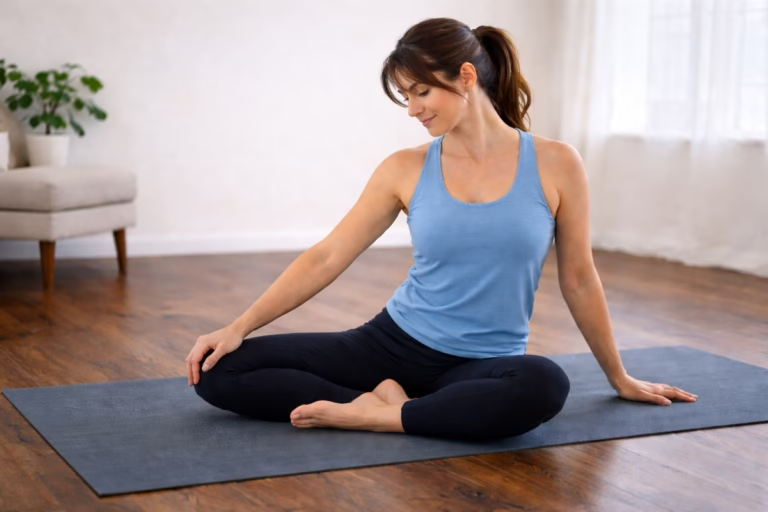
Sit comfortably with your legs crossed.
Place your right hand beside you and reach your left arm overhead, gently leaning toward the right.
Feel the stretch along the left side of your torso.
Return to the center and repeat on the opposite side.
3. Seated Spinal Twists
Remain seated with your legs crossed.
Reach one arm overhead and gently rotate your upper body downward.
Then rotate upward, opening your chest toward the ceiling.
Move slowly between the two positions, allowing your spine and shoulders to move through a comfortable range.
Repeat on the opposite side.
What Makes Day 6 Different From the Previous Workouts?
Day 6 marks an important progression in the 10-Day Pilates Challenge.
Earlier sessions helped establish movement patterns and prepare your muscles for more demanding variations. Today’s workout builds on that foundation by introducing exercises that require greater strength, balance, and stability.
Here are some of the main differences:
More advanced core exercises: Double-leg toe taps, extended leg stretches, and the Pilates Hundred create a greater abdominal challenge than their simpler variations.
Greater shoulder involvement: Hovering knee exercises, forearm planks, and elevated side leg movements require your shoulders to help stabilize your body.
More demanding glute exercises: The elevated side-lying series engages both the moving leg and the supporting side.
Additional balance and coordination: Exercises such as the hovering bird dog require several muscle groups to work together to maintain alignment.
Longer lever positions: Extending your legs farther away from your body increases the challenge of maintaining core stability.
The increased difficulty doesn’t mean you need to perform every movement perfectly. It means you’re practicing more complex patterns and learning to recognize when your body needs a modification.
Tips for Completing This Advanced Pilates Workout
Today’s exercises can feel demanding, particularly when you reach the abdominal and side plank sequences.
Keep these reminders in mind:
- Prioritize control over speed. Slow, deliberate repetitions allow you to focus on the intended muscles.
- Keep breathing. Exhale during the more demanding portion of a movement and avoid holding your breath.
- Protect your lower back. Reduce your range of motion whenever you struggle to maintain a comfortable, stable spinal position.
- Use modifications when needed. Keeping a knee on the mat or performing single-leg variations still provides a worthwhile workout.
- Take recovery breaks. Resting briefly can help you return to an exercise with better form.
You should feel your muscles working, but sharp pain, dizziness, or unusual discomfort are reasons to stop and reassess.
Day 6 Pilates Challenge: Frequently Asked Questions
Is Day 6 suitable for beginners?
Day 6 is designed as an advanced Pilates workout. Beginners may find the hovering knee exercises, double-leg abdominal movements, and full side planks especially challenging.
Consider practicing the earlier sessions or using the suggested modifications before progressing to the complete routine.
Do I need any equipment?
No. This workout uses your body weight and an exercise mat. No dumbbells, resistance bands, or Pilates equipment are required.
Can I do this workout on its own?
Yes. Although it’s part of the 10-Day Pilates Challenge, Day 6 can also be completed as a standalone advanced full-body Pilates session.
What muscles does this workout target?
The routine works several muscle groups, including your abdominals, obliques, glutes, quadriceps, shoulders, and spinal stabilizers.
The emphasis is on coordinated full-body movement rather than isolating one muscle group.
What should I do if the exercises feel too difficult?
Reduce your range of motion, keep your supporting knee on the floor during plank variations, or perform single-leg versions of the abdominal exercises.
You can also repeat the intermediate workout from the series until you feel more comfortable with the movements.
What’s Next? Day 7 of the 10-Day Pilates Challenge
Day 6 is complete, and you’ve now moved through one of the more demanding stages of our Pilates series.
Today’s session challenged your ability to stabilize your spine, maintain balance, and coordinate multiple muscle groups through advanced movements.
Some exercises may have felt easier than others, and that’s completely normal. Notice which movements required the most concentration and which ones felt more controlled than they might have earlier in the challenge.
Coming up next: Day 7 of the 10-Day Pilates Challenge.
We’ll continue the series with another guided workout as you build on the skills you’ve practiced so far.
Final Thoughts: You’ve Completed Day 6!
Completing Day 6 is a meaningful milestone in this 10-day challenge.
You’ve worked through demanding bird dog variations, forearm planks, elevated glute exercises, advanced abdominal movements, and full side planks—all without additional equipment.
More importantly, you’ve practiced staying focused and controlled even when an exercise becomes difficult.
Remember that Pilates progress isn’t measured by how quickly you finish a workout or whether you can complete every advanced variation. It’s also reflected in your ability to recognize your limits, maintain good technique, and gradually develop strength.
Take some time to recover, appreciate the work you’ve put in, and get ready for the next session.
Six days down, four to go. See you on the mat for Day 7!