6 Types of Squats + 20 Day Squat Challenge
Squats are one of the most effective lower-body exercises for building stronger legs, shaping your glutes, and improving everyday movement. But doing the same basic squat every workout can get a little boring. That’s where different types of squats can make your routine more interesting and challenging.
A good squat challenge doesn’t have to involve hundreds of repetitions or heavy weights. Sometimes, changing your foot position, adding a small movement, or practicing a new squat variation is enough to challenge your muscles in a different way.
Whether you’re beginning a Squat Challenge 30 Day Beginner routine or looking for new exercises to add to your leg workouts, these six squat variations can help you build strength, improve balance, and develop better lower-body control.
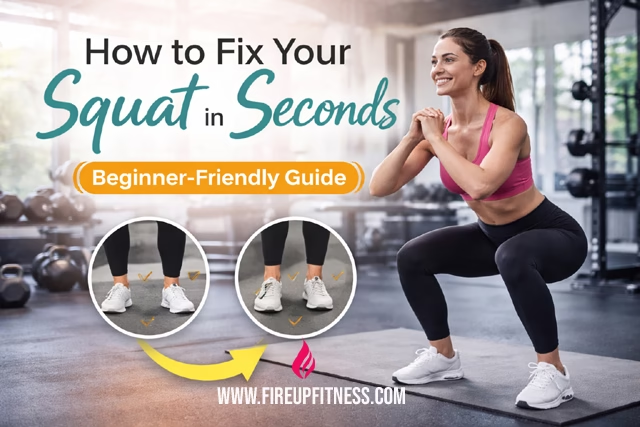
Before trying the more challenging movements, it’s important to understand how to squat properly. Good technique helps you get more from every repetition while reducing unnecessary stress on your knees and lower back.
Why Squats Deserve a Place in Your Workout Routine
Squats are compound exercises, meaning they work several muscle groups at the same time. Your glutes, quadriceps, hamstrings, and core all contribute to the movement.
Regular squat training can help you:
- Build stronger glutes: Squats strengthen the muscles responsible for hip extension and lower-body stability.
- Strengthen your thighs: Your quadriceps work hard as you lower and raise your body.
- Improve balance and coordination: Different squat variations challenge your ability to control your body.
- Support everyday activities: Stronger legs make movements such as climbing stairs, sitting down, and standing up easier.
- Develop core stability: Your abdominal and back muscles help keep your torso supported during each repetition.
The best part? Many squat exercises can be performed at home with little or no equipment.
How to Squat Properly: A Beginner’s Guide
Before exploring the different types of squats, start by mastering the basic bodyweight squat.
Understanding how to do squats correctly is more important than completing a high number of repetitions.
Step-by-step instructions
- Stand with your feet approximately shoulder-width apart and your toes pointing slightly outward.
- Keep your chest lifted, shoulders relaxed, and core gently engaged.
- Bend your knees and hips together as though you’re sitting down in a chair.
- Allow your knees to travel naturally in the same direction as your toes while keeping your feet grounded.
- Lower your hips as far as you comfortably can without losing control of your posture.
- Push through your feet to return to standing, squeezing your glutes gently at the top.
Beginner tip: Start with 8–10 controlled repetitions. You can also practice squatting onto a sturdy chair until you feel comfortable with the movement.
Your knees may move past your toes during a squat. That’s normal for many body types. Focus on keeping your feet stable, knees aligned, and movement comfortable rather than forcing an unnatural position.
6 Different Types of Squats to Strengthen Your Lower Body
These types of squats exercises range from beginner-friendly movements to advanced variations that require greater strength and balance.
You don’t need to master all six immediately. Start with the variations that match your current fitness level and gradually introduce more challenging exercises.
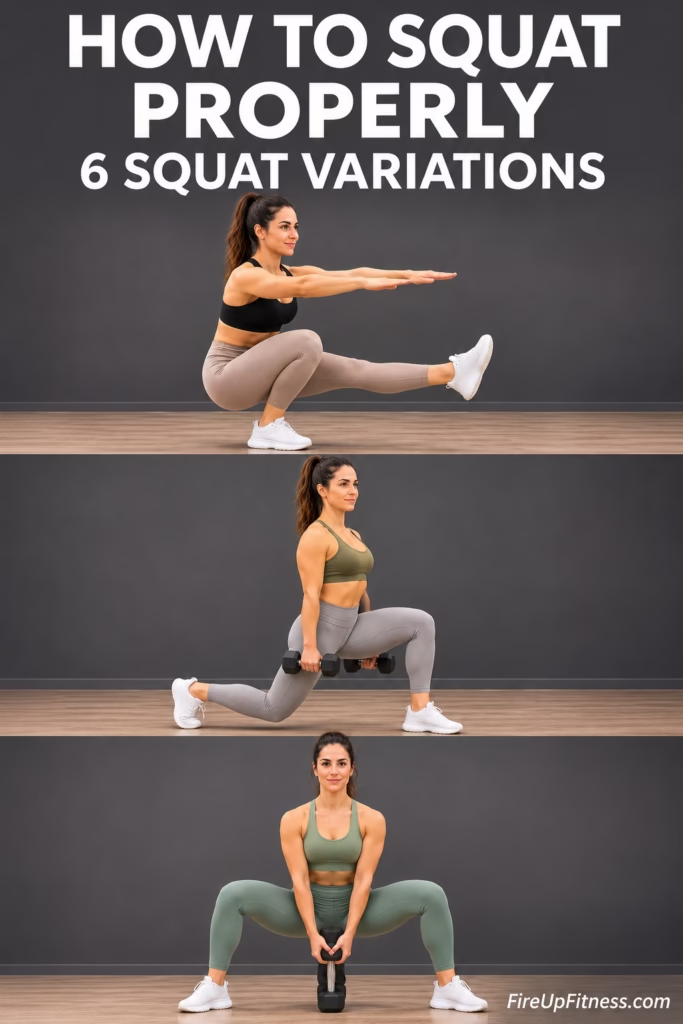
1. Adductor Squats for Inner Thigh and Glute Strength
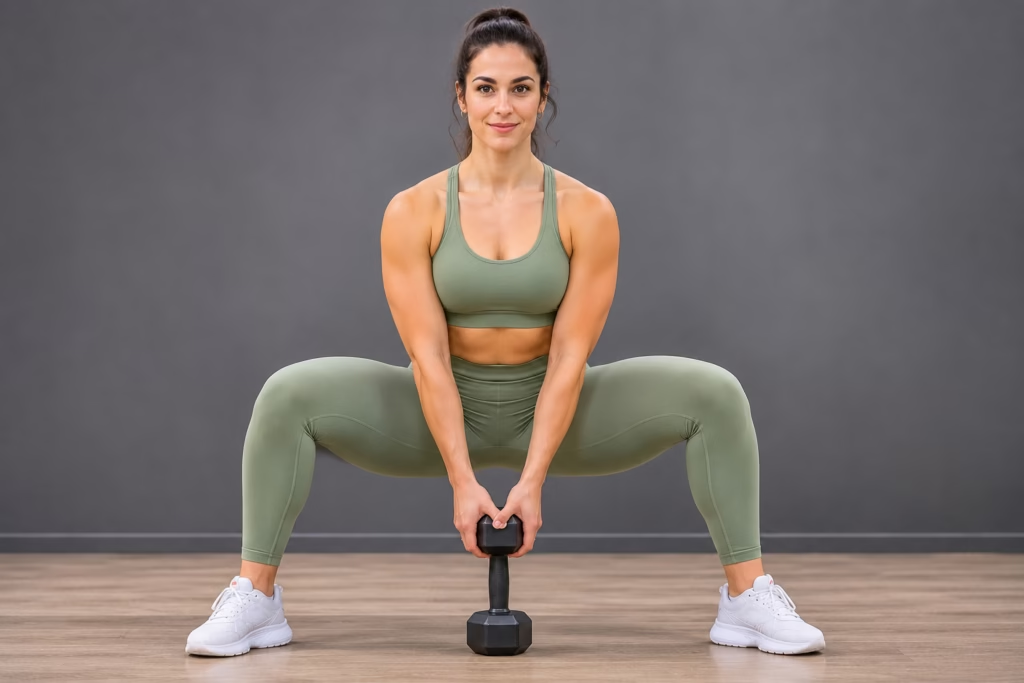
Adductor squats, often performed using a wide sumo-style stance, are a great addition to lower-body workouts.
The wider foot position changes the demands on your hips and thighs, while your glutes and quadriceps continue to do much of the work.
Holding a dumbbell can make this exercise more challenging, but beginners can perform it using bodyweight alone.
How to do adductor squats
- Stand with your feet wider than hip-width apart.
- Turn your toes slightly outward, keeping your knees aligned with your feet.
- Hold a dumbbell vertically in front of your body, or keep your hands together at chest level.
- Engage your core and slowly bend your knees to lower into a squat.
- Pause briefly at a comfortable depth.
- Push through your feet to return to standing.
Recommended repetitions: 10–12 reps for 2 sets.
Form tip: Keep your back in a comfortable, neutral position and avoid allowing your knees to collapse inward.
This variation is particularly useful when you want to include more inner-thigh involvement in your leg workout.
2. Heel-Lifted Sumo Squat for Balance and Leg Strength
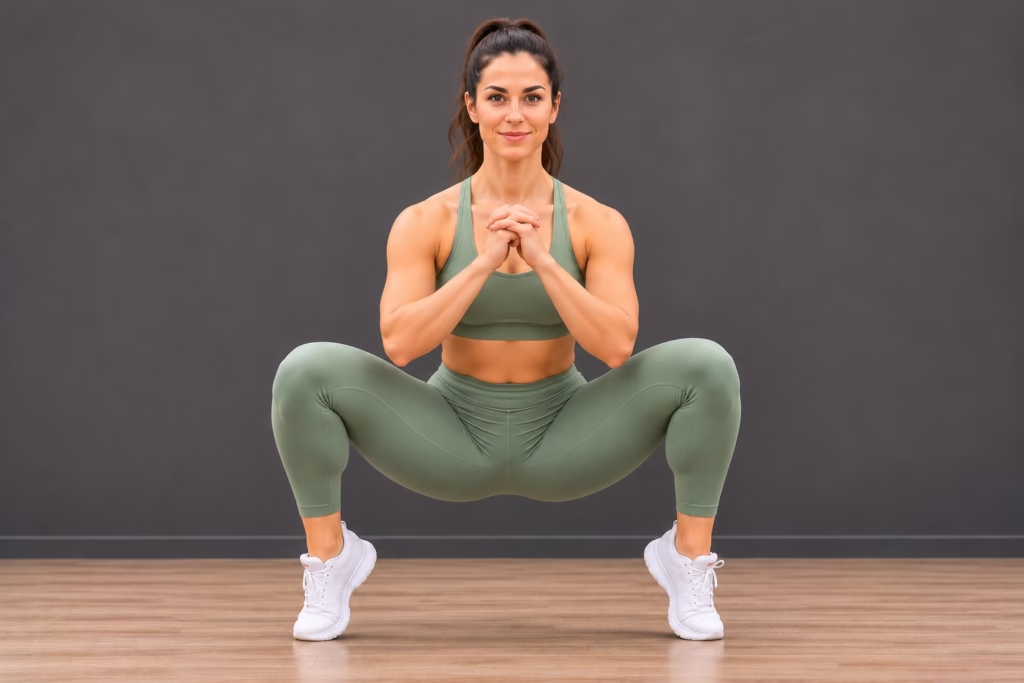
The heel-lifted sumo squat adds a balance challenge to the traditional wide-stance squat.
By lifting one heel, you change how your weight is distributed and ask your ankles, calves, and stabilizing muscles to work harder.
This movement requires control, so begin without weights and use a wall or chair for support when needed.
How to do heel-lifted sumo squats
- Stand with your feet slightly wider than shoulder-width apart.
- Point your toes outward at a comfortable angle.
- Raise your left heel while keeping the ball of your left foot on the floor.
- Engage your core and slowly lower your hips into a squat.
- Keep your knees tracking in the direction of your toes.
- Press through your feet to return to standing.
- Lower your heel and repeat on the opposite side.
Recommended repetitions: 8–10 reps per side.
Form tip: Avoid shifting all your weight onto one leg. Move slowly and maintain your balance throughout the exercise.
Beginners can first master a regular sumo squat before adding the heel lift.
3. Squat to Sumo for an Extra Lower-Body Challenge
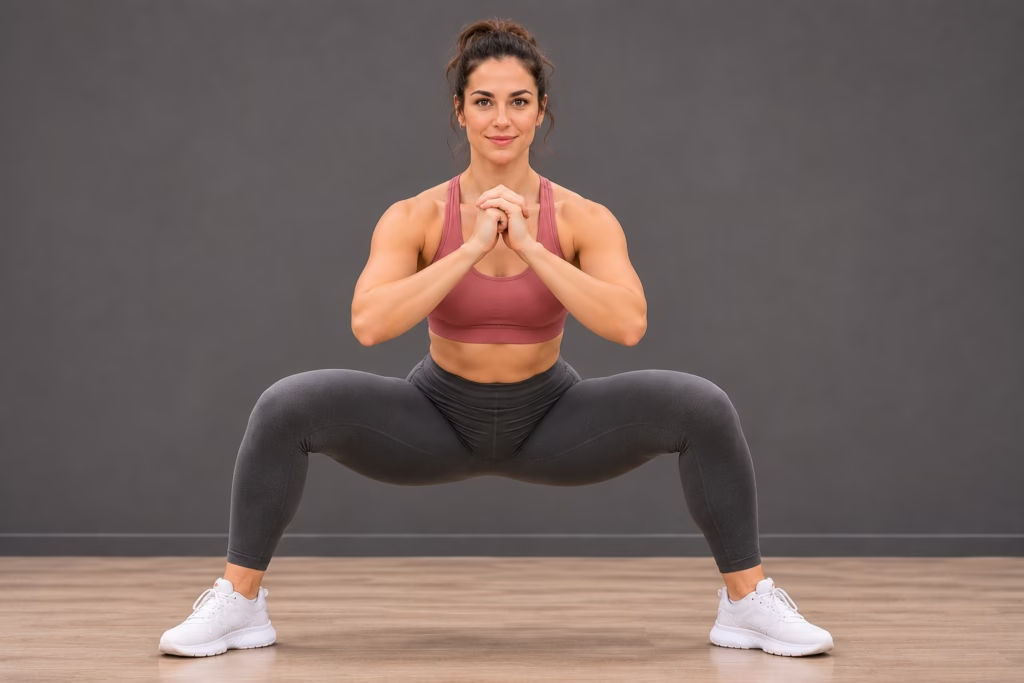
The squat-to-sumo variation combines two squat positions into one continuous movement.
Instead of standing completely upright between repetitions, you alternate between a regular wide squat and a sumo squat while staying partially lowered.
This increases the time your leg muscles spend working, making it an interesting addition to a short lower-body routine.
How to do squat to sumo
- Begin standing with your feet slightly wider than shoulder-width apart.
- Keep your toes facing mostly forward and lower into a comfortable squat.
- Rise a few inches without standing completely upright.
- Shift your feet carefully so your toes point outward at a comfortable angle.
- Lower into a sumo squat.
- Rise slightly again, reposition your feet, and repeat.
Recommended repetitions: 8–12 controlled transitions.
Form tip: Avoid twisting your feet against the floor while your knees are bent. Rise enough to reposition your feet safely before lowering again.
This is one of the more dynamic different types of squats and works well after you’ve mastered the standard squat and sumo squat separately.
4. Pistol Squat for Single-Leg Strength and Balance
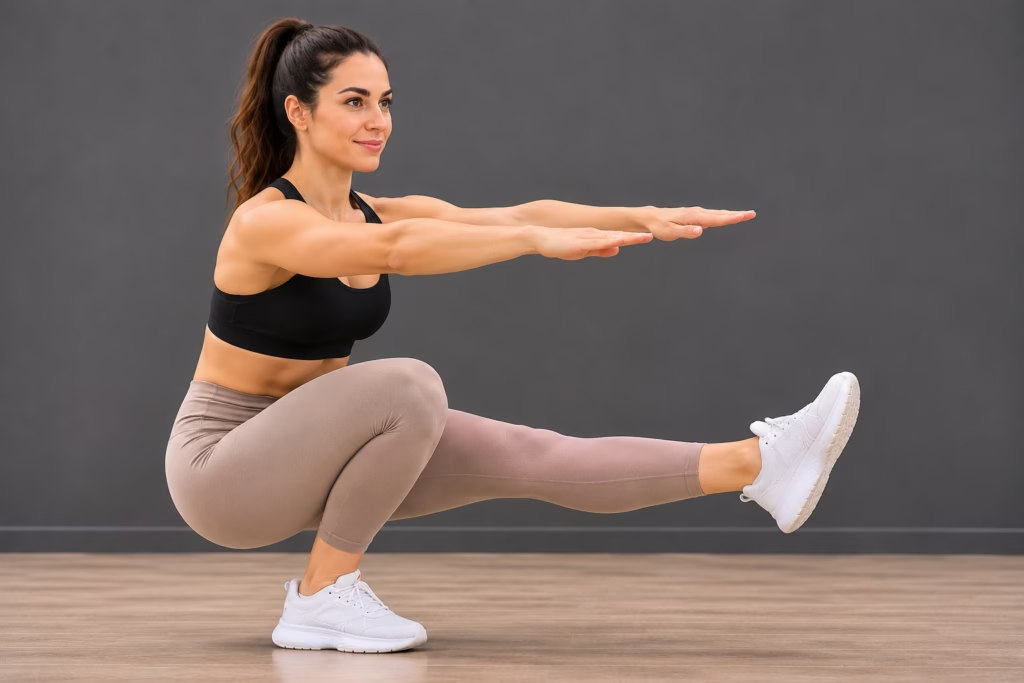
The pistol squat is an advanced bodyweight exercise that challenges your strength, mobility, coordination, and balance.
Unlike a traditional squat, this movement requires you to support your body on one leg while extending the other leg in front of you.
Your quadriceps and glutes work hard, while your core and smaller stabilizing muscles help you maintain control.
How to do a pistol squat
- Stand upright with your feet together.
- Extend both arms forward at shoulder height.
- Lift your right foot slightly off the floor.
- Slowly bend your left knee and lower your hips while extending your right leg forward.
- Lower only as far as you can maintain control.
- Press through your left foot to return to standing.
- Switch legs and repeat.
Recommended repetitions: 3–5 reps per leg, depending on your strength and experience.
Form tip: Keep your supporting foot grounded and avoid forcing yourself into a deep squat before you have the necessary mobility.
Beginner modification
Try a supported pistol squat by holding a sturdy chair or countertop. You can also practice lowering onto a chair using one leg while keeping the other foot lightly supported.
Pistol squats are best treated as an advanced progression rather than a required exercise for beginners.
5. Barbell Siff Squat for an Advanced Squat Variation
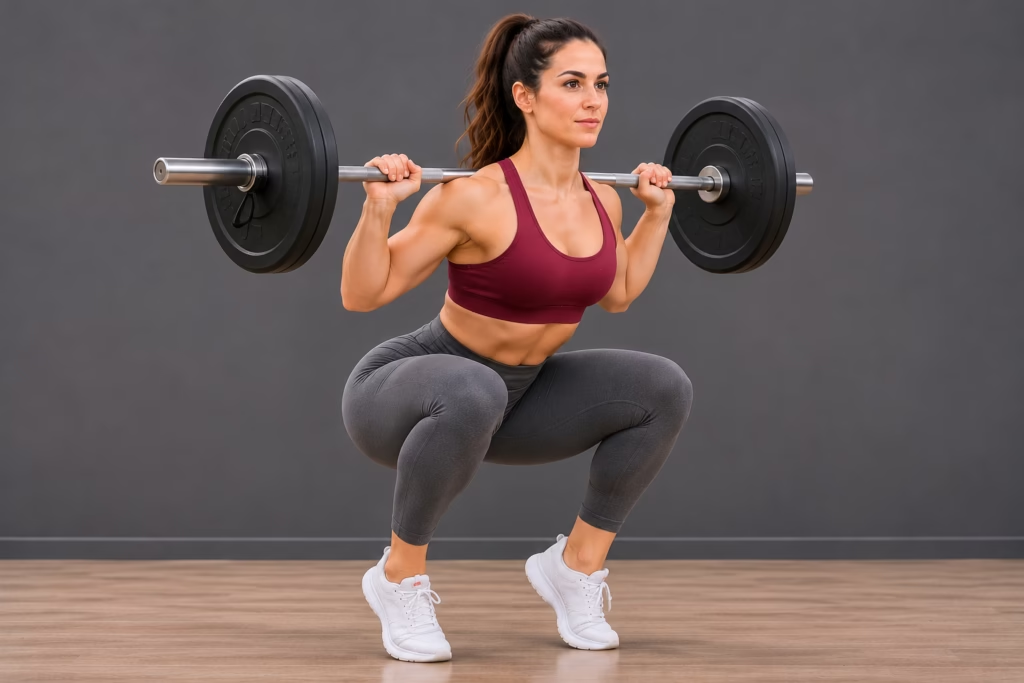
The barbell Siff squat is a challenging squat variation performed with your heels elevated throughout the movement.
This position increases the balance and ankle-control demands and can place greater emphasis on your quadriceps.
Because your heels remain raised, the movement requires more stability than a standard squat.
Adding a barbell makes it considerably more demanding, so this variation is better suited to experienced exercisers.
How to do a barbell Siff squat
- Position a barbell securely across your upper back, not directly on your neck.
- Stand with your feet approximately shoulder-width apart.
- Brace your core and lift your heels onto the balls of your feet.
- Slowly bend your knees and hips to lower into a controlled squat.
- Maintain a comfortable range of motion without losing your balance.
- Push through the balls of your feet to stand back up.
Recommended repetitions: 6–8 reps with an appropriate light load, once the movement has been mastered.
Form tip: Practice a supported, bodyweight heel-raised squat before attempting this variation with a barbell.
For most beginners, a regular squat with heels supported on a stable wedge is a more practical way to explore a heel-elevated squat position.
6. Dumbbell Split Squat for Glutes and Thighs
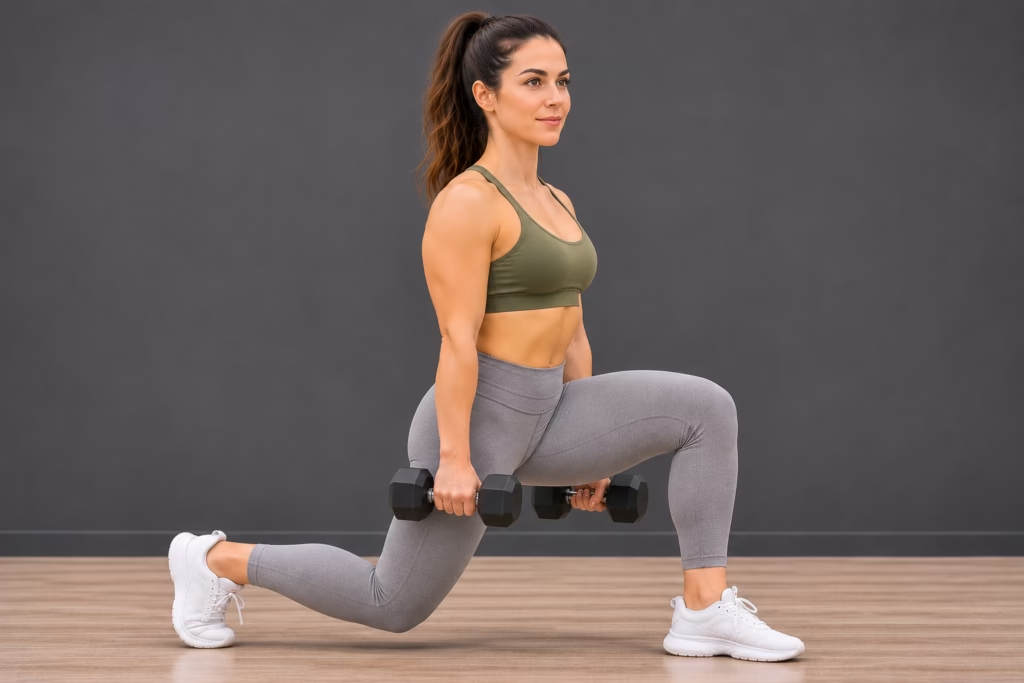
The dumbbell split squat is an excellent exercise for building strength in each leg individually.
Unlike traditional squats, which use both legs in a parallel stance, split squats place one foot forward and the other behind you.
This staggered position challenges your quadriceps, glutes, and balance while helping you notice strength differences between your legs.
You can begin with bodyweight and add dumbbells as your strength improves.
How to do dumbbell split squats
- Stand upright with a dumbbell in each hand, arms relaxed by your sides.
- Step your left foot forward and your right foot backward into a comfortable staggered stance.
- Keep your torso upright and your core engaged.
- Bend both knees, lowering your back knee toward the floor.
- Stop before your back knee touches the ground, or at a depth that feels comfortable.
- Press through your front foot to return to the starting position.
- Complete your repetitions before switching legs.
Recommended repetitions: 8–10 reps per leg for 2 sets.
Form tip: Keep your front knee aligned with your toes and avoid leaning excessively forward.
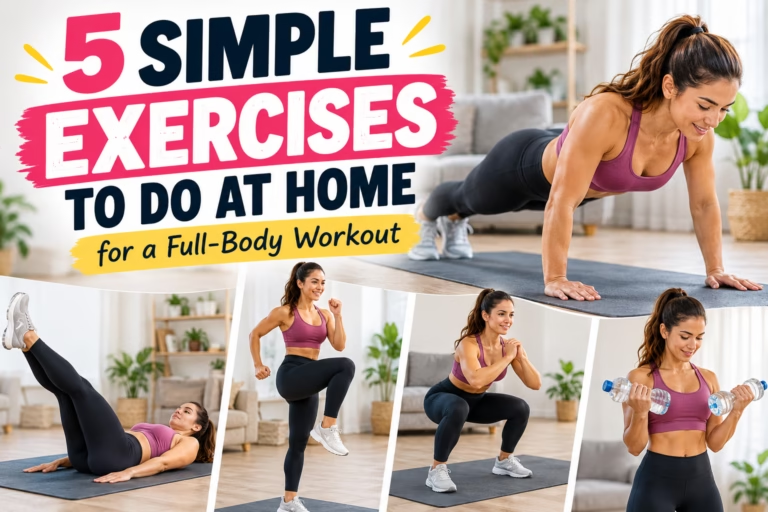
For another simple workout to complement your squat routine, explore these 5 at-home exercises to build strength and stay fit.
20 Day Squat Challenge for Beginners
Want to turn these squat variations into a consistent workout habit?
A 20 Day Squat Challenge is a practical way to develop lower-body strength without feeling pressured to complete an exhausting workout every day.
Instead of doing hundreds of squats, focus on controlled repetitions, gradual progression, and recovery.
Here’s a simple beginner-friendly schedule.
| Day | Workout |
|---|---|
| 1 | 2 sets of 8 bodyweight squats |
| 2 | 2 sets of 10 bodyweight squats |
| 3 | Rest or gentle walking |
| 4 | 2 sets of 10 adductor squats |
| 5 | 2 sets of 10 bodyweight squats |
| 6 | Rest |
| 7 | 2 sets of 10 sumo squats |
| 8 | 2 sets of 12 bodyweight squats |
| 9 | Rest |
| 10 | 2 sets of 8 split squats per leg |
| 11 | 2 sets of 12 adductor squats |
| 12 | Rest |
| 13 | 2 sets of 10 sumo squats |
| 14 | 2 sets of 10 split squats per leg |
| 15 | Rest |
| 16 | 2 sets of 12 bodyweight squats |
| 17 | 2 sets of 10 squat-to-sumo transitions |
| 18 | Rest |
| 19 | 2 sets of 12 adductor squats |
| 20 | 2 sets of 12 bodyweight squats and 8 split squats per leg |
Take approximately 45–90 seconds of rest between sets, or longer when needed.
This challenge emphasizes bodyweight exercises, with optional support for balance. The pistol squat and barbell Siff squat are intentionally excluded because they require more experience.
You can repeat a previous day’s workout or add an extra rest day whenever your muscles need more recovery.
How to Turn This Into a Squat Challenge 30 Day Beginner Routine
A 30-day challenge doesn’t mean you need to perform squats every single day.
After completing the 20-day routine, use the final 10 days to continue progressing at a comfortable pace.
| Days | Focus |
|---|---|
| 21–22 | Bodyweight squats and adductor squats |
| 23 | Recovery day |
| 24–25 | Sumo squats and supported split squats |
| 26 | Recovery day |
| 27–28 | Squat-to-sumo transitions and bodyweight squats |
| 29 | Recovery day |
| 30 | Repeat your favorite squat workout and assess your progress |
During the final 10 days, choose 2 sets of 10–12 repetitions per exercise, adjusting as necessary.
As you become stronger, consider adding light dumbbells, increasing your repetitions gradually, or slowing down the lowering phase of each squat.
The goal is to improve your technique and strength rather than chase a particular number of squats.
Common Squat Mistakes to Avoid
Even a simple bodyweight squat can become less effective when you rush through the movement.
Here are some common mistakes worth watching for.
1. Allowing your knees to collapse inward
Try to keep your knees moving in the same direction as your toes. This helps maintain control throughout the exercise.
2. Lifting your heels unintentionally
During regular squats, keep your feet grounded. Heel-raised variations are different exercises and should be performed deliberately.
3. Rounding your lower back excessively
Maintain a comfortable spinal position and avoid lowering farther than your mobility allows.
4. Moving too quickly
Controlled repetitions help you focus on your muscles and maintain consistent technique.
5. Adding weights too soon
Start with bodyweight squats and increase resistance only after you can complete your repetitions with good control.
6. Ignoring recovery
Your muscles need time to adapt to exercise. Rest days are an important part of building strength.
Stop if you experience sharp pain, dizziness, or unusual discomfort. Adjust the exercise or seek qualified guidance when needed.
Frequently Asked Questions About Squat Challenges
Can beginners do a 20 day squat challenge?
Yes. Beginners can follow a 20-day squat routine that includes basic bodyweight squats, manageable repetitions, and rest days. Start slowly and increase the difficulty as your strength improves.
Which squat is best for glutes?
Traditional squats, sumo squats, and split squats all strengthen your glutes. The most suitable variation depends on your mobility, strength, and ability to perform the movement comfortably.
How many squats should I do a day?
There isn’t one ideal number for everyone. Beginners can start with 2 sets of 8–12 repetitions on training days. Focus on technique and recovery rather than doing squats daily.
Can squats help strengthen the inner thighs?
Yes. Wide-stance squat variations involve the hip adductor muscles, which contribute to hip movement and stability. Adductor squats are a useful option for including these muscles in a lower-body workout.
Are squats better with or without weights?
Both can be effective. Bodyweight squats are ideal for learning proper technique, while weighted squats allow you to progressively increase resistance as you become stronger.
How long does it take to see results from a squat challenge?
You may notice improvements in movement control and exercise endurance within a few weeks. Visible muscle changes generally take longer and depend on your training consistency, recovery, nutrition, and individual response.
Final Thoughts: Build Strength One Squat at a Time
Squats don’t have to be complicated to be effective. A simple bodyweight squat can be a valuable exercise, while different squat variations can introduce new challenges as your strength and confidence improve.
The key is finding movements that suit your fitness level and practicing them consistently.
Start with the basics, pay attention to your technique, and give yourself enough time to recover between workouts. As you progress, explore new variations to keep your routine interesting.
Whether you choose the 20 Day Squat Challenge or extend your workouts into a 30-day routine, remember that progress isn’t measured only by the number of repetitions you complete.
It’s also about feeling stronger, moving with better control, and building a workout routine you genuinely enjoy.
Which squat variation will you try first? Save this workout to your Pinterest fitness board so you can return to it on your next leg day.