100 Squats a Day Challenge: Beginner Guide to Stronger Legs

Doing 100 squats might sound like a lot, especially when your legs start feeling tired after just 15 or 20 repetitions. But you don’t have to complete all 100 on your first day to benefit from this popular lower-body challenge.
The 100 squats a day challenge is a simple way to work toward stronger legs, firmer glutes, better muscular endurance, and a more consistent exercise routine. You don’t need gym equipment or an elaborate workout plan. All you need is enough space to move comfortably and a willingness to improve gradually.
The key is to start at a level that feels manageable. Rather than forcing yourself through 100 repetitions immediately, you can increase your squat count as your strength and confidence improve.
This beginner-friendly guide explains how to build up to 100 squats, practice proper technique, and make the challenge part of a balanced fitness routine.
Why Squats Are Good for Your Lower Body
Squats are one of the most practical bodyweight exercises because they strengthen several muscle groups through a single movement.
Every time you lower yourself into a squat and return to standing, your legs, hips, and core work together to support your body.
The primary muscles involved include:
- Glutes: Help extend your hips as you stand.
- Quadriceps: Support knee extension and control the movement.
- Hamstrings: Assist with hip movement and joint stability.
- Calves: Help stabilize your ankles.
- Core muscles: Support your torso and maintain balance.
Regular squat training can improve lower-body strength, muscular endurance, and everyday movements such as getting out of a chair, climbing stairs, and lifting objects.
Squats are also easy to modify. Beginners can use a chair for support, while more experienced exercisers can experiment with different squat variations.
How to Do a Squat Correctly
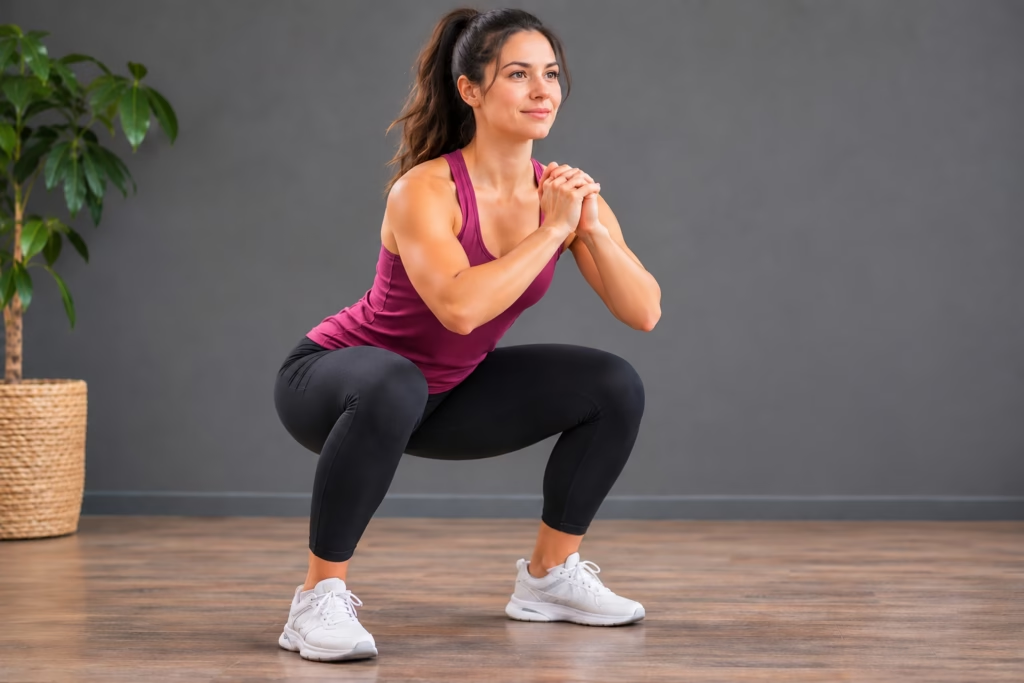
Before increasing your repetitions, take some time to practice proper squat technique.
- Stand with your feet approximately shoulder-width apart, with your toes pointing slightly outward.
- Engage your core and keep your chest comfortably lifted.
- Bend your knees and hips, lowering your body as though you’re sitting back into a chair.
- Keep your knees tracking in the same direction as your toes.
- Lower only as far as you can while maintaining control and keeping your heels grounded.
- Push through your feet to return to standing.
Inhale as you lower your body and exhale as you stand.
Beginner tip: Place a sturdy chair behind you and practice sitting down and standing up. This helps you learn the movement while building confidence.
You don’t need to squat deeply right away. Comfortable, controlled movement is more important than reaching a particular depth.
Warm Up Before Starting the Squat Challenge
A short warm-up prepares your muscles and joints for exercise.
Spend approximately three to five minutes performing gentle movements such as marching in place, hip circles, controlled leg swings, and a few shallow squats.
Begin your first working set at a comfortable pace.
A warm-up won’t eliminate every possibility of soreness or injury, but it can help you ease into the workout.
How to Build Up to 100 Squats a Day
Rather than treating 100 squats as a requirement from day one, use the following progression to gradually increase your repetitions.
The phases are flexible. Spend several sessions or longer at each level, depending on your experience and recovery. Include rest days between challenging squat sessions, especially when starting out.
Phase 1: Start With 10 Squats
Your first goal is simple: complete 10 controlled bodyweight squats.
Concentrate on your posture, balance, and breathing instead of speed.
Try performing one set of 10 repetitions. Take your time, and stop when your technique begins to deteriorate.
Some mild muscle soreness can occur when you begin a new exercise routine. However, sharp pain, persistent joint discomfort, or significant swelling should not be ignored.
Once 10 squats feel comfortable and you can complete them with good form, you’re ready to increase the challenge.
Phase 2: Increase to 30 Squats
The next goal is 30 total repetitions.
Instead of completing all 30 at once, divide them into three manageable sets:
- Set 1: 10 squats
- Set 2: 10 squats
- Set 3: 10 squats
Rest for approximately 30–90 seconds between sets, or longer if necessary.
You can complete these sets during one workout or spread them throughout the day.
This approach allows you to accumulate repetitions without placing all the effort into one continuous set.
Phase 3: Progress to 60 Squats
When 30 repetitions feel manageable, gradually work toward 60.
One option is to complete three sets of 20 squats, with sufficient rest between sets.
Another is to perform six sets of 10 repetitions.
Choose whichever approach allows you to maintain good technique.
As the number of repetitions increases, pay attention to how your knees, hips, and lower back feel. Take additional recovery time when needed.
Phase 4: Reach 100 Squats in Separate Sets
Your next milestone is completing 100 squats across several sets.
For example, you could try:
| Set | Repetitions |
|---|---|
| 1 | 20 |
| 2 | 20 |
| 3 | 20 |
| 4 | 20 |
| 5 | 20 |
| Total | 100 |
You can also divide the repetitions into smaller sets throughout the day.
There is no requirement to complete all 100 squats continuously. Breaking them into sets can help you maintain control and manage fatigue.
Reaching 100 total repetitions is an accomplishment, but it doesn’t mean you need to repeat the same high-volume workout every day.
Phase 5: Work Toward 50 Continuous Squats
Once you’re comfortable completing larger sets, you may want to challenge your muscular endurance by working toward 50 consecutive squats.
Start with a repetition count you can perform comfortably, then increase gradually.
Maintain a steady pace and avoid rushing through the movement.
You may find that performing 50 controlled repetitions requires more concentration than completing several smaller sets.
That’s perfectly fine. This stage is optional, and shorter sets can be equally useful for building a regular exercise habit.
Phase 6: Try 100 Squats in One Session
For those who enjoy an endurance challenge, the final milestone is completing 100 bodyweight squats in one continuous session.
Start slowly, maintain a comfortable breathing rhythm, and keep your movements controlled.
Take a break whenever your form begins to suffer.
Remember that 100 consecutive squats are not necessary for developing stronger legs or glutes. The number is simply a personal fitness milestone. For building strength, gradually increasing resistance over time may be more productive than continually adding repetitions.
Why Rest and Recovery Matter
Squats challenge your muscles, and those muscles need time to recover.
Doing a high number of repetitions every day can become difficult to sustain, particularly for beginners.
A balanced routine should include adequate sleep, nutritious meals, hydration, and recovery days.
Consider performing challenging squat workouts two or three times per week at first, allowing at least a day between sessions when needed. Gentle walking or mobility exercises can be useful on lighter days.
As your fitness improves, you can adjust the frequency according to your recovery and goals.
Common Squat Mistakes to Avoid
Even a simple bodyweight exercise can become less effective when technique is overlooked.
1. Letting Your Knees Collapse Inward
Try to keep your knees moving in line with your toes as you lower and rise.
2. Lifting Your Heels
Keep your feet grounded throughout the movement. Adjust your stance or squat depth if your heels repeatedly lift.
3. Rounding Your Lower Back
Maintain a comfortable, controlled spinal position. Avoid forcing yourself into a deeper squat than your mobility allows.
4. Moving Too Quickly
Rushing through repetitions can make it harder to maintain balance and technique. Use a steady pace instead.
5. Ignoring Joint Pain
Muscle fatigue and joint pain are not the same thing. Stop or modify the exercise when you experience pain, and seek professional guidance if it persists.
6. Focusing Only on Repetition Counts
Completing more squats isn’t always better. Good technique, progressive training, and adequate recovery matter more than reaching an arbitrary daily number.
How to Make Your Squat Challenge More Effective
Once regular bodyweight squats become comfortable, you can make your lower-body workouts more interesting by adding variety.
Try alternating traditional squats with chair squats, sumo squats, or slow-tempo squats.
You can also combine squats with glute bridges, step-ups, and calf raises for a more balanced lower-body routine.
For greater strength gains, consider adding resistance gradually when you’re ready. A resistance band or appropriately weighted dumbbell can make fewer repetitions more challenging.
What Results Can You Expect From 100 Squats?
The results of a squat challenge depend on your starting fitness level, exercise technique, training intensity, and recovery.
With consistent practice, you may notice that:
- Everyday activities such as climbing stairs feel easier.
- Your legs become less fatigued during exercise.
- Your balance and movement control improve.
- You can complete more repetitions with proper form.
- Your glutes and thighs become stronger.
Visible changes in muscle definition vary from person to person. Squats can contribute to muscle development, but meaningful changes generally require progressive training over time.
Rather than judging your progress by appearance alone, pay attention to improvements in strength, endurance, and movement quality.
How to Stay Consistent With the Challenge
The easiest way to maintain a fitness habit is to make it fit naturally into your routine.
Choose a convenient workout time, keep track of your repetitions, and celebrate improvements without comparing your progress to someone else’s.
On days when you’re tired or recovering, adjust your workout instead of forcing yourself to meet a number.
Some weeks you may progress quickly, while others require a slower approach. Both are normal parts of building strength.
The goal is to develop a routine you can continue beyond the challenge itself.
Final Thoughts
The 100 squats a day challenge can be a motivating way to improve lower-body endurance and develop a more consistent approach to exercise.
But the most valuable part of the challenge isn’t reaching 100 repetitions. It’s learning how to progress at a pace that supports your body.
Start with a manageable number of squats, practice proper technique, and increase the difficulty gradually. Give yourself enough recovery time, and remember that shorter, well-executed workouts still count.
Over time, movements that once felt challenging may become easier, and you’ll have a stronger foundation for other lower-body exercises.
Whether your personal milestone is 30, 60, or 100 squats, the progress you make along the way is worth recognizing.