Flat Tummy Workout at Home: Tone Your Core Today
A strong core makes everyday movements easier, from bending and lifting to walking and maintaining good posture. But building that strength doesn’t require complicated routines, expensive equipment, or endless crunches.
These five core exercises for beginners offer a practical way to strengthen your abdominal muscles, improve stability, and develop better body control.
This beginner core workout at home takes about 15–20 minutes and is suitable for women who are new to exercise or returning after a break.
All you need is a comfortable mat and a little space to move.
Why Core Strength Matters
Your core includes more than your abdominal muscles. It also involves the muscles around your pelvis, lower back, and trunk that work together to support your body.
Regular core strengthening exercises can help you:
- Improve posture: Support your spine during sitting, standing, and movement.
- Develop better balance: Maintain stability during daily activities and workouts.
- Strengthen abdominal muscles: Build endurance and control through your midsection.
- Support your lower back: Improve muscular support when bending, reaching, and lifting.
- Increase functional strength: Make everyday physical tasks feel more manageable.
A stronger core also provides a useful foundation for other activities, including yoga, Pilates, walking, and strength training.
5 Core Exercises for Beginners to Try at Home
This routine combines static holds, controlled leg movements, and gentle rotation to work different parts of your core.
Start with the suggested repetitions and adjust them according to your comfort level.
1. Forearm Plank
The forearm plank develops abdominal endurance while challenging the muscles responsible for keeping your body stable.
How to do it:
- Lie face down and place your forearms on the mat.
- Position your elbows directly beneath your shoulders.
- Extend your legs behind you and lift your body onto your toes.
- Tighten your abdominal muscles and keep your hips aligned with your shoulders.
- Hold the position while breathing normally.
Beginner target: 15–20 seconds.
Modification: Keep your knees on the floor to reduce the difficulty.
Muscles worked: Deep abdominal muscles, rectus abdominis, obliques, and supporting shoulder muscles.
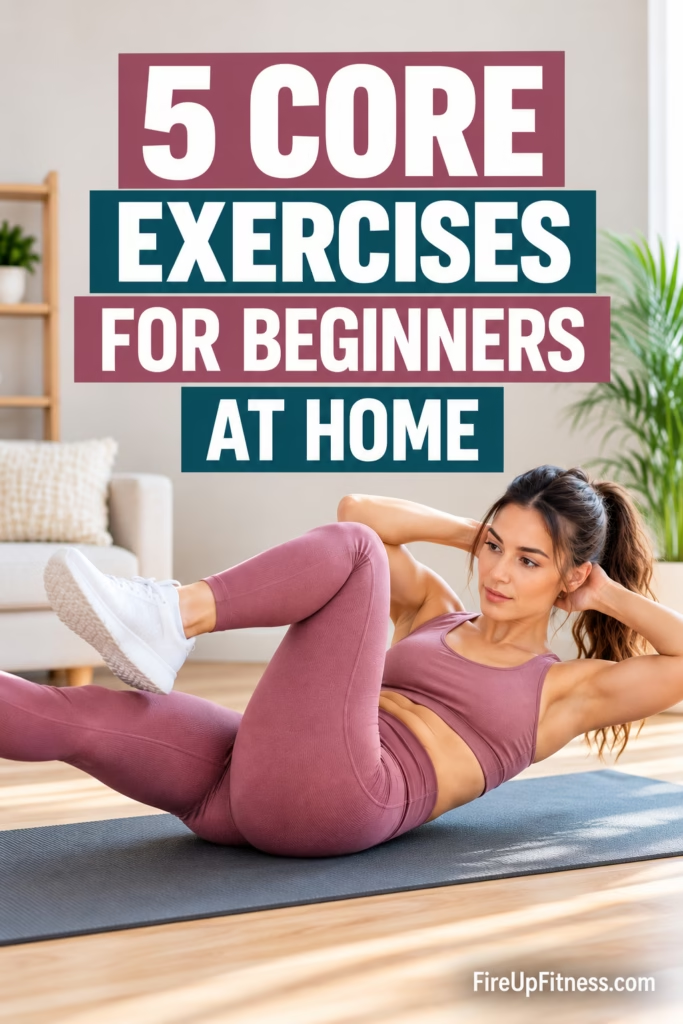
2. Bicycle Crunches
Bicycle crunches combine abdominal flexion and rotation, making them useful for strengthening the front and sides of your midsection.
How to do it:
- Lie on your back with your knees bent.
- Place your fingertips lightly behind your head.
- Raise your shoulders slightly off the mat.
- Bring your left shoulder toward your right knee while extending your left leg.
- Return to the center and switch sides.
- Continue alternating slowly.
Beginner target: 8–10 repetitions per side.
Modification: Keep one foot on the floor between repetitions.
Muscles worked: Rectus abdominis and obliques.
Avoid pulling your head forward with your hands. Keep your neck relaxed throughout the exercise.
3. Bent-Knee Leg Raises
Bent-knee leg raises are an accessible alternative to traditional straight-leg raises, particularly when you’re still developing abdominal control.
How to do it:
- Lie on your back with your knees bent and feet flat.
- Rest your arms beside your body.
- Gently brace your abdominal muscles.
- Lift one bent knee toward your chest without rocking your pelvis.
- Lower your foot slowly.
- Repeat with the opposite leg.
Beginner target: 10 repetitions per side.
Modification: Reduce the height of the knee lift if your lower back begins to arch.
Muscles worked: Abdominal stabilizers and hip flexors.
4. Seated Russian Twists
Russian twists introduce controlled rotation to your workout and strengthen the muscles along the sides of your abdomen.
How to do it:
- Sit on the floor with your knees bent and feet flat.
- Lean back slightly while maintaining a comfortable, upright spine.
- Bring your hands together in front of your chest.
- Rotate your upper body gently to the right.
- Return to the center, then turn left.
- Continue alternating with controlled movements.
Beginner target: 8–10 repetitions per side.
Modification: Sit more upright and use a smaller range of motion.
Muscles worked: Internal and external obliques, with support from other trunk stabilizers.
Keep both feet grounded and avoid forcing the twist.
5. Slow Mountain Climbers
Slow mountain climbers combine core stability with alternating leg movement. They also challenge your shoulders and improve coordination.
How to do it:
- Begin in a high plank with your hands beneath your shoulders.
- Extend your legs and keep your body aligned.
- Bring your right knee toward your chest.
- Return your foot to the starting position.
- Repeat with your left leg.
- Alternate sides without allowing your hips to sway excessively.
Beginner target: 20–30 seconds.
Modification: Place your hands on a sturdy countertop to make the movement easier.
Muscles worked: Abdominals, hip flexors, shoulders, and other stabilizing muscles.
Your 15–20 Minute Core Workout at Home
Use this simple routine as part of your weekly work outs for women at home.
Warm-Up: 3–5 Minutes
Prepare your body with gentle movements:
- Marching in place
- Arm circles
- Standing side bends
- Gentle torso rotations
Main Workout
| Exercise | Duration or repetitions |
|---|---|
| Forearm plank | 15–20 seconds |
| Bicycle crunches | 8–10 per side |
| Bent-knee leg raises | 10 per side |
| Seated Russian twists | 8–10 per side |
| Slow mountain climbers | 20–30 seconds |
Complete one or two rounds, resting 30–45 seconds between exercises.
Cool-Down: 3 Minutes
Finish with Cat-Cow stretches, Child’s Pose, and relaxed breathing.
Adjust the workout length as needed. Beginners can start with one round and gradually work toward two.
How Often Should You Do Core Exercises?
Two or three sessions per week are a reasonable starting point for most beginners.
Here’s a simple schedule that allows time for recovery.
| Day | Activity |
|---|---|
| Monday | Core workout |
| Tuesday | Walking or stretching |
| Wednesday | Rest |
| Thursday | Core workout |
| Friday | Gentle mobility exercises |
| Saturday | Optional core session |
| Sunday | Rest |
You can combine these sessions with other easy exercises for beginners, including low-impact cardio, beginner Pilates, and bodyweight strength training.
Common Core Workout Mistakes to Avoid
Good technique helps you exercise comfortably and get more from each movement.
Moving too quickly: Rushing can reduce control and make it harder to maintain proper alignment.
Holding your breath: Breathe steadily and exhale during the more challenging part of each exercise.
Arching your lower back: Use a smaller range of motion when necessary to maintain a comfortable spine position.
Ignoring discomfort: Muscle effort is normal, but sharp pain or unusual strain is a reason to stop and reassess your technique.
Increasing difficulty too soon: Master the basic movements before adding longer holds, more repetitions, or additional rounds.
How to Progress With Your Beginner Core Workout
As your strength develops, introduce small changes to keep the exercises challenging.
For example, you can increase your plank hold by five seconds, add two repetitions to your bicycle crunches, or extend your mountain climbers by another 10 seconds.
Once these adjustments feel manageable, try adding exercises such as dead bugs, bird dogs, or glute bridges.
Gradual progression allows you to develop strength without making every session unnecessarily demanding.
Frequently Asked Questions
What are the best core exercises for beginners?
Forearm planks, modified bicycle crunches, bent-knee leg raises, and slow mountain climbers are useful beginner options. The best choices are those you can perform comfortably with good technique.
Can I strengthen my core without equipment?
Yes. Bodyweight exercises can effectively challenge your abdominal and stabilizing muscles. Resistance bands and weights are optional additions as you progress.
Are core exercises for women different from men’s exercises?
The fundamental exercises are similar. Your workout should be adapted to your fitness level, mobility, goals, and individual needs rather than gender alone.
How long does it take to improve core strength?
Some people notice better control and exercise endurance within a few weeks. Strength gains vary depending on consistency, recovery, and the difficulty of the routine.
Can core workouts help improve posture?
Strengthening your trunk muscles can support posture, particularly when combined with regular movement, mobility work, and good everyday habits.
Final Thoughts
Building core strength doesn’t have to be complicated. A few well-chosen exercises, performed consistently, can improve stability, coordination, and everyday movement.
Start with one round of these five core exercises for beginners, concentrate on technique, and increase the difficulty as your body becomes stronger.
The goal isn’t to complete the hardest workout possible. It’s to create a routine that feels manageable enough to maintain.
Save this beginner core workout for your next at-home exercise session and start building strength one movement at a time.