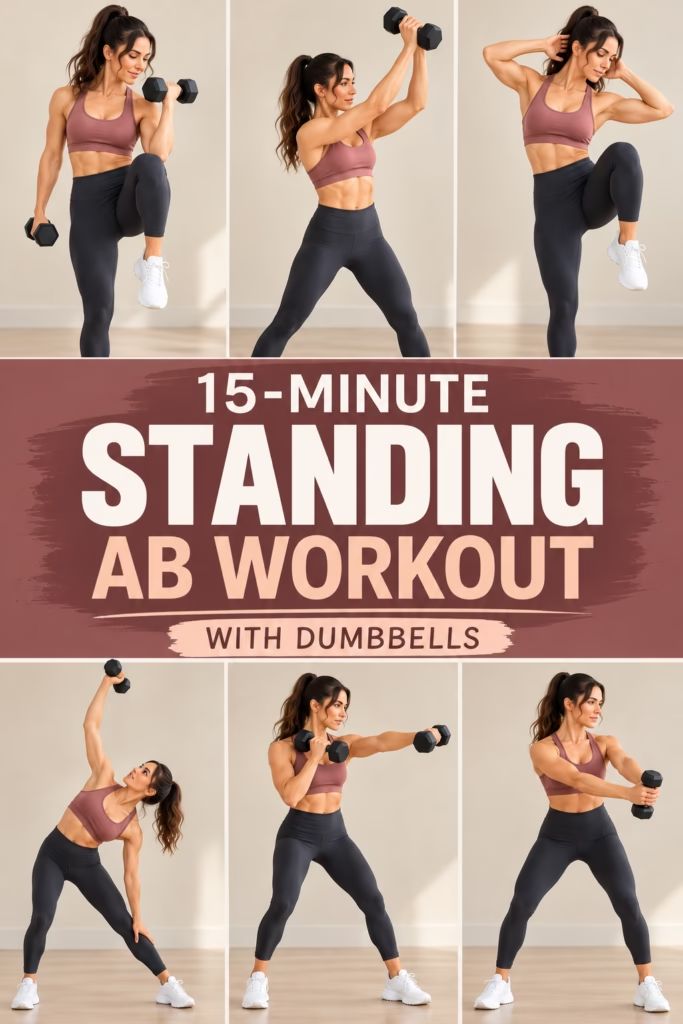
15-Minute Standing Ab Workout With Dumbbells
Want a stronger core but don’t feel like getting down on the floor? This 15-minute standing ab workout might become your new favorite way to train your abs at home.
All you need is a pair of dumbbells and a little room to move. No exercise mat, no jumping, and no endless crunches.
The workout combines standing knee raises, controlled twists, and dumbbell movements that challenge your abs, obliques, shoulders, and balance. It’s a great option for women who want a practical core routine without spending an hour exercising.
And don’t worry about lifting heavy. Even light dumbbells—or no weights at all—can make these movements surprisingly challenging when you slow down and focus on your form.
Ready to give your core some attention? Let’s get started.
Why Standing Ab Workouts Are Worth Trying
When most people think about ab exercises, they picture crunches, sit-ups, or planks on the floor.
But your core does much more than help you curl your upper body. It supports your spine, keeps you steady when you move, and helps you maintain balance during everyday activities.
That’s what makes standing ab exercises so useful.
Instead of exercising while lying down, you’re training your abdominal muscles to support your body while you’re upright.
A standing core workout can help you:
- Strengthen your abs and obliques.
- Improve balance and body coordination.
- Build stability for everyday movements.
- Engage your shoulders, hips, and legs.
- Add variety to your usual workout routine.
It’s also a convenient alternative to a floor ab workout, especially on days when you want to keep things simple.
Your 15-Minute Standing Ab Workout at a Glance
You don’t need a complicated routine to challenge your core. This workout uses a handful of effective movements, repeated with small variations to keep things interesting.
| Workout details | Your plan |
|---|---|
| Total time | 15 minutes |
| Equipment | 1–2 dumbbells |
| Work interval | 40 seconds |
| Rest interval | 20 seconds |
| Difficulty | Beginner-friendly with modifications |
| Impact | Low-impact, no jumping |
| Focus | Abs, obliques, balance, and stability |
Before you begin: March in place, gently rotate your shoulders, and practice a few slow knee raises for two or three minutes. Use light weights that you can comfortably control. Keep a sturdy chair nearby if balance is challenging.
6 Standing Ab Exercises to Strengthen Your Core
1. Standing Dumbbell Knee-to-Elbow Crunch
This move looks simple, but it asks your abs to work while your shoulders and supporting leg help keep you steady.
How to do it:
- Stand tall with your feet hip-width apart.
- Hold one dumbbell in your right hand and raise it overhead.
- Extend your left leg slightly out to the side.
- Bring your left knee toward your right elbow, lowering the elbow as you crunch.
- Return to the starting position without rushing.
- Continue for 40 seconds, then switch sides after a 20-second rest.
Make it easier: Skip the dumbbell and keep your arms at shoulder height.
Feel it working: Exhale as your knee rises. Focus on bringing your ribs and pelvis slightly closer together rather than swinging your leg.
2. Standing Dumbbell Twist With Overhead Press
This exercise brings your shoulders into the action while your core helps control the movement.
How to do it:
- Stand with your feet slightly wider than your hips.
- Hold a dumbbell in each hand at shoulder height.
- Keep your knees relaxed and your stomach muscles gently braced.
- Rotate slightly to the right while pressing your right arm upward.
- Let your feet and hips turn naturally instead of twisting through a fixed lower back.
- Return to the center and repeat on the left.
Continue alternating for 40 seconds.
Make it easier: Put the weights down and reach one arm overhead at a time.
Feel it working: Keep your movements deliberate. Avoid snapping your elbows straight or leaning backward as you press.
3. Standing Knee Crunch With a Twist
Want to challenge your abs and balance at the same time? This move combines a regular knee crunch with a cross-body crunch.
How to do it:
- Hold one dumbbell securely at chest height.
- Step your right leg slightly behind you.
- Lift your right knee toward your chest while gently crunching forward.
- Step back.
- Lift the right knee again, adding a small, controlled twist toward it.
- Alternate between the straight crunch and the twisting crunch.
Work for 40 seconds, rest for 20 seconds, and repeat on the other leg.
Make it easier: Leave the dumbbell aside and hold a chair for balance.
Feel it working: Exhale during each crunch and avoid using momentum to pull your knee upward.
4. Standing Cross-Body Punches
Here’s where the workout gets a little more energetic.
Cross-body punches engage your arms and shoulders while your core works to stabilize your torso.
How to do it:
- Stand with your feet shoulder-width apart.
- Bend your knees slightly and bring your fists near your chest.
- Extend your right arm across your body.
- Bring it back to the starting position.
- Repeat with your left arm.
- Continue alternating for 40 seconds.
Make it easier: Use shorter, slower punches without weights.
Feel it working: Keep your core firm and your movements controlled. For a weighted version, use slow cross-body reaches with very light dumbbells instead of fast punches.
5. Standing Dumbbell Triangle Reach
This exercise slows things down while challenging the muscles along the sides of your waist.
It’s a great reminder that you don’t have to move quickly to make your core work.
How to do it:
- Stand with your feet comfortably wider than shoulder-width apart.
- Hold one light dumbbell in your right hand, extending your arm toward the ceiling.
- Turn your left foot slightly outward.
- Slowly hinge toward your left side, sliding your left hand down your leg.
- Keep your chest open and your back in a comfortable, neutral position.
- Return to standing with control.
Complete 40 seconds on one side, rest, and repeat on the other.
Make it easier: Perform the reach without a dumbbell and keep your top hand on your hip if necessary.
Feel it working: Don’t worry about how far you can reach. A smaller movement with good control is more useful than forcing a deep bend.
6. Standing Dumbbell Twists
You may already know Russian twists as a floor ab workout exercise. This standing variation gives you a different way to challenge your core.
How to do it:
- Stand with your feet shoulder-width apart and knees slightly bent.
- Hold one dumbbell with both hands in front of your waist.
- Move the dumbbell toward your right hip with a small, comfortable turn.
- Bring it back to the center.
- Repeat toward your left hip.
- Continue alternating sides for 40 seconds.
Make it easier: Perform the movement without a dumbbell.
Feel it working: Keep the weight close to your body. Avoid swinging your arms or forcefully twisting your lower back.
Follow the Complete 15-Minute Routine
Now put everything together. Each exercise lasts 40 seconds, followed by 20 seconds of rest.
| Minute | Exercise |
|---|---|
| 1 | Knee-to-elbow crunch – right |
| 2 | Knee-to-elbow crunch – left |
| 3 | Dumbbell twist with overhead press |
| 4 | Knee crunch with twist – right |
| 5 | Knee crunch with twist – left |
| 6 | Cross-body punches |
| 7 | Triangle reach – right |
| 8 | Triangle reach – left |
| 9 | Knee-to-elbow crunch – right |
| 10 | Knee-to-elbow crunch – left |
| 11 | Standing elbow-to-knee crunches |
| 12 | Knee crunch with twist – right |
| 13 | Knee crunch with twist – left |
| 14 | Cross-body punches |
| 15 | Standing dumbbell twists |
For minute 11, put your dumbbells aside, place your hands lightly near your head, and alternate lifting each knee toward the same-side elbow.
That’s your full 15-minute standing ab workout!
Take a moment afterward to walk slowly, relax your shoulders, and allow your breathing to return to normal.
How to Make This Workout More Effective
You don’t need heavier weights or faster repetitions to get more from your core exercises.
Instead, pay attention to these three things.
1. Slow down your movements. Your abs should help control each knee raise, reach, and twist. When you rush, momentum often takes over.
2. Keep breathing. Exhale during the challenging part of each exercise. Avoid holding your breath, especially when using dumbbells.
3. Choose consistency over intensity. Start with two or three sessions per week, giving your muscles time to recover. As your strength improves, you can gradually increase your repetitions or resistance.
For beginners, a shorter 8–10-minute version is perfectly fine. You can build up to the full routine over time.
Are Standing Ab Exercises as Effective as Floor Exercises?
They can be effective, but they don’t work in exactly the same way.
Standing ab exercises are useful for training your core while you balance, rotate, and move your arms and legs. Floor exercises, such as dead bugs, reverse crunches, and planks, offer different ways to challenge abdominal strength and stability.
The most effective ab workouts don’t necessarily rely on one type of movement.
For a well-rounded routine, you can combine standing workouts at home with occasional floor exercises.
And while some people search specifically for lower ab exercises, remember that your abdominal muscles work together. Controlled knee raises can challenge your core, but they don’t isolate a completely separate set of lower abdominal muscles.
Can You Do This Standing Ab Workout Daily?
You can practice gentle core movements regularly, but a challenging weighted daily ab workout isn’t necessary.
Your abdominal muscles benefit from recovery, particularly when you’re adding resistance.
Try this routine two or three times a week alongside walking, full-body strength training, and mobility exercises.
Over time, you may notice that your balance feels steadier, your movements become more controlled, and the same exercises feel easier to perform.
Those are meaningful signs of progress.
Final Thoughts
A stronger core doesn’t require complicated equipment, endless crunches, or long workout sessions.
This 15-minute standing ab workout with dumbbells gives you a practical way to train your abs, challenge your obliques, and improve stability without getting down on the floor.
Start with light weights, focus on your form, and move at a pace that feels right for you.
Some days, you’ll complete all 15 minutes. Other days, you might only manage a few exercises. Both can be worthwhile.