5 Kettlebell Exercises for Full-Body Strength at Home
A single kettlebell might be one of the simplest ways to make your home workouts more effective.
No complicated machines. No crowded gym. Just one weight and a few movements that challenge your arms, legs, core, and balance together.
And here’s something many women don’t realize: kettlebell exercises aren’t just for experienced lifters. With the right movements and a manageable weight, beginners can enjoy them too.
Whether you’re starting strength training after 40, getting back into exercise, or simply looking for something different, a beginner-friendly kettlebell workout can help you feel stronger and more confident in everyday life.
The best part? You can get started with just five exercises.
Why Kettlebell Exercises Are Worth Trying
There’s something different about working out with a kettlebell.
Unlike a traditional dumbbell, a kettlebell has an offset center of mass. That design can challenge your grip, balance, and stabilizing muscles as you move.
You might notice your core working during a squat or your shoulders staying active while carrying the weight across the room.
That’s what makes kettlebell training so useful for building practical, everyday strength.
A few reasons to try kettlebell exercises:
- Strengthen multiple muscle groups in one workout.
- Improve coordination and balance.
- Build core stability and support better posture.
- Develop stronger arms, shoulders, legs, and glutes.
- Make home workouts more interesting without needing much equipment.
You don’t need to rush through the movements to benefit. In fact, starting slowly helps you learn proper form and feel more comfortable handling the weight.
5 Kettlebell Exercises for Beginners
Ready to give it a try?
This simple routine combines lower-body strength, upper-body training, and core stability. You can complete it at home with one kettlebell and enough space to move comfortably.
Choose a weight you can control without straining. Begin with one round and gradually build up as the movements become familiar.
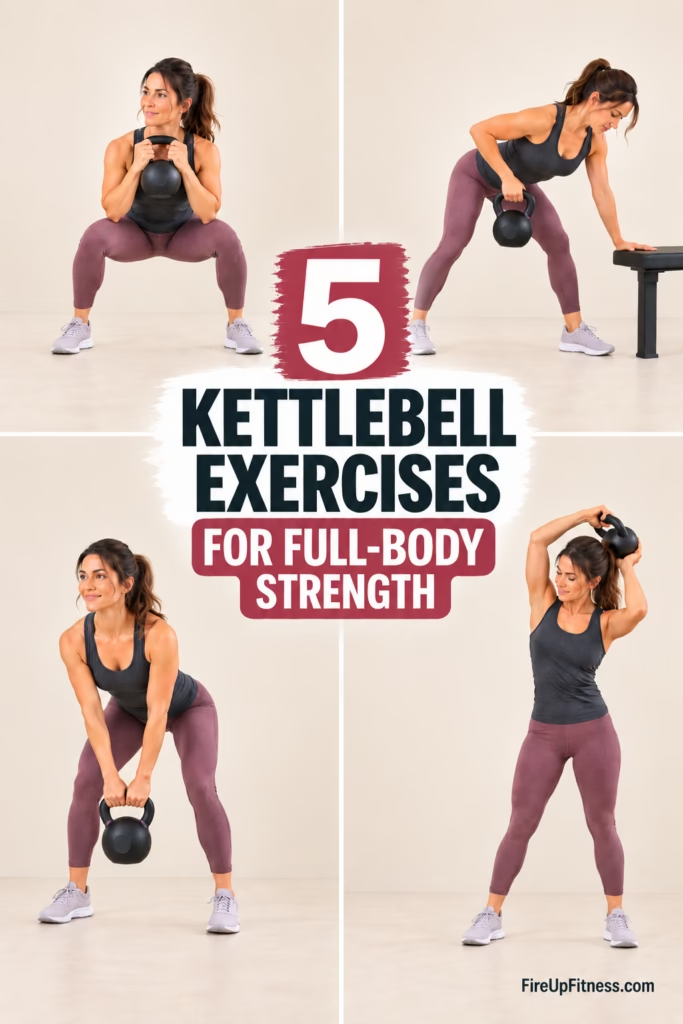
1. Kettlebell Deadlift – Build Stronger Legs and Glutes
The kettlebell deadlift is a great place to start because it teaches you how to lift weight using your hips and legs instead of relying on your lower back.
It’s also a movement that translates directly into everyday activities, like picking up groceries or lifting something from the floor.
How to do it:
- Stand with your feet about hip-width apart and place the kettlebell between your feet.
- Push your hips backward and bend your knees slightly.
- Keep your back neutral as you grip the kettlebell with both hands.
- Press through your feet and stand tall, keeping the kettlebell close to your body.
- Lower it slowly by pushing your hips back again.
Try: 8–12 repetitions.
Beginner tip: Practice the hip-hinge movement without a kettlebell first. If reaching the floor feels uncomfortable, start with the kettlebell on a stable raised surface.
2. Kettlebell Goblet Squat – Strengthen Your Lower Body and Core
Squats already work several major muscles, but holding a kettlebell close to your chest adds another challenge.
Your legs do the lifting while your core helps keep your upper body steady.
This makes goblet squats a useful addition to a full-body kettlebell workout.
How to do it:
- Stand with your feet slightly wider than hip-width apart.
- Hold the kettlebell by its horns close to your chest.
- Bend your knees and lower your hips into a comfortable squat.
- Keep your chest lifted and your heels grounded.
- Push through your feet to return to standing.
Try: 8–10 repetitions.
Beginner tip: Don’t worry about squatting deeply. Lower only as far as you can while maintaining control. You can also squat toward a sturdy chair for extra confidence.
3. Kettlebell Row – Strengthen Your Back and Arms
Looking for a simple kettlebell upper body workout movement?
The kettlebell row deserves a spot in your routine.
It targets your upper back and helps strengthen the muscles involved in pulling, lifting, and maintaining good posture.
This can be particularly helpful when you spend much of your day sitting at a desk or looking down at a screen.
How to do it:
- Hold the kettlebell in one hand.
- Step one foot slightly backward and hinge forward at your hips.
- Support your free hand on a sturdy bench or chair if needed.
- Pull the kettlebell toward your ribs, keeping your elbow close to your body.
- Slowly lower the weight and repeat before switching sides.
Try: 8–10 repetitions per arm.
Beginner tip: Keep your shoulders level and avoid twisting your torso. A lighter kettlebell makes it easier to focus on the muscles doing the work.
4. Kettlebell Halo – Improve Shoulder Mobility and Control
The kettlebell halo might look unusual at first, but it’s a controlled movement that challenges your shoulders and core.
Instead of lifting the weight straight up, you guide it slowly around your head.
It’s a nice change from traditional arm exercises and can help develop shoulder coordination.
How to do it:
- Stand tall with your feet hip-width apart.
- Hold a light kettlebell upside down by the horns in front of your chest.
- Slowly guide the weight around one side of your head.
- Continue behind your head and bring it around the opposite side.
- Return to the starting position and reverse directions.
Try: 5 slow circles in each direction.
Beginner tip: Start with a very light kettlebell. Keep the movement small, your ribs down, and your neck relaxed. Skip this exercise if it causes shoulder discomfort.
5. Kettlebell Carry – Build Core Strength and Balance
This may be the simplest exercise on the list, but don’t underestimate it.
Holding a kettlebell in one hand while walking forces your body to resist leaning toward the weight.
Your core, grip, shoulders, and stabilizing muscles all work together to keep you upright.
That’s why carries are among the most practical kettlebell exercises for stomach and core stability, even though they don’t involve crunches or sit-ups.
How to do it:
- Stand tall with a kettlebell in one hand at your side.
- Keep your shoulders level and your core gently engaged.
- Walk forward slowly with controlled steps.
- Avoid leaning toward or away from the kettlebell.
- Switch hands and repeat.
Try: 20–30 seconds per side.
Beginner tip: Don’t have much room? March slowly in place while holding the kettlebell.
Your Simple 20-Minute Kettlebell Workout
You don’t need to spend an hour exercising to enjoy a meaningful strength-training session.
This beginner kettlebell workout can fit into a busy morning, an afternoon break, or an evening at home.
| Exercise | Repetitions |
|---|---|
| Kettlebell deadlift | 8–12 reps |
| Kettlebell goblet squat | 8–10 reps |
| Kettlebell row | 8–10 per arm |
| Kettlebell halo | 5 each direction |
| Kettlebell carry | 20–30 seconds per side |
How to follow the routine:
Start with 3–5 minutes of gentle marching, arm circles, and bodyweight squats to warm up.
Complete the five exercises in order, resting about 30–60 seconds between movements or longer when needed.
Beginners can start with one round. As your strength improves, work toward two or three rounds, depending on your pace and recovery.
Finish with a few minutes of gentle movement and relaxed breathing.
The session may take around 15–25 minutes. The goal is controlled movement, not finishing as quickly as possible.
Try This Beginner-Friendly Kettlebell Challenge
Sometimes the hardest part of exercising isn’t the workout itself. It’s making time to begin.
A simple kettlebell challenge can help you build a routine without feeling pressured to do too much.
Here’s an easy two-week approach:
| Week | Your goal |
|---|---|
| Week 1 | Complete 1 round, 2 days this week |
| Week 2 | Complete 1–2 rounds, 2–3 days this week |
Leave at least one recovery day between strength-training sessions.
Rather than focusing on how heavy your kettlebell is, pay attention to how your movements feel.
Are your squats becoming smoother? Can you keep your shoulders steadier during carries? Do the exercises feel more familiar?
Those small improvements matter.
And there’s no need to increase the weight until you’re ready.
Can Kettlebell Exercises Strengthen Your Stomach?
Yes. Kettlebell training can help strengthen your abdominal muscles, particularly through movements that require you to stabilize your torso.
You don’t always need traditional ab exercises to challenge your core.
For example:
- Goblet squats encourage your abdominal muscles to stabilize your torso while you squat.
- Kettlebell carries challenge your obliques as you resist leaning sideways.
- Kettlebell halos require core control as the weight moves around your head.
- Kettlebell deadlifts train your trunk to stay stable while your hips and legs produce force.
These kettlebell exercises for stomach strength focus on stability and control rather than isolated abdominal movements.
A stronger core can make everyday tasks, such as carrying groceries, standing tall, and lifting objects, feel easier.
How Often Should You Do Kettlebell Workouts?
For beginners, two or three nonconsecutive days per week is a practical starting point.
You can alternate kettlebell workouts with walking, stretching, gentle yoga, or other activities you enjoy.
You don’t need to train hard every day to make progress.
Consistency, proper technique, and adequate recovery are more valuable than constantly increasing intensity.
One important reminder: Always choose a kettlebell that feels manageable. Stop if a movement causes sharp pain, and seek guidance from a qualified trainer when learning unfamiliar techniques.
Why Kettlebell Training Works Well for Women Over 40
Strength training becomes especially valuable as we get older.
Maintaining muscle strength supports mobility, balance, and the ability to handle everyday activities comfortably.
Kettlebells offer a convenient way to work on these qualities without needing a large collection of weights or a complicated home gym.
A kettlebell workout can also be adjusted to suit different experience levels.
You might begin with light deadlifts and supported rows, then gradually add goblet squats, carries, and other movements as your confidence improves.
There’s no need to compare your routine with someone else’s.
The best workout is one you can perform safely, enjoy, and return to consistently.
Final Thoughts: Start Small and Build Strength
You don’t need an elaborate fitness plan to start feeling stronger.
Sometimes, one kettlebell and a few simple exercises are enough to make your workouts feel more purposeful.
These five kettlebell exercises help train your legs, glutes, arms, shoulders, and core while encouraging better balance and coordination.
Start with a comfortable weight. Take your time learning each movement. Let your confidence grow naturally.
Save this beginner-friendly kettlebell workout for your next home strength session. You might be surprised by how much you can accomplish with just one kettlebell.