5 Best Butt Workouts to Lift and Strengthen Your Glutes
Want a stronger, firmer butt without spending hours at the gym? You don’t need complicated machines or an exhausting workout plan to start strengthening your glutes.
A few simple butt workouts performed consistently can help you build stronger glutes, improve lower-body strength, and create a more lifted, toned appearance over time.
And there’s another reason to train your glutes that goes far beyond appearance.
Your glutes are some of the largest and most powerful muscles in your body. They help you walk, climb stairs, squat, stand up from a chair, stabilize your hips, and support your lower back. Strong glutes can make everyday movement feel easier while giving your lower body more strength and stability.
The best part? You can do this butt workout at home with little to no equipment.
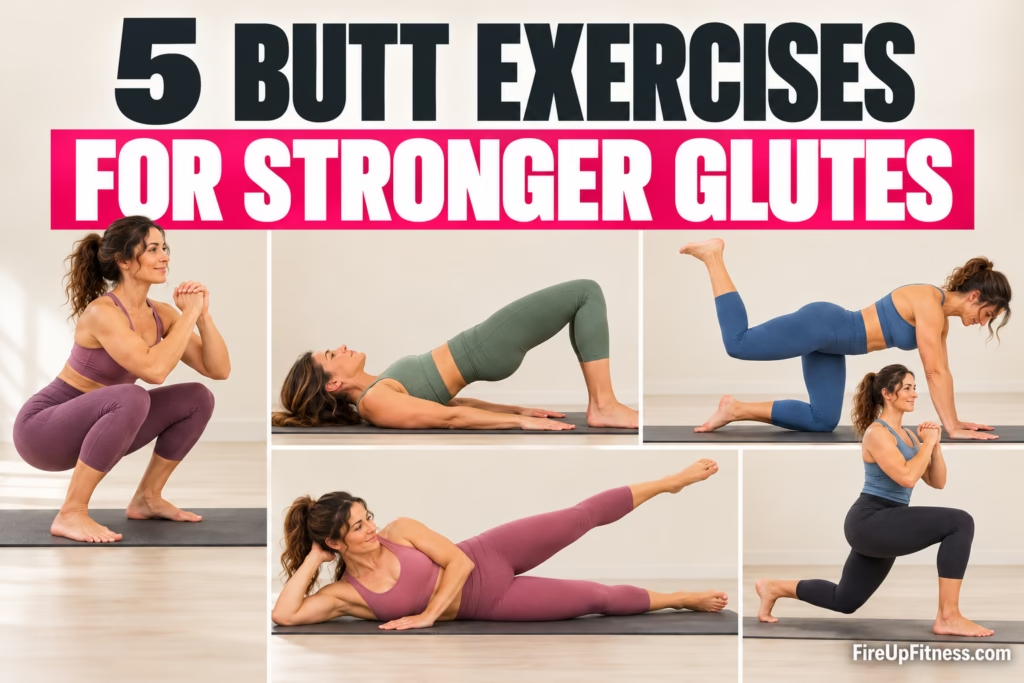
Below are five effective glute exercises that target your butt from different angles. Save this workout for your next lower-body day and give it a try!
Why These Butt Workouts Are So Effective
Your glutes aren’t just one muscle. They include three main muscles:
- Gluteus maximus: The largest glute muscle and an important contributor to hip extension and power.
- Gluteus medius: Helps stabilize your pelvis and move your leg away from your body.
- Gluteus minimus: Works with the gluteus medius to support hip movement and stability.
That’s why doing only one type of squat isn’t necessarily the best approach.
A well-rounded glute workout should include several movement patterns. Squats and lunges work your entire lower body, bridges emphasize hip extension, kickbacks isolate the glutes, and side leg raises target the muscles around the outer hips.
Put them together and you have a simple but surprisingly effective at-home butt workout.
1. Squat Hold and Pulse
Looking for an exercise that makes your glutes work without requiring equipment? Add squat pulses to your routine.
The small pulsing movement keeps tension on your lower body rather than giving your muscles a complete break between repetitions. You’ll likely feel this one in your glutes and thighs quickly.
How to Do a Squat Hold and Pulse
- Stand with your feet approximately hip- to shoulder-width apart.
- Brace your core and keep your chest comfortably lifted.
- Push your hips backward as though you’re sitting into a chair.
- Bend your knees and lower into a comfortable squat.
- Keep your weight distributed through your feet rather than shifting excessively onto your toes.
- Hold the squat position.
- Move your hips slightly up and down using small, controlled pulses.
- Continue for 15–20 pulses.
- Stand up, rest briefly, and repeat.
Try: 2 sets of 15–20 pulses.
Beginner Modification
You don’t have to squat deeply to make this exercise effective. Start with a shallow squat and gradually increase your range of motion as your strength and mobility improve.
You can also place a sturdy chair behind you for reassurance while learning the movement.
Make it harder: After your final pulse, hold the squat position for another 10–20 seconds.
That extra hold can make your glutes and thighs work even harder.
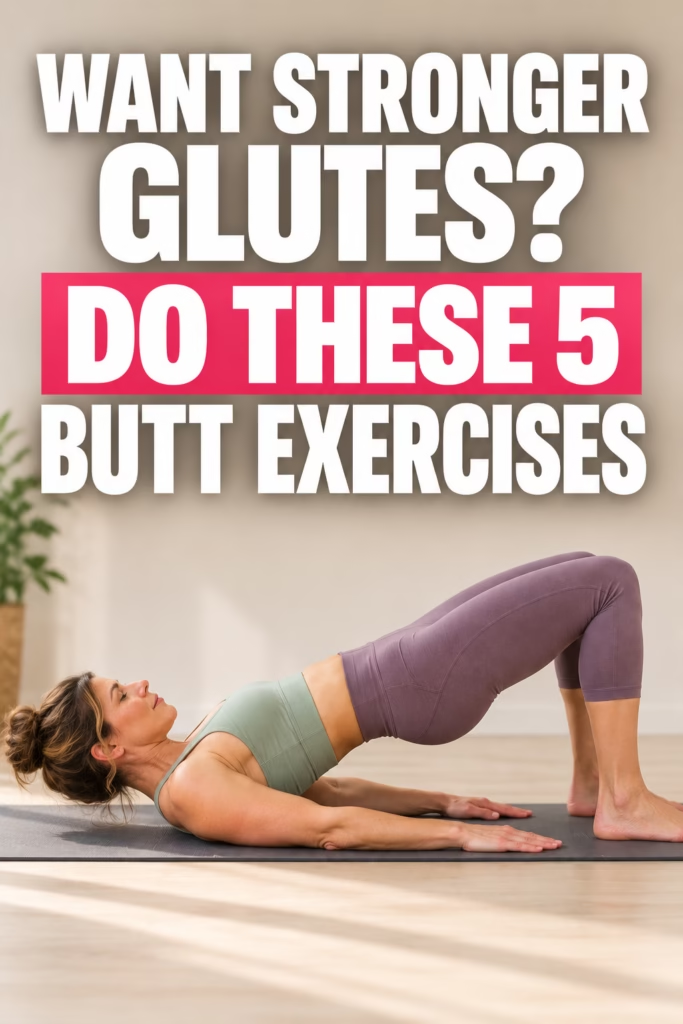
2. Glute Bridge
The glute bridge deserves a place in almost every lower-body workout.
It’s simple, beginner-friendly, requires no equipment, and allows you to concentrate on squeezing your glutes without putting much stress on your knees.
How to Do a Glute Bridge
- Lie on your back with your knees bent.
- Place your feet flat on the floor about hip-width apart.
- Rest your arms comfortably beside your body.
- Brace your core gently.
- Press through your feet and squeeze your glutes.
- Lift your hips toward the ceiling.
- Pause briefly at the top.
- Slowly lower your hips toward the floor.
- Repeat with control.
Avoid trying to lift your hips as high as possible by excessively arching your lower back. Think about creating the movement by squeezing your glutes instead.
Try: 2–3 sets of 12–15 repetitions.
Want More Glute Activation?
Pause at the top of each bridge for two or three seconds and consciously squeeze your glutes before lowering.
Slowing the exercise down can make a basic bodyweight movement considerably more challenging.
3. Single-Leg Kickbacks
Kickbacks are an excellent addition to your butt workout at home because they allow you to focus on one side at a time.
They’re particularly useful when you want to target your glutes without needing weights.
How to Do Glute Kickbacks
- Start on your hands and knees.
- Position your hands underneath your shoulders and knees underneath your hips.
- Keep your core gently braced.
- Keep your right knee bent.
- Lift your right leg behind you by squeezing your right glute.
- Stop before your lower back begins to arch.
- Slowly lower your knee toward the starting position.
- Complete your repetitions before changing sides.
Try: 10–15 repetitions on each leg for 2–3 sets.
Form Tip
Don’t worry about getting your foot as high as possible.
A smaller, controlled movement driven by your glutes is usually better than lifting your leg higher by arching your back.
Keep your neck neutral and your shoulders relaxed throughout the movement.
Make It More Challenging
Straighten your working leg and perform the same controlled lifting motion.
You can also pause briefly at the top of each repetition.
4. Side-Lying Leg Raise
Don’t forget about the sides of your glutes.
The side-lying leg raise primarily challenges the hip abductor muscles, including the gluteus medius. These muscles play an important role in hip and pelvic stability.
This is also a useful exercise because it can be performed almost anywhere.
How to Do Side-Lying Leg Raises
- Lie comfortably on your right side.
- Bend your bottom leg slightly for stability if needed.
- Keep your top leg straight.
- Stack your hips rather than rolling backward.
- Brace your abdominal muscles gently.
- Slowly lift your top leg.
- Pause briefly.
- Lower the leg with control.
- Complete your repetitions before switching sides.
Try: 12–15 repetitions on each side for 2–3 sets.
Common Mistake to Avoid
Don’t swing your leg.
Using momentum makes the exercise easier but takes some of the work away from the muscles you’re trying to train.
Instead, lift for about two seconds and lower for about two seconds.
You may be surprised how much harder the exercise becomes.
5. Reverse Lunges
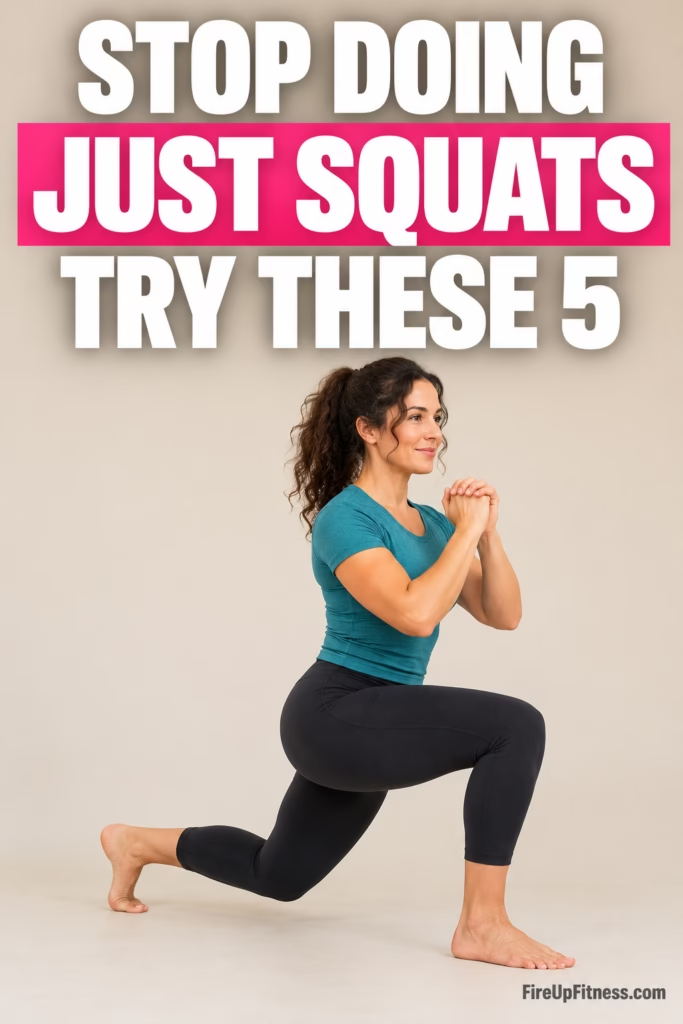
Lunges are one of the most useful lower-body exercises because they train your glutes, thighs, balance, and coordination simultaneously.
For many beginners, reverse lunges can feel easier to control than stepping forward.
How to Do a Reverse Lunge
- Stand tall with your feet approximately hip-width apart.
- Brace your core.
- Step backward with your right foot.
- Bend both knees and lower your body comfortably.
- Keep your front foot planted firmly on the floor.
- Push through your front foot to return to standing.
- Repeat on the opposite side.
Try: 8–12 repetitions on each leg for 2–3 sets.
Beginner Modification
Hold onto a wall, countertop, or sturdy chair for balance.
You can also reduce how far you lower your body. As your leg strength and balance improve, gradually work toward a deeper lunge.
Put the 5 Butt Exercises Together
You can turn these exercises into a quick at-home glute workout.
Start with a 3–5 minute warm-up such as marching in place, gentle bodyweight squats, hip circles, or easy walking.
Then complete:
Squat Hold and Pulse: 15–20 pulses
Glute Bridges: 12–15 reps
Glute Kickbacks: 10–15 reps per leg
Side-Lying Leg Raises: 12–15 reps per side
Reverse Lunges: 8–12 reps per leg
Rest for approximately 30–60 seconds between exercises when needed.
Complete 2 rounds as a beginner or work toward 3 rounds as you become stronger.
The entire routine can fit comfortably into a short home workout.
How Often Should You Train Your Glutes?
More isn’t always better.
Your muscles need time to recover and adapt after resistance training. Rather than doing an intense butt workout every single day, give your glutes adequate recovery between challenging sessions.
For many beginners, two or three glute-focused workouts per week can be a practical starting point.
Pay attention to how your body feels and gradually increase the difficulty rather than immediately adding more and more workouts.
How to Make Butt Workouts Harder Without Weights
Eventually, the exercises that once made your muscles burn may start feeling surprisingly easy.
That’s a good thing.
It means you’re getting stronger.
To continue challenging your muscles without buying equipment, you can:
- Add more repetitions.
- Add another set.
- Slow down each repetition.
- Pause at the hardest part of the exercise.
- Increase your comfortable range of motion.
- Progress to single-leg variations.
- Reduce momentum and concentrate on controlled movement.
For example, instead of quickly performing 20 glute bridges, try 12 slow bridges with a three-second squeeze at the top.
Quality matters.
Don’t Rush Your Repetitions
One of the biggest mistakes people make with home butt workouts is trying to complete the repetitions as quickly as possible.
Slower isn’t always automatically better, but controlled movement can help you maintain good form and keep tension on the muscles you’re trying to train.
Instead of thinking:
“How quickly can I finish 20 reps?”
Think:
“Can I make every repetition controlled?”
That small change can make a basic bodyweight workout feel completely different.
Can Butt Workouts Get Rid of Fat Around Your Butt and Thighs?
It’s important to separate building muscle from losing body fat.
Glute exercises can strengthen and build the muscles around your butt and hips, but you can’t choose exactly where your body loses fat first.
Fat loss happens throughout the body and is influenced by factors such as your overall calorie balance, activity level, genetics, sleep, and lifestyle.
A better strategy is to combine regular strength training with walking or other enjoyable activity, adequate protein, balanced meals, sufficient sleep, and sustainable nutrition habits.
That way you’re working toward both stronger muscles and overall health rather than chasing spot reduction.
A Simple Weekly Glute Workout Schedule
Consistency will take you further than one exhausting workout.
A beginner-friendly week might look like this:
Monday: 5-exercise glute workout
Tuesday: Walking or gentle activity
Wednesday: Rest or upper-body workout
Thursday: 5-exercise glute workout
Friday: Walking or another activity you enjoy
Saturday: Optional full-body strength workout
Sunday: Recovery
Adjust the schedule to match your fitness level and recovery.
Your routine doesn’t have to be perfect. It just needs to be realistic enough that you’ll continue doing it.
Final Thoughts: Stronger Glutes Start With Simple Moves
You don’t need a gym full of equipment to start building a stronger lower body.
Squat pulses, glute bridges, kickbacks, side leg raises, and lunges give you five simple exercises that challenge your glutes from several angles while also strengthening your legs and hips.
Start with two rounds.
Move slowly enough to maintain control.
Focus on good form.
Then gradually increase the challenge as you become stronger.
The workout may look simple on paper, but simple exercises performed consistently can add up.
Save this 5-move butt workout so you have an easy lower-body routine ready whenever you want to train at home.