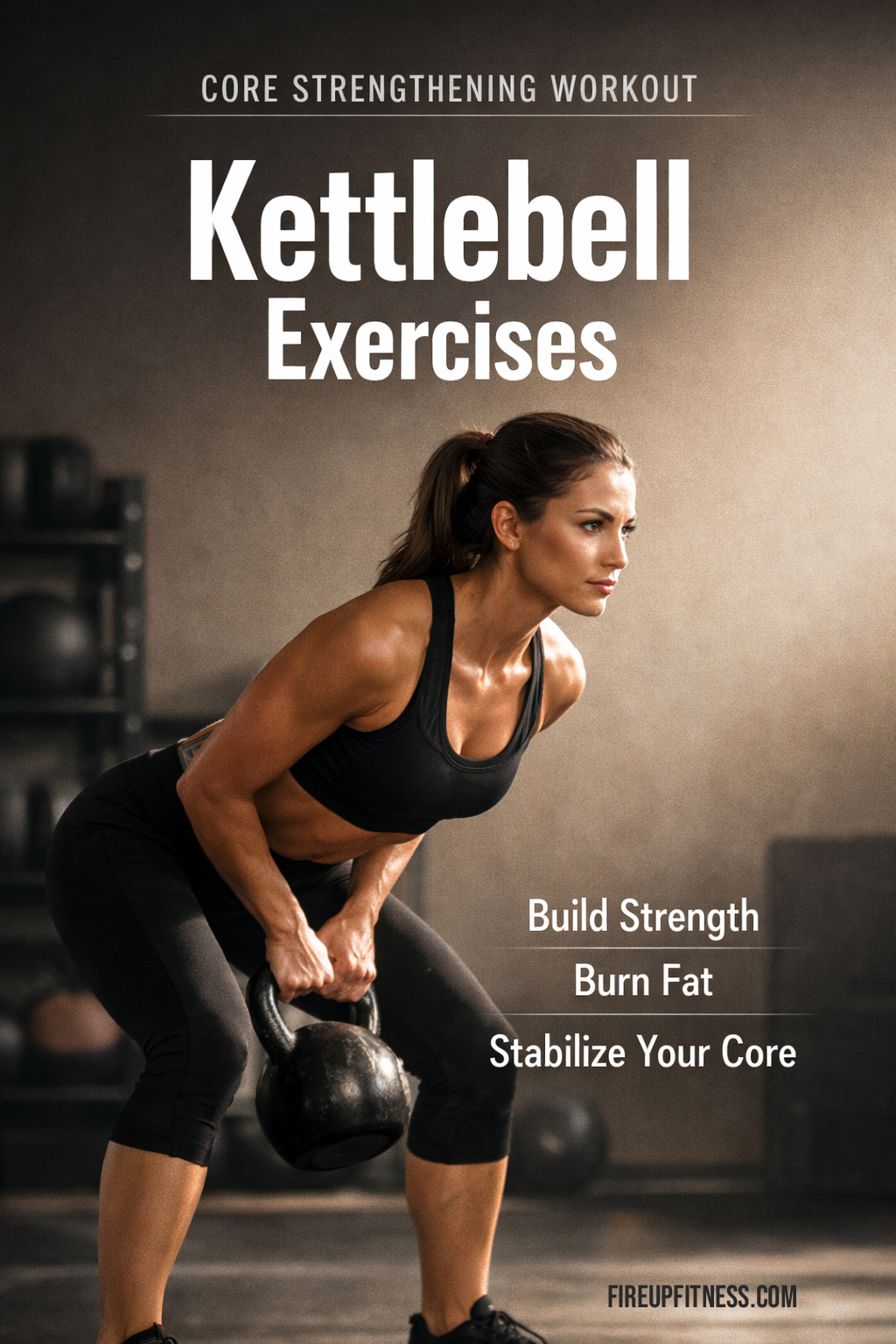
Kettlebell Exercises for a Powerful Core Strengthening Workout
If you’ve walked into a gym lately, chances are you’ve seen more people reaching for kettlebells. While they may seem like a newer trend in modern fitness spaces, kettlebell exercises have quickly earned their place as one of the most effective tools for building strength, stability, and endurance.
In fact, many trainers believe kettlebells can be even more versatile than dumbbells. Why? Because kettlebell training isn’t just about lifting weight — it’s about movement, control, coordination, and power.
If you’re looking for a core strengthening workout that challenges your entire body, kettlebells deliver in a way few other tools can.
Let’s break down why they work — and how to use them properly.
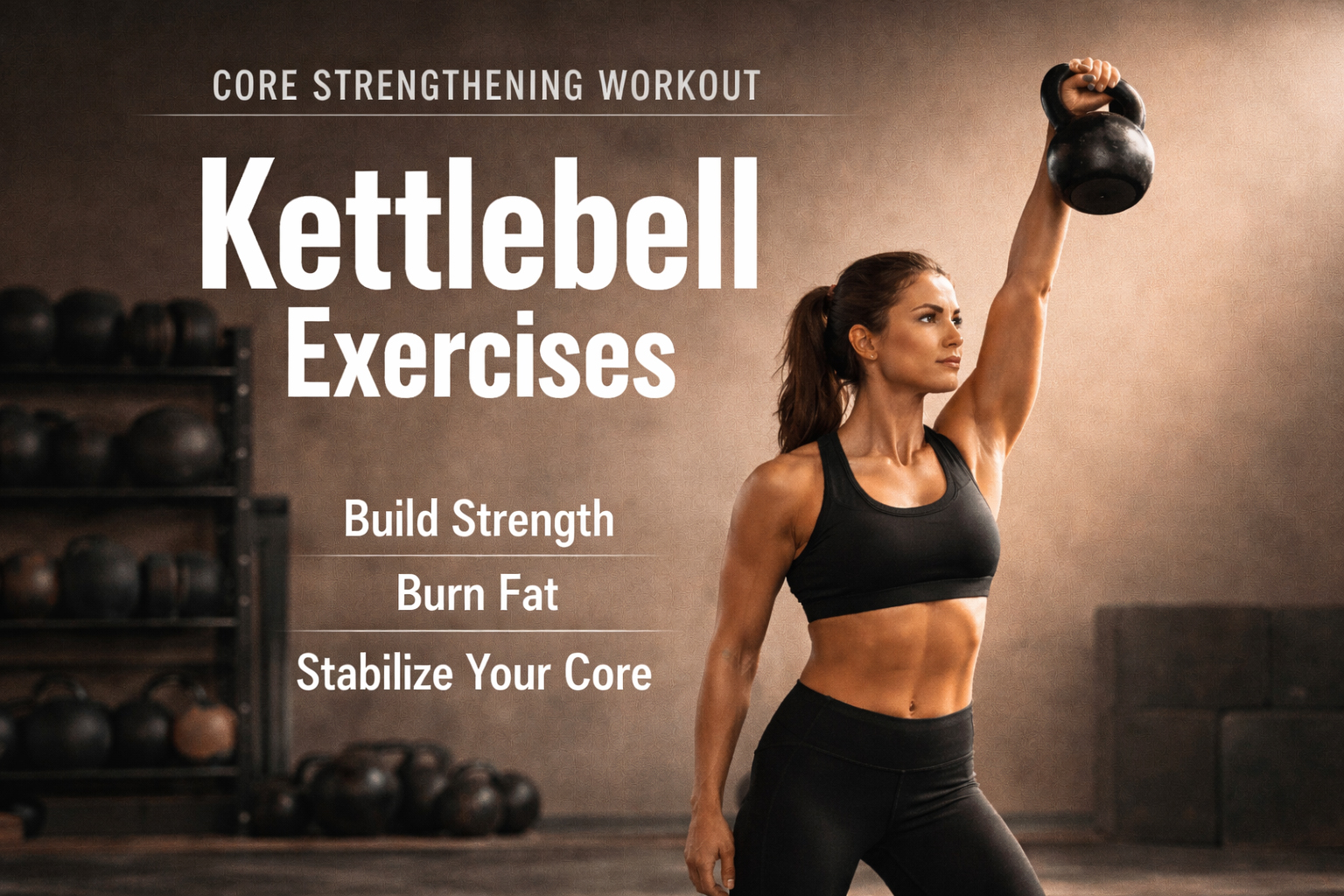
Why Kettlebell Exercises Are So Effective
Unlike traditional weights, kettlebells have an offset center of gravity. That small design difference forces your muscles — especially your core — to work harder to stabilize every movement.
That means:
- More muscle activation
- Greater calorie burn
- Improved coordination
- Better functional strength
Kettlebell exercises are dynamic. They train your body to move as a unit rather than isolating one muscle at a time. Almost every movement becomes a built-in core strengthening workout because your abs, obliques, and lower back must stabilize constantly.
Before You Start: Important Safety Tips
Kettlebell moves are powerful — but they’re not for the faint-hearted. Form matters more than weight.
Keep these guidelines in mind:
- Start with a lighter kettlebell to master technique.
- Focus on hip movement, not arm pulling.
- Maintain a neutral spine at all times.
- Progress to heavier weights gradually.
- Stop if your form breaks down.
Many kettlebell exercises use what’s called the rack position — where the kettlebell rests against your forearm and upper arm near your chest. This position allows smooth transitions between movements while keeping your core fully engaged.
Now let’s dive into four powerful kettlebell exercises that double as an intense core strengthening workout.
1. Kettlebell Swings
If there’s one foundational kettlebell exercise, it’s the swing.
Muscles Worked:
- Hamstrings
- Glutes
- Quads
- Upper and lower back
- Core
- Shoulders
Despite how it looks, the swing is not a shoulder exercise. It’s a hip hinge movement driven by your glutes and hamstrings.
How to Perform:
- Stand with feet slightly wider than hip-width apart.
- Hold the kettlebell with both hands.
- Hinge at your hips and swing the kettlebell back between your legs.
- Drive your hips forward explosively.
- Let the kettlebell rise to mid-torso height.
- Keep your spine neutral and core tight.
At the top of the swing, stand tall without arching your back. Your arms should stay relaxed — they guide the bell, but your hips generate the power.
Breathing tip:
Inhale at the top. Exhale sharply as the kettlebell swings back between your legs.
Why it’s powerful:
The kettlebell swing is a metabolic machine. It burns fat, strengthens the posterior chain, and builds explosive power while acting as a dynamic core strengthening workout.
2. Kettlebell Clean
The clean builds strength and control while transitioning into the rack position.
Muscles Worked:
- Hamstrings
- Glutes
- Quads
- Core
- Upper and lower back
- Arms
How to Perform:
- Start with the kettlebell between your feet.
- Hinge at the hips and swing it back.
- Drive your hips forward.
- Guide the kettlebell into the rack position.
- Let it land softly in the “V” created by your bicep and forearm.
Your elbow should stay close to your body and rest near your ribcage or hip area.
The clean requires precision. Avoid letting the kettlebell slam onto your forearm — instead, rotate your hand around the bell smoothly.
Why it works:
The clean trains coordination and full-body strength. Because the weight moves dynamically, your core must brace throughout the entire motion.
3. Clean and Jerk
This movement takes the clean to the next level.
It combines power, shoulder strength, and explosive leg drive into one fluid motion.
Muscles Worked:
- Glutes
- Quads
- Hamstrings
- Core
- Shoulders
- Triceps
How to Perform:
- Clean the kettlebell into the rack position.
- Dip slightly by bending your knees.
- Drive through your legs.
- Press or jerk the kettlebell overhead.
- Lock your elbow fully.
- Stand tall to complete the movement.
The key here is leg drive — not pressing with just your shoulder.
Drop slightly under the kettlebell as you drive it upward to reduce strain and increase power.
Why it’s effective:
The clean and jerk forces your entire body to coordinate in one explosive sequence. Your core acts as the stabilizer from hips to shoulders, making it an advanced core strengthening workout.
4. Kettlebell Snatch
The snatch is one of the most technical — and rewarding — kettlebell exercises.
It’s similar to the swing, but instead of stopping at chest height, the kettlebell travels overhead in one continuous motion.
Muscles Worked:
- Glutes
- Hamstrings
- Back
- Shoulders
- Core
How to Perform:
- Start like a swing.
- Drive through your hips.
- Guide the kettlebell upward.
- Punch your hand through at the top.
- Lock your arm straight overhead.
- Keep the kettlebell resting softly on your forearm.
Your arm should stay close to your head, and your core must remain tight to avoid overextending your back.
Why it’s powerful:
The snatch is a full-body strength and endurance builder. It challenges stability, mobility, coordination, and grip strength — all while deeply engaging your core.
Common Mistakes to Avoid
Even experienced lifters make errors with kettlebell exercises. Watch out for:
- Squatting instead of hinging in swings
- Rounding your lower back
- Using arms instead of hips to lift
- Letting the kettlebell crash onto your forearm
- Going too heavy too soon
Master technique first. Strength follows.
Sample Core Strengthening Workout with Kettlebells
Try this simple circuit:
- 15 Kettlebell Swings
- 10 Cleans (each side)
- 8 Clean and Jerks (each side)
- 6 Snatches (each side)
Rest 60 seconds. Repeat 3 rounds.
This routine works your entire body while delivering an intense core strengthening workout that builds both strength and endurance.
Why You Should Add Kettlebell Exercises to Your Routine
Kettlebell training offers:
- Efficient full-body workouts
- Core stability and strength
- Improved posture
- Increased calorie burn
- Functional real-world strength
Because your core is engaged in nearly every movement, you don’t just “train abs” — you train total-body stability.
Final Thoughts
Have you tried kettlebell exercises before?
If not, this might be your sign to start. They’re challenging, yes — but incredibly rewarding. Whether your goal is fat loss, muscle tone, or stronger core stability, kettlebells can transform your workouts.
Start light. Move with control. Progress gradually.
Consistency builds strength — and strength builds confidence.