How to Lose Back Fat: 4 Exercises for a Stronger Back
Back fat can be frustrating, especially when you are making progress elsewhere but still notice softness around your bra line, sides, or lower back.
You may strengthen your back, walk more, clean up your diet, and still wonder: Why is my back fat taking so long to change?
The answer is simpler than it seems.
Your body decides where it stores fat and where it loses fat first. Genetics, hormones, age, overall body-fat levels, lifestyle, and other factors can all influence fat distribution. Unfortunately, you cannot tell your body to burn fat specifically from your lower back.
That does not mean your efforts are wasted.
A combination of regular movement, strength training, adequate protein, good nutrition, sleep, and a sustainable calorie deficit can help reduce overall body fat over time. At the same time, exercises that strengthen your back, shoulders, and core can improve muscle tone, posture, and definition.
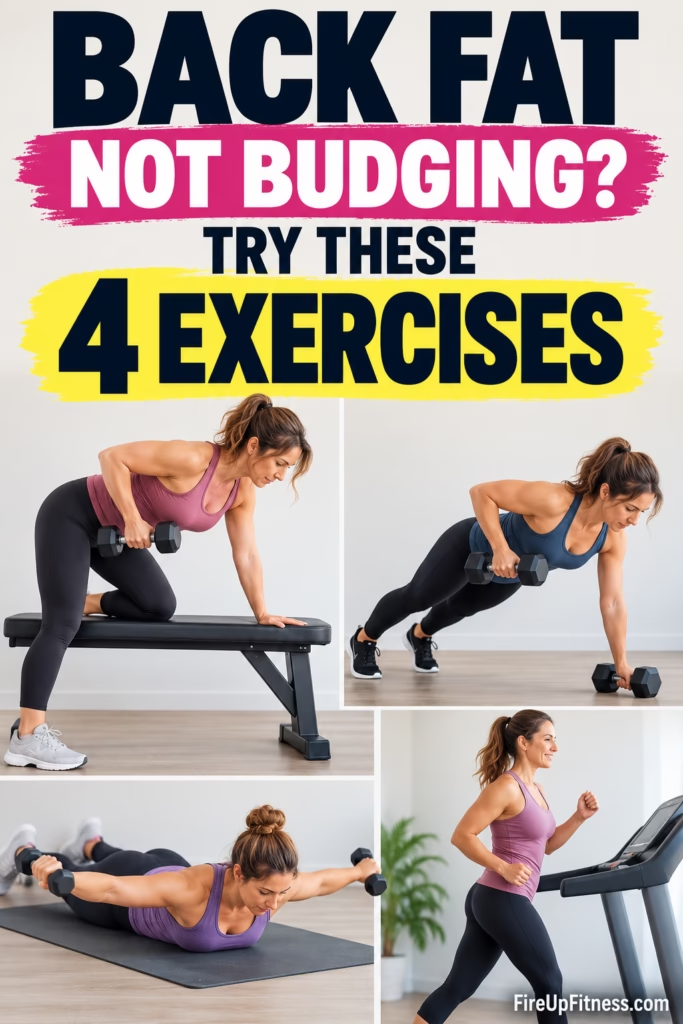
The following four exercises are a simple place to start.
Can You Actually Target Back Fat?
Before getting into the exercises, there is one important point to understand: spot reduction is not a reliable fat-loss strategy.
Doing hundreds of back exercises will not force your body to take stored fat specifically from your back.
What those exercises can do is strengthen the muscles underneath the area.
Combine that with habits that support overall fat loss, and your back may gradually begin looking stronger and more defined as your body composition changes.
Think of your plan as having two jobs:
Reduce overall body fat while building and maintaining muscle.
That approach is far more realistic than chasing a workout that promises to melt back fat in a few days.
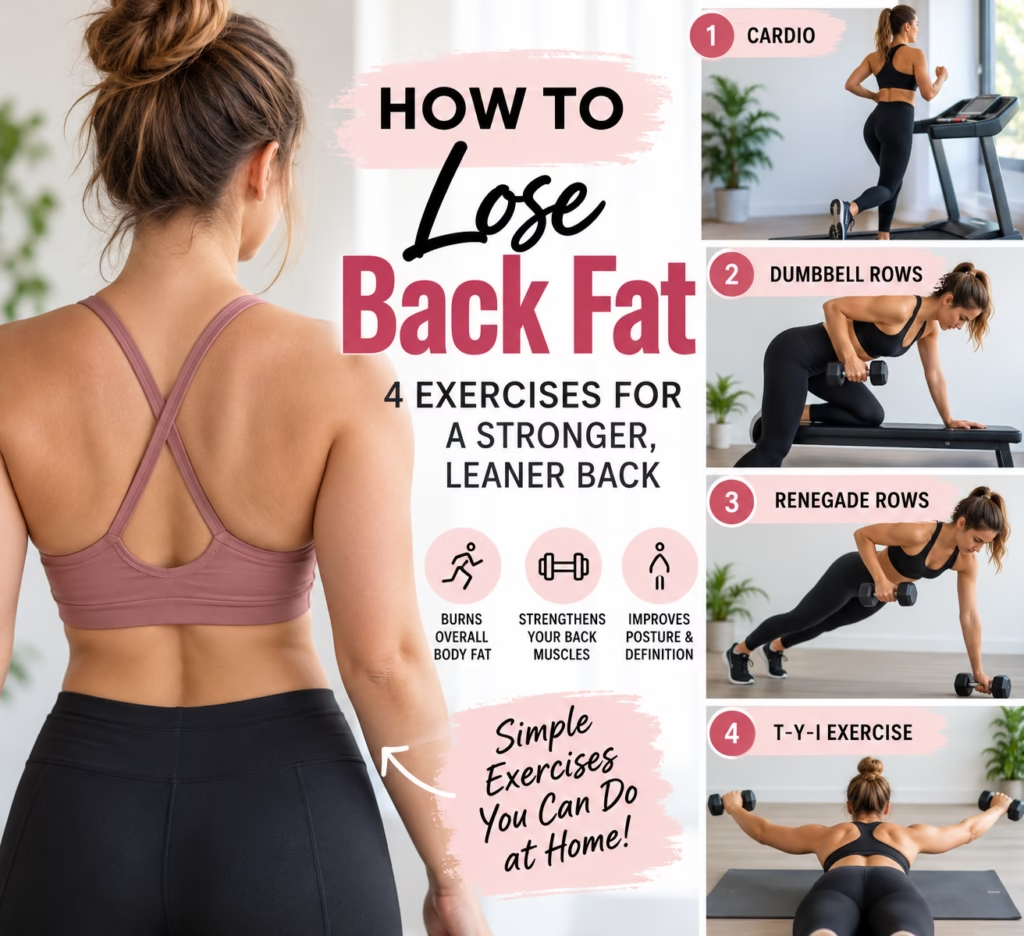
1. Cardio for Overall Fat Loss
Cardio is not technically a back exercise, but it can play an important role when reducing overall body fat is your goal.
And you do not need to punish yourself with exhausting workouts.
Walking, cycling, swimming, jogging, dancing, hiking, and using an elliptical are all options. The best choice is usually an activity you enjoy enough to continue doing consistently.
Beginner-friendly options include:
- Brisk walking
- Incline treadmill walking
- Stationary cycling
- Swimming
- Low-impact aerobics
- Elliptical training
Rather than assuming more cardio is always better, gradually build an activity routine that fits your fitness level and schedule.
For example, a 20- to 30-minute brisk walk can be much more useful when you consistently do it than an exhausting hour-long workout you dread and eventually abandon.
Make it work harder: Add short periods of faster walking or increased resistance once your fitness improves.
2. Dumbbell Rows
Dumbbell rows are one of the simplest strength exercises for working the muscles of your upper and middle back.
They also train your arms and shoulders while requiring your core to help stabilize your body.
How to do a dumbbell row:
- Place your right hand and right knee on a sturdy bench or supportive surface.
- Keep your back relatively flat and your core engaged.
- Hold a dumbbell in your left hand with your arm hanging toward the floor.
- Pull the dumbbell toward your ribs while keeping your elbow relatively close to your body.
- Squeeze your back muscles briefly at the top.
- Slowly lower the weight instead of letting it drop.
- Complete 10–12 controlled repetitions.
- Switch sides.
Aim for 2–3 sets on each side.
Choose a weight that allows you to maintain good form. The final few repetitions should feel challenging without forcing you to twist your torso or jerk the weight upward.
Beginner modification: Start with a very light dumbbell or another manageable household weight while learning the movement.
3. Renegade Rows
Ready for something more challenging?
Renegade rows combine a plank with a rowing movement, making them a powerful exercise for your back, shoulders, arms, and core.
How to do renegade rows:
- Place two dumbbells on the floor about shoulder-width apart.
- Hold the dumbbells and move into a high-plank position.
- Keep your body in a relatively straight line from your head to your heels.
- Brace your core and squeeze your glutes.
- Pull one dumbbell toward your ribs.
- Try to prevent your hips from rotating excessively.
- Lower the dumbbell under control.
- Repeat with the opposite arm.
Start with 6–10 repetitions per side for 2–3 sets.
Too difficult?
Skip the full plank version at first.
You can perform the movement from your knees or practice supported one-arm dumbbell rows until you develop enough core and upper-body strength.
Quality matters more than trying to complete as many repetitions as possible.
4. T-Y-I Raises
The T-Y-I exercise looks simple, but slow, controlled repetitions can make your upper back and shoulders work surprisingly hard.
You can perform it lying face down on the floor or another stable surface. Beginners may want to start without weights.
How to do T-Y-I raises:
Lie face down with your neck in a comfortable, neutral position.
T position:
Extend your arms out to your sides so your body resembles the letter T. Gently lift your arms, squeeze your upper-back muscles, then lower them slowly.
Y position:
Move your arms diagonally overhead to create a Y shape. Lift them slightly, pause, and lower with control.
I position:
Extend your arms straight overhead so your body resembles the letter I. Lift gently and return to the starting position.
That completes one sequence.
Try 6–10 controlled T-Y-I sequences for 2–3 sets.
Do not worry about lifting your arms very high. A small controlled movement is enough when the correct muscles are doing the work.
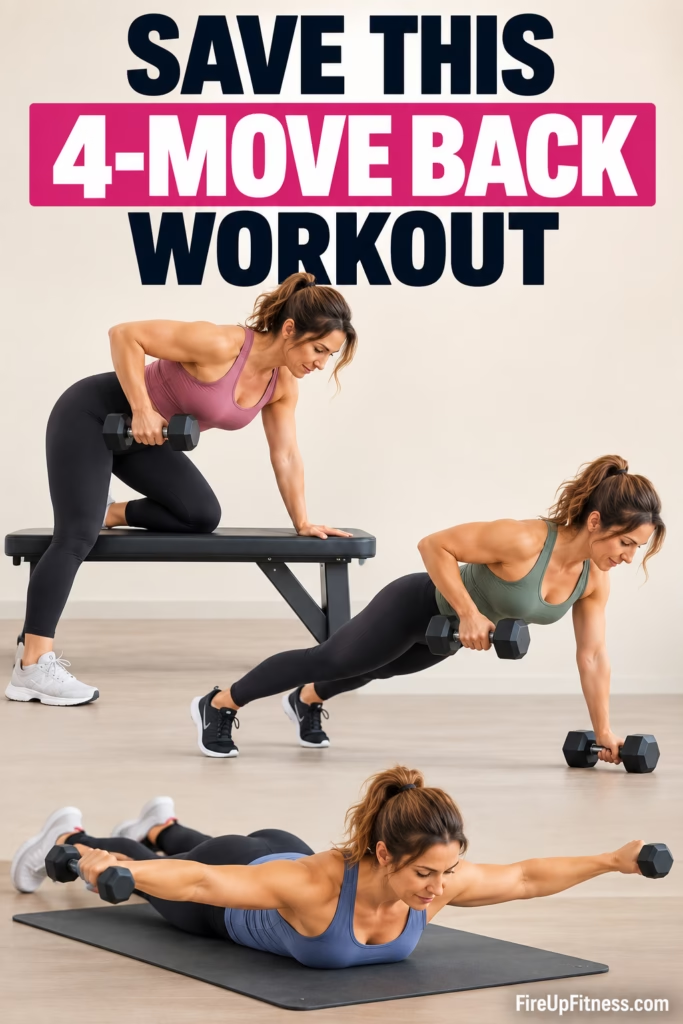
A Simple Back Workout to Save for Later
You can combine the strength exercises into one short routine:
Dumbbell Rows: 10–12 reps per side
Renegade Rows: 6–10 reps per side
T-Y-I Raises: 6–10 sequences
Complete 2–3 rounds, resting as needed between exercises.
You could perform this routine two or three times per week, allowing recovery time between strength sessions.
On other days, focus on walking or another form of cardio you enjoy.
Beginners do not need to do everything at once. Start with one or two rounds and gradually progress.
What About Lower Back Fat?
Lower-back fat and love handles can be particularly stubborn for some people.
Doing exercises that work the back and core can strengthen these areas, but increasing the number of repetitions will not necessarily make the fat disappear faster.
For noticeable changes in body composition, look at the bigger picture.
Your routine should ideally include:
- Regular strength training
- Daily movement
- Cardio you can maintain
- Protein-rich meals
- Plenty of minimally processed foods
- Appropriate portions
- Adequate sleep
- Stress management
- Consistency over time
You do not need a perfect week.
You need enough good weeks stacked together for your habits to begin producing visible results.
How Long Does It Take to Notice a Difference?
This is where patience becomes important.
A three-week routine can be a great way to build consistency, improve strength, and establish better habits, but there is no guarantee that back fat will disappear within three weeks.
Your starting body composition, nutrition, activity level, genetics, sleep, and consistency all influence the rate of change.
Instead of judging progress only by the mirror, pay attention to other improvements too.
Are your rows getting stronger?
Can you walk farther without becoming tired?
Does your posture feel better?
Are your clothes fitting differently?
Can you complete more repetitions with good form?
Those changes matter.
Common Mistakes That Can Slow Your Progress
One common mistake is doing only back exercises because back fat is the area you want to change.
Your body benefits from full-body strength training.
Squats, lunges, push-ups, rows, hip hinges, presses, and core exercises train much more muscle and can help you build a stronger body overall.
Another mistake is trying to compensate with excessive cardio or drastically cutting food.
A plan that leaves you exhausted, extremely hungry, and miserable is difficult to maintain.
Instead, aim for a routine you could realistically continue beyond the next few weeks.
The Bottom Line
You cannot choose exactly where your body loses fat first, but you can control the habits that gradually change your overall body composition.
Use cardio and daily movement to stay active. Strength train your entire body. Add exercises such as dumbbell rows, renegade rows, and T-Y-I raises to develop a stronger back. Support your workouts with balanced nutrition, enough protein, recovery, and consistent sleep.
Most importantly, give your body time.
The goal is not to find a magical exercise that burns lower-back fat overnight.
The goal is to build a routine that makes you stronger while supporting gradual, sustainable fat loss.
Start with what you can manage today, stay consistent, and allow those small efforts to add up.