
5-Minute Before Bed Workout for Stronger Abs
Some evenings, the last thing you want to do is change into workout clothes, roll out an exercise mat, or squeeze in another long fitness session. You’re tired, your bed looks inviting, and you’re ready to unwind.
But what if you could fit in a little core strengthening without even leaving your bed?
This 5-minute before bed workout combines five simple abdominal exercises to help strengthen your core, improve stability, and keep your body moving. You don’t need dumbbells, resistance bands, or special equipment. Just a supportive surface and five minutes of your time.
The routine includes full-body crunches, crisscross movements, wide-leg cross sit-ups, leg raises, and single-leg pulses. Each exercise challenges your abdominal muscles in a slightly different way, giving you a short but focused core workout.
Although the original video demonstrates these exercises as a morning routine, you can also use them as a bedtime workout when the intensity feels comfortable. Simply slow down the movements and focus on steady breathing rather than speed.
Ready to give your abs a little attention before calling it a night?
Why a 5-Minute Before Bed Workout Is Worth Trying
It’s easy to assume that a workout needs to be long or intense to make a difference. While five minutes won’t replace a complete fitness program, short exercise sessions can help you build strength and establish a consistent movement habit.
A bedtime core routine offers several practical benefits.
1. Strengthens Your Core Muscles
Your abdominal muscles do much more than help you perform crunches. They support your spine, stabilize your pelvis, and assist with everyday movements.
Exercises such as leg raises and full-body crunches challenge these muscles through controlled movement. With regular practice and gradual progression, you can improve core strength and muscular endurance.
2. Helps Improve Body Control and Stability
Core exercises teach your body to maintain stability while your arms or legs move.
During crisscross movements and single-leg pulses, your abdominal muscles work to limit unwanted movement through your lower back and pelvis.
This type of control is useful for activities such as walking, lifting, bending, and maintaining balance.
3. Adds Gentle Stretching to Your Routine
The wide-leg cross sit-up incorporates a light hamstring stretch, while the full-body crunch alternates between extending and curling your body.
These movements encourage mobility alongside muscular engagement.
However, stretching should always feel comfortable. You don’t need to reach your toes or force a larger range of motion to benefit.
4. Makes Exercise Easier to Fit Into a Busy Schedule
One of the biggest challenges with fitness is finding time.
A five-minute workout removes many of the usual barriers. There’s no commute, no complicated equipment setup, and no lengthy routine to remember.
You can complete the exercises in your bedroom before starting your usual evening wind-down.
5. Encourages Consistency Without Overcomplicating Fitness
A manageable routine is often easier to repeat than an ambitious workout that doesn’t fit your schedule.
Starting with a few minutes of core training can help you develop a regular exercise habit. As you become stronger, you can gradually add more challenging workouts throughout the week.
Your 5-Minute Bedtime Abs Workout
This routine includes five exercises, each performed for 50 seconds, followed by 10 seconds to rest or change positions.
| Exercise | Duration | Main focus |
|---|---|---|
| Full-body crunch | 50 seconds | Abdominal strength and coordination |
| Crisscross | 50 seconds | Core stability and leg control |
| Wide-leg cross sit-ups | 50 seconds | Abs, rotation, and hamstring mobility |
| Leg raises | 50 seconds | Abdominal stabilization and hip flexors |
| Single-leg pulses | 50 seconds | Core control and hip flexors |
Total time: 5 minutes, including the short rest intervals.
Equipment: None.
Fitness level: Beginner-friendly with modifications.
Where to exercise: A firm mattress or an exercise mat.
Before beginning, check that your mattress provides enough support. Very soft beds can make abdominal exercises more difficult to control, especially movements involving both legs. A firm mat on the floor is a better choice when you cannot keep your lower back comfortably supported.
1. Full-Body Crunch: Wake Up Your Core Muscles
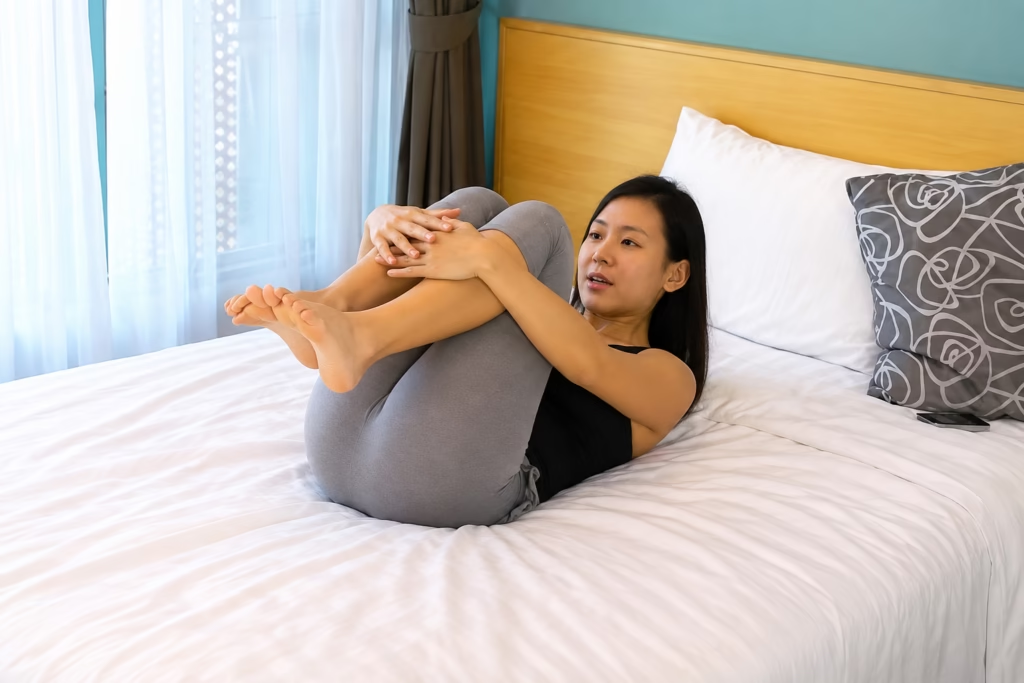
The full-body crunch is a dynamic exercise that challenges your abdominal muscles as you bring your upper and lower body toward each other.
Unlike a traditional crunch, which mainly involves curling your shoulders off the surface, this variation adds leg movement to increase the coordination and stability required.
How to Do a Full-Body Crunch
- Lie on your back with your arms extended overhead and your legs straight.
- Gently engage your abdominal muscles and keep your lower back supported.
- Exhale as you lift your shoulders and bring your knees toward your chest.
- Reach your arms forward as your body curls into a compact position.
- Slowly extend your arms and legs toward the starting position.
- Continue for 50 seconds, moving at a controlled pace.
Make it easier: Keep your knees bent and extend only one leg at a time if the full movement feels too demanding.
Common mistake to avoid: Don’t allow your lower back to arch as your legs extend. Shorten the movement instead of sacrificing control.
The goal isn’t to perform as many repetitions as possible. Focus on feeling your abdominal muscles engage while keeping your movement smooth.
2. Crisscross: Challenge Your Lower Core Stability
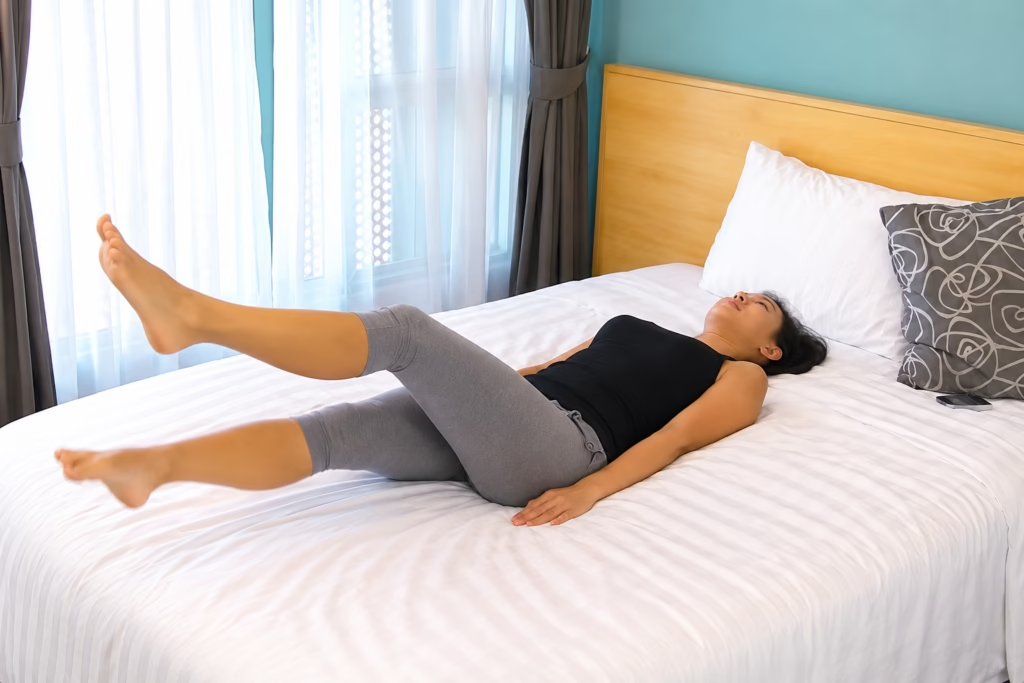
Crisscross is a scissors-style leg exercise that challenges your abdominal muscles to stabilize your pelvis.
You may notice a strong sensation around your lower abdomen, but your abdominal muscles work together rather than as completely separate upper and lower sections.
How to Do Crisscross
- Lie flat on your back with your hands resting beside your hips.
- Raise both legs to a comfortable height.
- Keep your knees soft rather than locking them straight.
- Cross one leg over the other, then alternate.
- Continue the small crossing movements without swinging your legs.
- Breathe steadily throughout the 50-second interval.
For a more challenging variation, you can lift your shoulders slightly off the bed while keeping your neck relaxed.
Make it easier: Keep your head down, bend your knees slightly, or raise your legs higher to reduce the demand on your abdominal muscles.
Common mistake to avoid: Lowering your legs so far that your back begins to arch.
Think about keeping your pelvis steady while your legs move. This makes the exercise more controlled and helps prevent unnecessary strain.
3. Wide-Leg Cross Sit-Ups: Strengthen and Stretch
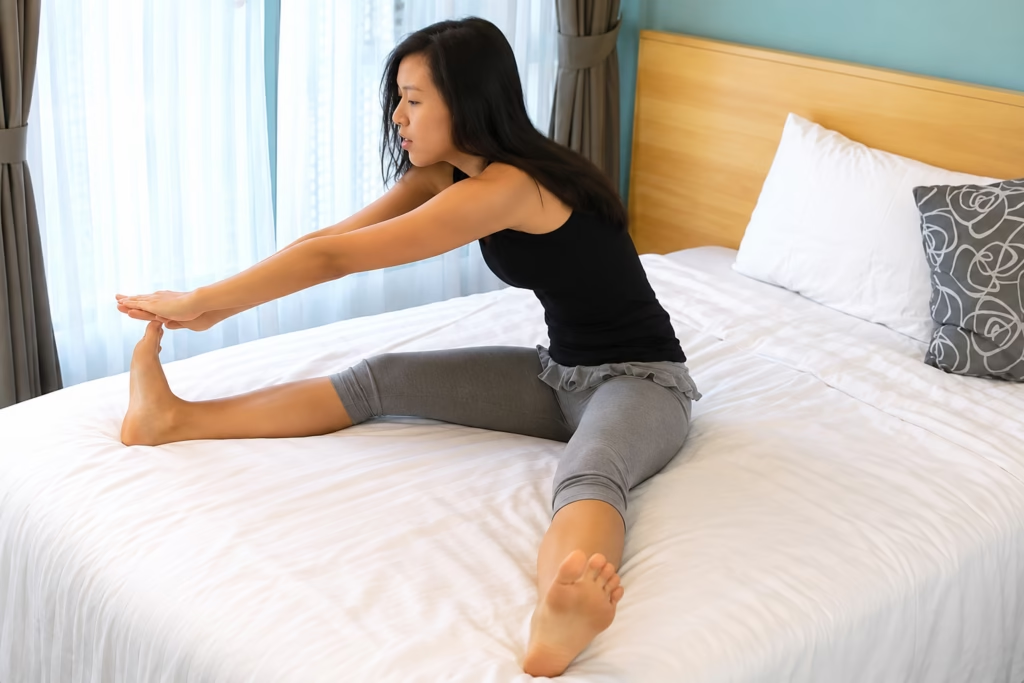
Wide-leg cross sit-ups bring together abdominal curling, gentle rotation, and hamstring mobility.
The alternating reach introduces a different movement pattern from the previous exercises, making it a useful addition to this short core routine.
How to Do Wide-Leg Cross Sit-Ups
- Lie on your back and raise your legs upward.
- Open your legs into a comfortable V-shape.
- Point your toes toward the ceiling, keeping your knees slightly bent if necessary.
- Exhale as you curl your upper body forward.
- Reach one hand toward the opposite foot.
- Lower yourself slowly and repeat toward the other side.
- Continue alternating for 50 seconds.
Make it easier: Reduce the width of your legs and reach toward your opposite knee instead of your foot.
Common mistake to avoid: Forcing your shoulders upward or pulling your head forward to reach farther.
Your flexibility will determine how far you can reach. A small, controlled movement is more useful than a large movement performed with poor form.
4. Leg Raises: Build Abdominal Strength and Control
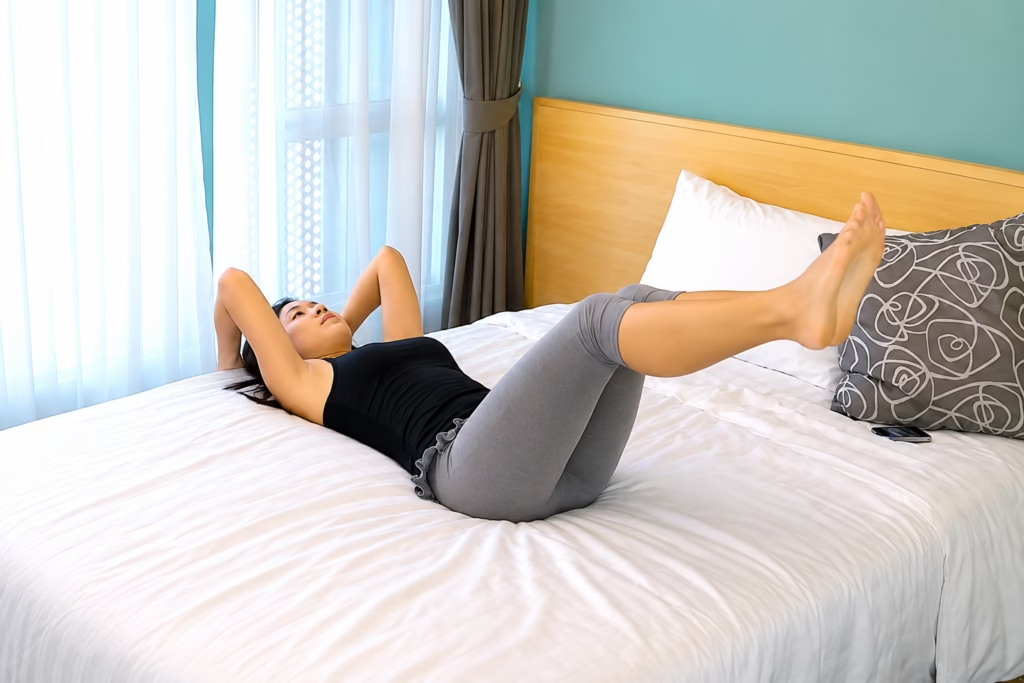
Leg raises are one of the most recognizable exercises in an at-home abs workout.
They challenge your abdominal muscles to stabilize your spine and pelvis while your hip flexors lift and lower your legs.
This exercise can feel surprisingly demanding, especially when performed on a soft surface.
How to Do Leg Raises
- Lie on your back with your legs extended.
- Place your arms beside your body for support.
- Engage your abdominal muscles and slowly raise both legs.
- Lower your legs with control, stopping before your lower back begins to arch.
- If comfortable, add a small pelvic curl at the top rather than swinging your hips upward.
- Repeat for 50 seconds.
Make it easier: Bend your knees and perform slow knee raises instead of straight-leg raises.
Common mistake to avoid: Using momentum or lowering your legs too close to the mattress when you cannot maintain proper alignment.
You don’t need to lift your hips high off the bed. A small, controlled pelvic movement is enough.
5. Single-Leg Pulses: Finish With Controlled Core Work
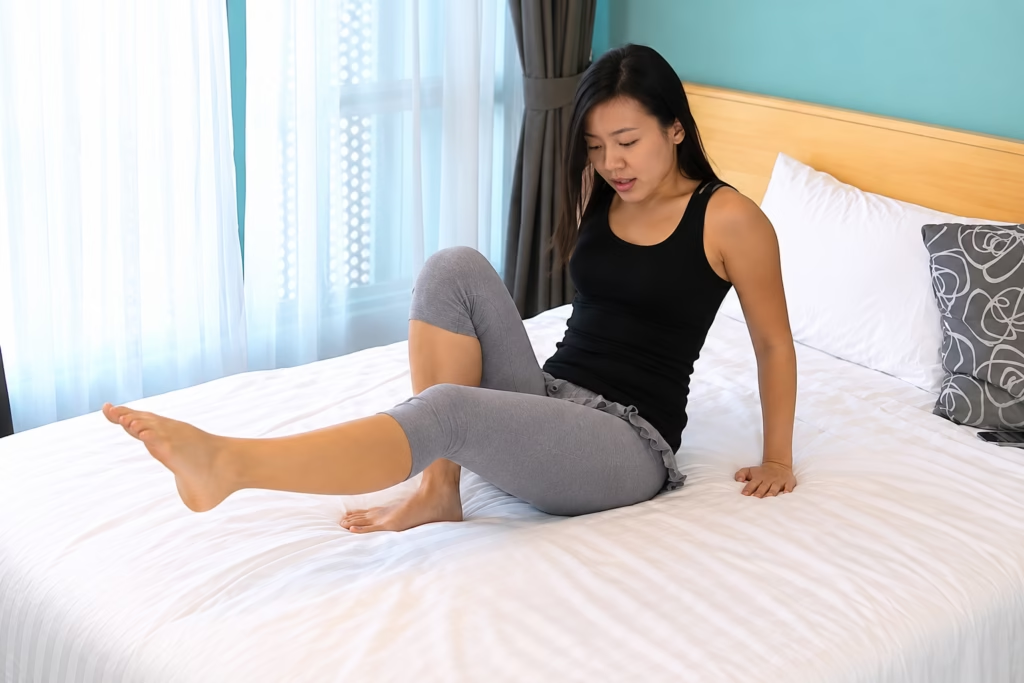
The final exercise focuses on small, repeated leg movements.
Single-leg pulses engage your hip flexors while your abdominal muscles help stabilize your pelvis. The small range of motion makes control particularly important.
How to Do Single-Leg Pulses
- Lie on your back with your arms relaxed beside your body.
- Keep your right leg resting comfortably on the bed.
- Raise your left leg slightly, keeping your knee soft.
- Perform small upward pulses without swinging.
- Continue for approximately 25 seconds.
- Switch legs and repeat for another 25 seconds.
Make it easier: Bend the raised knee or reduce the height and size of each pulse.
Common mistake to avoid: Allowing your hips to rock or your lower back to arch with each movement.
Once you’ve finished both sides, lower your legs and take a few relaxed breaths.
You’ve completed the five-minute workout.
Follow Along With the 5-Minute Bed Workout Video
The easiest way to learn this routine is to follow the instructor through each movement.
The video demonstrates all five exercises, including the correct order, timing, and transitions. You can watch the movements first, then follow along at your own pace.
Although the instructor originally presents the routine as a morning ab workout, the same movements can be adapted for the evening.
For a before bed workout, choose a comfortable pace and avoid pushing yourself to exhaustion. You should finish feeling that you’ve exercised your core without becoming overly energized just before sleep.
How to Make This Bedtime Workout Easier for Beginners
Not everyone will feel comfortable performing five consecutive abdominal exercises for 50 seconds each.
That’s completely fine. The routine can be adjusted to match your current fitness level.
Start with 30 seconds of movement and 20 seconds of recovery if the original intervals feel too challenging. You can also bend your knees during leg exercises to reduce the demand on your core.
During crunches, focus on gently lifting your shoulders instead of trying to sit all the way up.
For crisscross movements, keep your upper body resting on the bed until you develop enough strength to maintain a stable position.
And remember, quality matters more than speed. Ten controlled repetitions can be more productive than rushing through a movement with poor technique.
As your strength improves, gradually work toward completing the full 50-second intervals.
Is a Before Bed Workout Good for Sleep?
Exercise and sleep are closely connected, but not everyone responds to nighttime workouts in the same way.
Regular physical activity is associated with better sleep quality for many people. However, a challenging workout immediately before bedtime may leave some individuals feeling more alert.
This routine contains active abdominal exercises rather than purely relaxing stretches.
If you enjoy exercising at night and find that it doesn’t interfere with your sleep, a short core workout may fit comfortably into your evening schedule.
On the other hand, if crunches and leg raises leave you feeling energized, try completing the routine earlier in the evening.
You can also finish with a brief relaxation period.
Lie comfortably with your knees bent, rest your arms beside your body, and take five slow breaths. Allow your shoulders to relax and your breathing to return to its natural rhythm.
The best bedtime workout is one that supports your fitness goals without disrupting your rest.
Can You Strengthen Your Abs With Just 5 Minutes a Day?
Five minutes of abdominal exercise can be a useful starting point, particularly for someone who is new to core training.
However, noticeable improvements in strength depend on several factors, including exercise difficulty, consistency, recovery, and gradual progression.
When an exercise becomes easier, your muscles need an appropriate new challenge to continue adapting.
You might progress by increasing your control, adding repetitions, improving your range of motion, or incorporating more demanding core exercises into your weekly routine.
It’s also important to remember that core exercises don’t specifically burn fat from your stomach.
Abdominal workouts strengthen the muscles beneath the skin, but they cannot determine where your body loses fat.
For overall fitness and body composition, a balanced routine should include cardiovascular exercise, full-body strength training, nutritious meals, and sufficient sleep.
This five-minute routine works best as one small part of that bigger picture.
How Often Should You Do This Before Bed Workout?
A practical starting point is two or three sessions per week, with recovery time between challenging core workouts.
You can adjust the frequency based on your fitness level and how your muscles feel afterward.
Here’s one example of how to include this routine in a balanced week:
| Day | Activity |
|---|---|
| Monday | 5-minute bedtime core workout |
| Tuesday | Walking or gentle stretching |
| Wednesday | 5-minute bedtime core workout |
| Thursday | Full-body strength training |
| Friday | Rest or relaxing yoga |
| Saturday | 5-minute bedtime core workout |
| Sunday | Light activity or recovery |
This schedule gives your core regular attention without relying on abdominal exercises as your only form of physical activity.
If your muscles are still sore or fatigued, allow more recovery time before repeating the routine.
Simple Ways to Make Your Evening Workout More Enjoyable
The easier a routine feels to fit into your life, the more likely you are to continue doing it.
A few small adjustments can make your bedtime workout more comfortable.
Keep your bedroom comfortable. Choose a temperature and lighting level that allows you to move safely without feeling overstimulated.
Wear comfortable clothing. You don’t need a complete gym outfit. Stretchy clothing that allows unrestricted movement is enough.
Avoid rushing. Even though the routine lasts only five minutes, each movement should be controlled.
Keep water nearby. Drink according to your thirst rather than forcing yourself to drink large amounts immediately before sleeping.
Give yourself time to settle afterward. A few minutes of relaxed breathing or gentle stretching can help you transition from exercise to rest.
Most importantly, don’t turn a short evening workout into another stressful task. Fitness should fit into your life, not make your schedule feel more overwhelming.
Frequently Asked Questions About Bedtime Workouts
Can I really do an ab workout in bed?
Yes, provided your mattress is firm and stable enough to support the movements. A very soft mattress can make it harder to control your pelvis and lower back. If your form suffers, use an exercise mat on the floor.
Is a 5-minute bedtime workout enough for beginners?
Five minutes can be a manageable starting point for building an exercise habit and practicing core movements. For broader fitness benefits, combine it with other physical activities throughout the week.
Will doing abs before bed help me get a flatter stomach?
Abdominal exercises can strengthen your core, but they cannot selectively reduce belly fat. Changes in body composition depend on overall activity, nutrition, and individual factors.
Should I do this workout every night?
You don’t need to. Starting with two or three sessions per week gives you an opportunity to practice the exercises while allowing time for recovery. Increase frequency gradually if appropriate.
Can I do this routine in the morning instead?
Absolutely. The original workout was designed as a quick morning ab routine. You can perform it after waking up or earlier in the evening, depending on your schedule and preferences.
Final Thoughts: A Stronger Core Starts With Small Habits
You don’t need a complicated workout plan to begin building a stronger core.
This 5-minute before bed workout offers a convenient way to work your abdominal muscles using five straightforward exercises. From full-body crunches to single-leg pulses, each movement helps develop strength, stability, and body control.
The routine is short enough to fit into a busy day, requires no equipment, and can be adjusted for different fitness levels.
Some evenings, you may have the energy for the complete workout. On others, a few gentle stretches might be the better choice. Both can have a place in a balanced approach to movement.
What matters most is finding a routine you can maintain without sacrificing comfort, recovery, or sleep.
Save this bedtime workout for the next evening you have five minutes to spare, and give your core a little attention before you call it a night.